
The Life of Jesus
Puzzle 46 · Wonders by the Water · Page 71 in print
The Storm Stilled
A crossing becomes a crisis when wind and waves threaten the boat; Jesus rebukes the storm and questions their fear.
Jump to a word
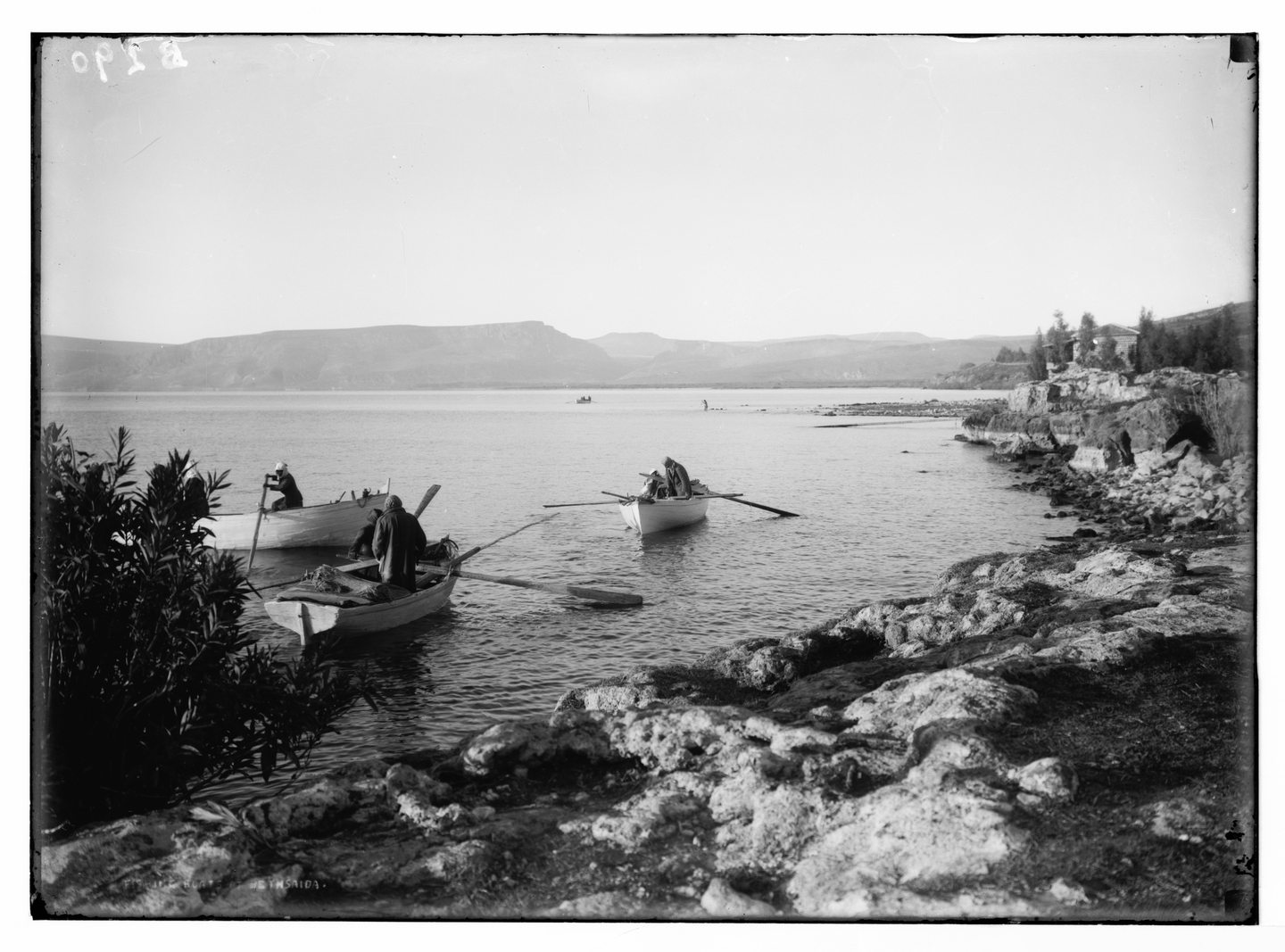
Fishing boats on the Sea of Galilee, about 1900–1920.
Later working boats on the Sea of Galilee help convey the vulnerability of a small vessel, not the disciples’ actual boat.
G. Eric and Edith Matson Photograph Collection, Library of Congress · Public Domain Mark 1.0 · Original recordImage changes
Resized proportionally to at most 1440px and JPEG compressed; no crop or content alteration.
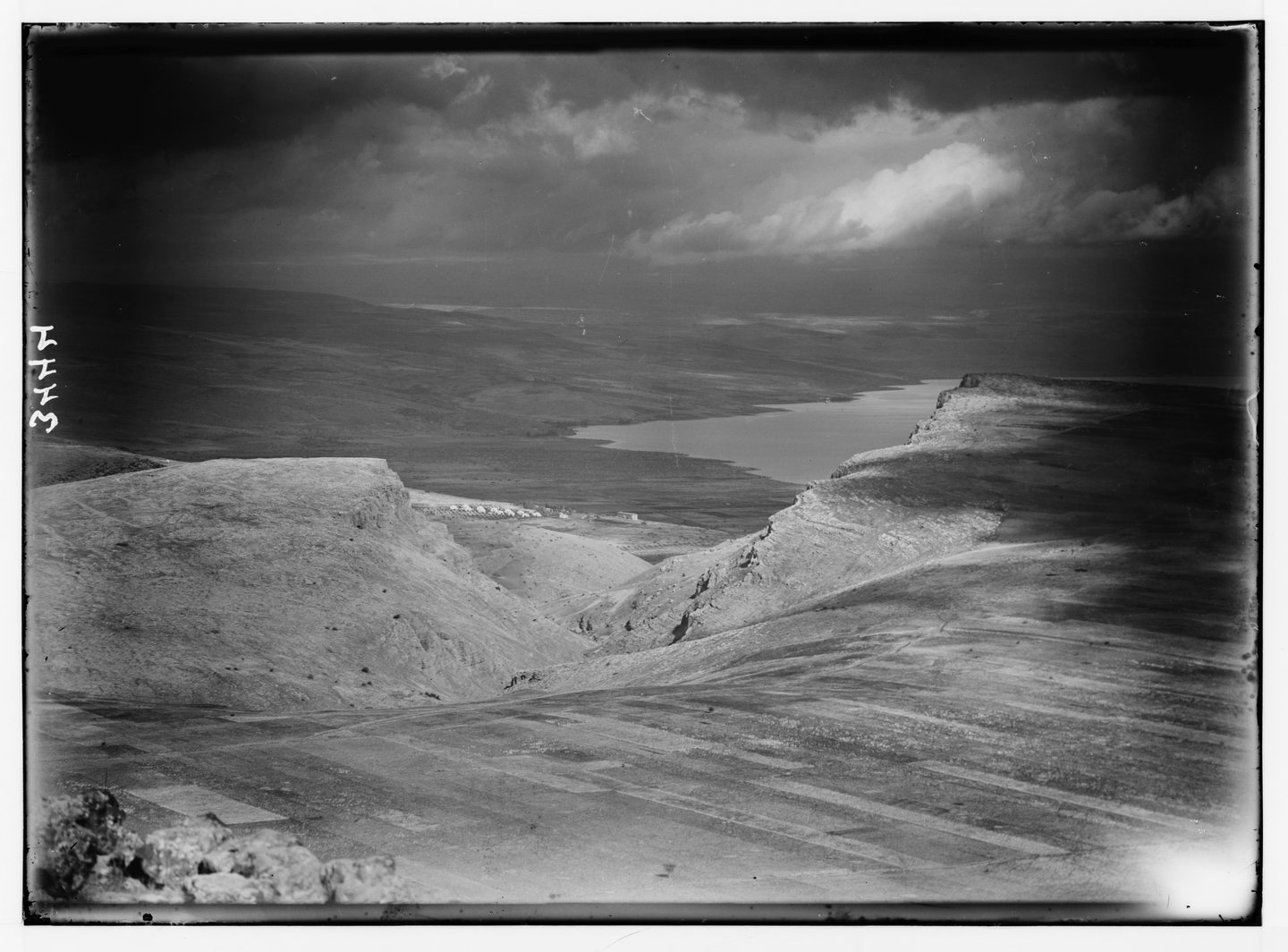
Lake Galilee from Hattin (1920).
The same lake supplies the geographical setting for the wind and waves in the account.
G. Eric and Edith Matson Photograph Collection, Library of Congress · Public Domain Mark 1.0 · Original recordImage changes
Resized proportionally to at most 1440px and JPEG compressed; no crop or content alteration.
The words
Asleep
Mark places Jesus asleep on a pillow at the stern; Luke says he falls asleep while they sail, and Matthew contrasts his sleep with waves covering the boat.
Mark 4:38 (opens a new tab) · Luke 8:23 (opens a new tab) · Matthew 8:24 (opens a new tab)
Be Still
Mark records Jesus rebuking the wind and saying to the sea, “Peace, be still”; the wind then ceases and Mark describes a great calm.
Fearful
Matthew places Jesus’s question about being fearful before he rebukes the winds and sea; Mark gives the question after the wind has ceased and the great calm has come.
Matthew 8:26 (opens a new tab) · Mark 4:39–40 (opens a new tab)
Great Calm
Matthew and Mark both describe a great calm after the rebuke; Luke says there is a calm, then places Jesus’s question about faith before the disciples’ wondering.
Matthew 8:26 (opens a new tab) · Mark 4:39 (opens a new tab) · Luke 8:24–25 (opens a new tab)
Hinder Part
Stern; the rear of the boat.
Mark locates Jesus in the hinder part of the ship, asleep on a pillow before the disciples wake him; the NET names that position as the stern.
Mark 4:38 (opens a new tab) · NET Bible: Mark 4:35-41 (opens a new tab)
Jeopardy
Danger or peril.
Luke’s KJV describes them as filled with water and in jeopardy during the crossing; NET supplies the boat as what is filling and describes the people as in danger.
Luke 8:23 (opens a new tab) · NET Bible: Luke 8:22-25 (opens a new tab)
Little Ships
Small boats.
Mark mentions other little ships with Jesus’s boat after the crowd is sent away and before the storm arises; the NET describes them simply as other boats.
Did you know?
The Library of Congress titles the pictured boats as part of a thirteen-slide Galilee set, while cataloging the surviving source as a glass dry-plate negative.
Mark 4:36–37 (opens a new tab) · NET Bible: Mark 4:35-41 (opens a new tab) · Library of Congress: Galilee boats (opens a new tab)
Manner of Man
What sort of person.
Mark and Matthew use “What manner of man is this” after the calm; Luke’s KJV exclamation uses the same phrase while adding that wind and water obey him.
Mark 4:41 (opens a new tab) · Matthew 8:27 (opens a new tab) · Luke 8:25 (opens a new tab) · NET Bible: Matthew 8:23-27 (opens a new tab)
Master
Mark’s KJV uses Master when the disciples wake Jesus, while NET Mark uses Teacher; Luke repeats Master, master, and Matthew gives the appeal “Lord, save us.”
Mark 4:38 (opens a new tab) · NET Bible: Mark 4:35-41 (opens a new tab) · Luke 8:24 (opens a new tab) · Matthew 8:25 (opens a new tab)
Other Side
Mark places “Let us pass over unto the other side” at evening before the crossing; Luke’s KJV names the other side of the lake as Jesus’s proposed destination.
Perish
Die; be lost.
All three KJV accounts place perish in the disciples’ words when they wake Jesus; Matthew pairs it with “save us,” while Mark asks whether he cares.
Matthew 8:25 (opens a new tab) · Mark 4:38 (opens a new tab) · Luke 8:24 (opens a new tab) · NET Bible: Luke 8:22-25 (opens a new tab)
Pillow
Mark describes Jesus asleep on a pillow in the stern before the disciples wake him; the NET calls it a cushion, without identifying a particular material or object.
Mark 4:38 (opens a new tab) · NET Bible: Mark 4:35-41 (opens a new tab)
Storm of Wind
Mark’s KJV describes a great storm of wind with waves beating into the ship; Luke uses storm of wind for what comes down on the lake while they sail.
Tempest
A violent storm.
Matthew’s KJV calls the disturbance a great tempest and says the boat is covered with waves while Jesus sleeps; NET Matthew uses the word storm in this description.
Matthew 8:24 (opens a new tab) · NET Bible: Matthew 8:23-27 (opens a new tab)
Waves
Mark says the waves beat into the ship until it is full; Matthew describes the ship covered with waves, then has the disciples wake Jesus with their appeal.
Mark 4:37 (opens a new tab) · Matthew 8:24–25 (opens a new tab)
Sources
- Mark 4:35-41 (King James Version)King James Version, passage navigation via Bible Gateway
- Luke 8:22-25 (King James Version)King James Version, passage navigation via Bible Gateway
- Matthew 8:23-27 (King James Version)King James Version, passage navigation via Bible Gateway
- Mark 4:35-41 (NET Bible), translation and notesNET Bible, via Bible Gateway
- Luke 8:22-25 (NET Bible), translation and notesNET Bible, via Bible Gateway
- Matthew 8:23-27 (NET Bible), translation and notesNET Bible, via Bible Gateway
- Fishing boats at Bethsaida, Matson photograph matpc.05682Library of Congress