
The Life of Jesus
Puzzle 45 · The Sermon on the Mount · Page 68 in print
The Wise and Foolish Builders
Two houses meet the same storm; the difference is whether hearing Jesus’s words becomes action.
Jump to a word
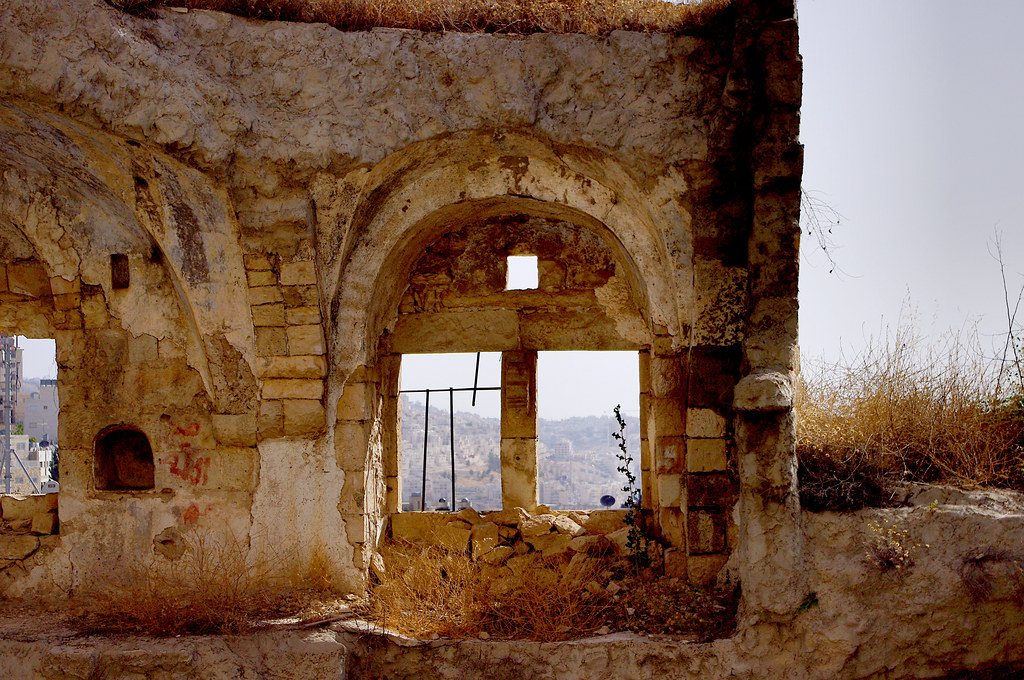
Stonework in Bethlehem, photographed June 22, 2010.
The stone structure gives a visual comparison for the houses in Jesus’s parable, not an actual surviving parable house.
Jan Helebrant · CC0 (Public Domain Dedication) · Original recordImage changes
Resized proportionally to at most 1440px and JPEG compressed; no crop or content alteration.
The words
Authority
Matthew closes the sermon by contrasting Jesus’s authority with the scribes; the NET calls them “experts in the law,” while the preceding verse describes the crowd’s astonishment.
Matthew 7:28–29 (opens a new tab) · NET Bible: Matthew 7:24-29 (opens a new tab)
Beat
Matthew uses beat for the storm striking both houses; Luke’s KJV describes the stream beating vehemently against the houses, with different outcomes for the two foundations.
Matthew 7:25; Matthew 7:27 (opens a new tab) · Luke 6:48–49 (opens a new tab)
Doctrine
Teaching; what is taught.
Matthew’s KJV uses doctrine for the teaching that astonishes the people after Jesus ends these sayings; the NET uses teaching, before describing his authority in the next verse.
Matthew 7:28–29 (opens a new tab) · NET Bible: Matthew 7:24-29 (opens a new tab)
Doeth
Does; puts the sayings into practice.
Matthew pairs hearing and doing Jesus’s sayings in the comparison with the wise builder; the foolish builder hears the same sayings but does not do them.
Matthew 7:24; Matthew 7:26 (opens a new tab) · NET Bible: Matthew 7:24-29 (opens a new tab)
Floods
Matthew lists floods with rain and winds in the testing of both houses; Luke describes a flood arising and the stream striking the houses in his account.
Matthew 7:25; Matthew 7:27 (opens a new tab) · Luke 6:48–49 (opens a new tab)
Foolish Man
Matthew compares the hearer who does not do Jesus’s sayings with a foolish builder on sand; the storm comes, the house falls, and its fall is described as great.
Founded
Established on a foundation.
Matthew’s KJV explains the house’s survival as “founded upon a rock”; Luke’s KJV uses the same explanation, while NET Luke reads “well built” and notes the manuscript difference.
Matthew 7:25 (opens a new tab) · Luke 6:48 (opens a new tab) · NET Bible: Luke 6:46-49 (opens a new tab)
Heareth
Hears; the older verb form.
Matthew uses heareth for both responses to Jesus’s sayings: the wise hearer also does them, while the foolish hearer does not; hearing itself is shared by both comparisons.
Matthew 7:24; Matthew 7:26 (opens a new tab) · NET Bible: Matthew 7:24-29 (opens a new tab)
Liken
Compare; show what something is like.
Matthew gives Jesus’s comparison in the words “I will liken him unto a wise man,” referring to someone who hears his sayings and does them before the storm arrives.
Rain
Matthew repeats “the rain descended” for both houses, alongside floods and winds; the house on rock does not fall, while the house on sand does.
Rock
Matthew places the wise builder’s house on rock; Luke describes digging deep and laying a foundation on rock before the flood and the stream’s force test the house.
Matthew 7:24–25 (opens a new tab) · Luke 6:48 (opens a new tab)
Sand
Matthew locates the foolish builder’s house on sand; Luke’s corresponding comparison describes building on the earth without a foundation, before the stream strikes and the house falls.
Matthew 7:26–27 (opens a new tab) · Luke 6:49 (opens a new tab)
Sayings
Matthew repeats Jesus’s phrase “these sayings of mine” for both hearers; after the house comparisons, the narrator marks the end of the teaching and the people’s astonishment.
Did you know?
Matthew 13:53 also marks the end of teaching: “when Jesus had finished these parables,” he leaves that place, echoing the transition after the sayings here.
Matthew 7:24; Matthew 7:26; Matthew 7:28 (opens a new tab) · Matthew 13:53 (opens a new tab)
Winds
Matthew describes winds blowing and beating against both houses, together with rain and floods; the different endings follow the earlier contrast between rock and sand.
Wise Man
Matthew compares hearing and doing Jesus’s sayings with a wise builder whose house stands on rock; Luke similarly pairs hearing and doing before describing the deeply founded house.
Matthew 7:24–25 (opens a new tab) · Luke 6:47–48 (opens a new tab)
Sources
- Matthew 7:24-29 (King James Version)King James Version, passage navigation via Bible Gateway
- Luke 6:46-49 (King James Version)King James Version, passage navigation via Bible Gateway
- Matthew 13:51-54 (King James Version)King James Version, passage navigation via Bible Gateway
- Matthew 7:24-29 (NET Bible), translation and notesNET Bible, via Bible Gateway
- Luke 6:46-49 (NET Bible), translation and notesNET Bible, via Bible Gateway