
The Life of Jesus
Puzzle 41 · The Sermon on the Mount · Page 64 in print
The Lord's Prayer
Jesus teaches prayer without display, placing daily need, forgiveness and deliverance within an address to the Father.
Jump to a word
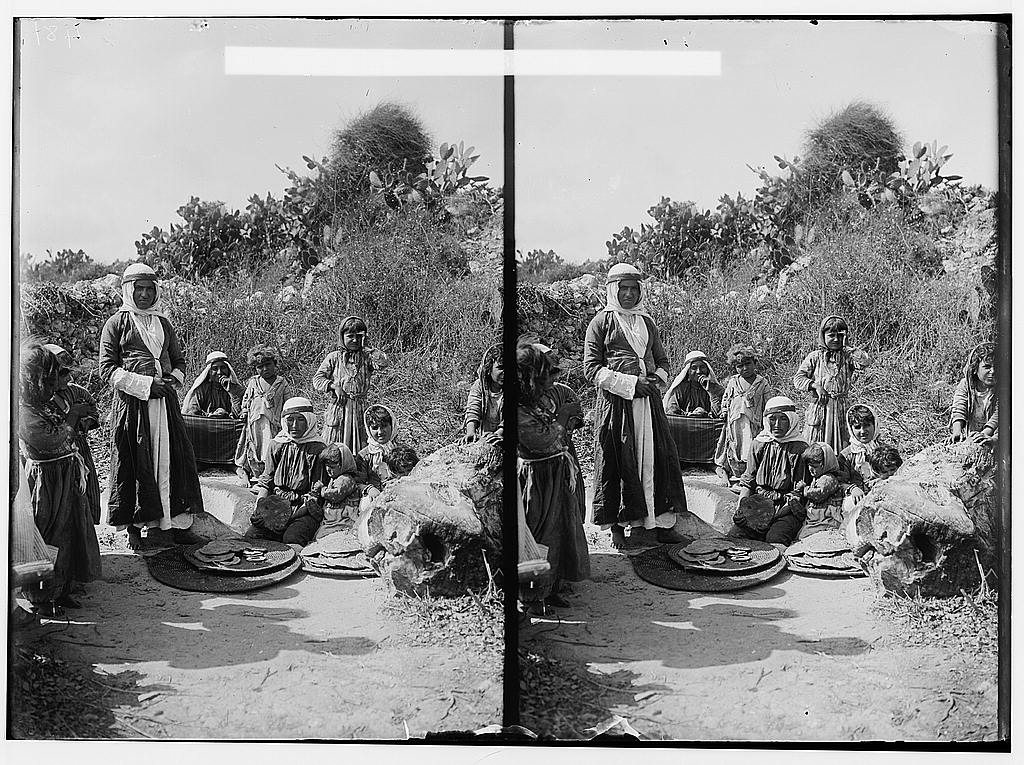
Druze women baking bread, about 1900–1920.
Bread-making connects directly with the prayer’s request for daily bread.
American Colony (Jerusalem). Photo Department; G. Eric and Edith Matson Photograph Collection, Library of Congress. · No known restrictions on publication · Original recordImage changes
Resized proportionally to at most 1440px and JPEG compressed; no crop or content alteration.
The words
Amen
So be it; a closing affirmation.
Amen closes Matthew’s KJV prayer. The King James Version follows later manuscripts here; many modern Bibles, following older ones, read differently or put these words in a footnote.
Matthew 6:13 (opens a new tab) · NET Bible: Matthew 6:5-15 (opens a new tab) · Thayer’s G281: Amen (opens a new tab)
Closet
A private inner room.
Matthew places the closet in Jesus’s instruction to close the door and pray to the Father in secret; the NET calls it an inner room.
Matthew 6:6 (opens a new tab) · NET Bible: Matthew 6:5-15 (opens a new tab)
Daily Bread
Matthew’s KJV asks “Give us this day our daily bread”; Luke’s KJV says “day by day,” while NET’s notes describe uncertainty about the Greek word translated daily.
Matthew 6:11 (opens a new tab) · Luke 11:3 (opens a new tab) · NET Bible: Luke 11:1-4 (opens a new tab)
Debtors
Matthew’s KJV pairs “forgive us our debts” with “as we forgive our debtors”; Luke’s KJV asks forgiveness of sins before mentioning those indebted to us.
Matthew 6:12 (opens a new tab) · Luke 11:4 (opens a new tab)
Debts
Matthew’s prayer uses debts in the forgiveness request, while Luke’s uses sins; both KJV accounts pair the request with forgiving others, using the language of owing.
Matthew 6:12 (opens a new tab) · Luke 11:4 (opens a new tab)
Father
Matthew’s KJV prayer opens “Our Father which art in heaven”; Luke’s KJV uses the same address after a disciple asks Jesus to teach them to pray.
Matthew 6:9 (opens a new tab) · Luke 11:1–2 (opens a new tab)
Forgive
Matthew places a request for forgiveness within the prayer, then discusses forgiving other people’s trespasses immediately afterward; Luke’s KJV pairs forgiveness of sins with forgiving those indebted to us.
Matthew 6:12; Matthew 6:14–15 (opens a new tab) · Luke 11:4 (opens a new tab)
Hallowed
Treated as holy; held in reverence.
Matthew and Luke both place “Hallowed be thy name” near the beginning of their KJV prayers; the NET’s note explains it as treating the name as holy.
Matthew 6:9 (opens a new tab) · Luke 11:2 (opens a new tab) · NET Bible: Luke 11:1-4 (opens a new tab)
Heathen
Gentiles, in the NET wording.
Matthew’s KJV uses heathen in Jesus’s warning against vain repetitions and expecting to be heard for much speaking; the NET uses Gentiles in that comparison.
Matthew 6:7 (opens a new tab) · NET Bible: Matthew 6:5-15 (opens a new tab)
Heaven
Matthew’s prayer addresses the Father in heaven, then asks for his will to be done on earth as in heaven; Luke’s KJV also contains both phrases.
Matthew 6:9–10 (opens a new tab) · Luke 11:2 (opens a new tab)
Hypocrites
Matthew attributes the warning to Jesus: the people criticized love praying where others can see them; the next verse contrasts this display with prayer behind a closed door.
Kingdom Come
Matthew’s prayer places “Thy kingdom come” after the request concerning the Father’s name and before the request concerning his will; Luke’s KJV follows the same sequence.
Matthew 6:9–10 (opens a new tab) · Luke 11:2 (opens a new tab)
Secret
Matthew repeats secret in Jesus’s contrast with visible prayer: the instruction names the Father in secret and then the Father who sees in secret, after the door is shut.
Temptation
Temptation or testing, in NET’s alternative wording.
Both KJV accounts ask not to be led into temptation, following their forgiveness requests; the NET’s note gives “a time of testing” as another way to render the phrase.
Matthew 6:12–13 (opens a new tab) · Luke 11:4 (opens a new tab) · NET Bible: Luke 11:1-4 (opens a new tab)
Trespasses
Wrongs or sins.
Matthew uses trespasses in the statements following the prayer’s debts wording; Luke’s prayer asks forgiveness of sins, while also mentioning those who are indebted to the praying group.
Did you know?
The Church of England’s Book of Common Prayer uses “forgive us our trespasses” in Morning Prayer; Matthew’s KJV prayer says debts, with trespasses discussed just afterward.
Matthew 6:12; Matthew 6:14–15 (opens a new tab) · Luke 11:4 (opens a new tab) · NET Bible: Matthew 6:5-15 (opens a new tab) · Book of Common Prayer: Morning Prayer (opens a new tab)
Sources
- Matthew 6:5-15 (King James Version)King James Version, passage navigation via Bible Gateway
- Luke 11:1-4 (King James Version)King James Version, passage navigation via Bible Gateway
- Matthew 6:5-15 (NET Bible), translation and notesNET Bible, via Bible Gateway
- Luke 11:1-4 (NET Bible), translation and notesNET Bible, via Bible Gateway
- Thayer’s Greek Lexicon, G281: amenThayer’s Greek Lexicon, via Bible Hub
- The Book of Common Prayer: The Order for Morning PrayerThe Church of England