
The Life of Jesus
Puzzle 39 · The Sermon on the Mount · Page 62 in print
Salt and Light
Salt and light become images for the disciples’ visible effect in the world.
Jump to a word
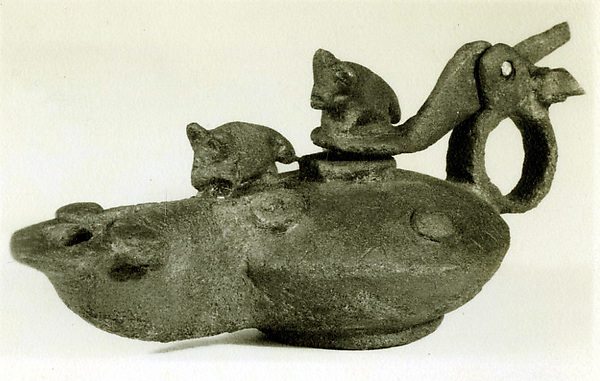
Lamp, 30 BCE–364 CE. Egypt.
The ancient lamp makes the saying about light and a lampstand concrete; this particular lamp is from Egypt.
The Metropolitan Museum of Art; Rogers Fund, 1964; object 64.195. · CC0 / Public Domain · Original recordImage changes
Resized proportionally to at most 1440px and JPEG compressed; no crop or content alteration.
The words
Bushel
A dry-measure container; about 2 gallons (8 liters), in NET’s note.
In Jesus’s example, a light goes on a stand instead of under a bushel; the NET uses basket for the dry-measure container described in its note.
Matthew 5:15 (opens a new tab) · NET Bible: Matthew 5:13-16 (opens a new tab) · Thayer’s G3426: dry measure (opens a new tab)
Candlestick
A lampstand, in this example.
Matthew’s KJV puts the light on a candlestick so it illuminates everyone in the house; the NET uses lamp and lampstand for the objects in this example.
Did you know?
The Met lists the pictured Egyptian lamp as copper alloy, measuring about 2 inches (5.1 cm) high and 5½ inches (14 cm) long.
Matthew 5:15 (opens a new tab) · NET Bible: Matthew 5:13-16 (opens a new tab) · Met: Egyptian copper-alloy lamp (opens a new tab)
Cast Out
Jesus’s salt image ends with salt being cast out and trodden underfoot after losing its savor; Matthew then moves to the images of light and a visible city.
Foot
In Matthew’s account of the salt saying, foot occurs in “trodden under foot of men,” describing what happens to the salt after it is cast out.
Glorify
Give honor or praise.
Jesus ends the light saying with people seeing good works and glorifying the Father in heaven; the NET renders glorify here as “give honor.”
Matthew 5:16 (opens a new tab) · NET Bible: Matthew 5:13-16 (opens a new tab)
Good Works
Matthew places good works in Jesus’s explanation of shining light: people are to see the deeds and glorify the Father in heaven, following the example of a household lamp.
Hill
Matthew follows “Ye are the light of the world” with Jesus’s image of a city set on a hill that cannot be hidden; the city is not named.
Light
Jesus calls his hearers “the light of the world,” then describes a visible city and a household light before telling them to let their light shine before others.
Salt
Matthew records Jesus calling his hearers “the salt of the earth,” followed by a question about salt losing its savor and a description of it being discarded.
Savour
Salt’s flavor.
Matthew’s KJV asks what happens if salt loses its “savour”; the NET uses flavor, while both versions follow the loss with a question about restoring saltiness.
Matthew 5:13 (opens a new tab) · NET Bible: Matthew 5:13-16 (opens a new tab)
Shine
Matthew records Jesus saying, “Let your light so shine before men,” then linking that visibility to people seeing good works and glorifying the Father in heaven.
Thenceforth
From then on.
In Matthew’s KJV, thenceforth follows the question about salt losing its savor; Jesus’s saying then describes the salt as good for nothing except being discarded and trampled.
Trodden
Trampled; walked on.
Matthew’s KJV ends the salt image with “trodden under foot of men”; the NET says trampled on by people, keeping the focus on the discarded salt.
Matthew 5:13 (opens a new tab) · NET Bible: Matthew 5:13-16 (opens a new tab)
Wherewith
With what.
Matthew’s KJV uses wherewith in Jesus’s question about restoring salt that has lost its savor; the question comes before the description of the salt being cast out.
World
Matthew pairs Jesus’s address “Ye are the light of the world” with a city that cannot be hidden, then narrows the next example to light within a house.
Sources
- Matthew 5:13-16 (King James Version)King James Version, passage navigation via Bible Gateway
- Matthew 5:13-16 (NET Bible), translation and notesNET Bible, via Bible Gateway
- Thayer’s Greek Lexicon, G3426: modiosThayer’s Greek Lexicon, via Bible Hub
- Lamp, object 64.195The Metropolitan Museum of Art