
The Life of Jesus
Puzzle 37 · Works of Healing · Page 58 in print
The Alabaster Box
At a Pharisee’s table, a woman anoints Jesus’s feet; a parable of forgiven debts explains her love.
Jump to a word
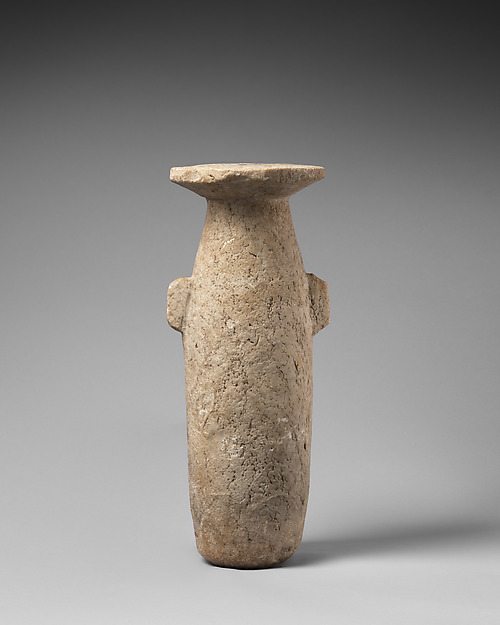
Alabastron, ca. 2nd century BCE–3rd century CE. Parthian.
The actual alabaster vessel clarifies the material named in the passage; its Parthian origin means it is a comparison, not the woman’s box.
The Metropolitan Museum of Art; Wolfe Expedition, Purchase, Catharine Lorillard Wolfe Gift, 1886; object 86.16.6. · CC0 / Public Domain · Original recordImage changes
Resized proportionally to at most 1440px and JPEG compressed; no crop or content alteration.
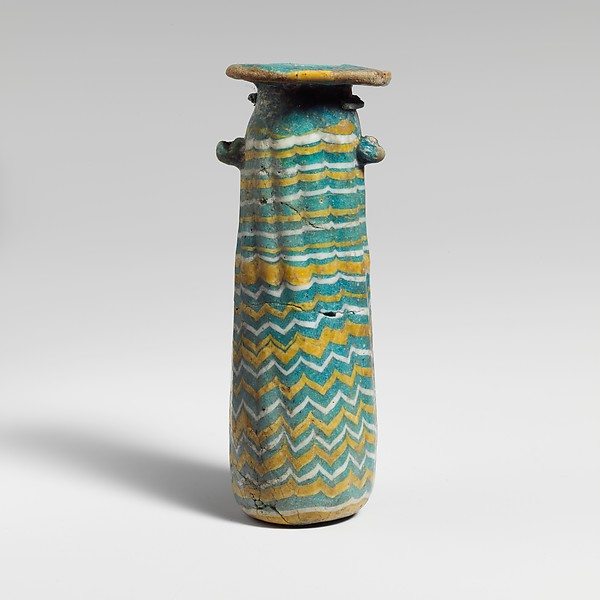
Glass alabastron (perfume bottle), late 4th–early 3rd century BCE. Greek, Eastern Mediterranean.
The Eastern Mediterranean perfume bottle gives a second view of ancient scented-oil containers, with no claimed link to this meal.
The Metropolitan Museum of Art; Gift of J. Pierpont Morgan, 1917; object 17.194.793. · CC0 / Public Domain · Original recordImage changes
Resized proportionally to at most 1440px and JPEG compressed; no crop or content alteration.
The words
Alabaster Box
An alabaster jar or flask.
Luke says the woman brings an “alabaster box of ointment” after learning Jesus is at the Pharisee’s meal; the NET calls the container an alabaster jar.
Luke 7:37 (opens a new tab) · NET Bible: Luke 7:36-50 (opens a new tab)
Creditor
A lender to whom money is owed.
In Jesus’s story to Simon, one creditor has two debtors owing different amounts; when neither can pay, he forgives both and Jesus asks who will love him most.
Luke 7:40–42 (opens a new tab) · NET Bible: Luke 7:36-50 (opens a new tab)
Forgave
Luke uses forgave for the creditor’s cancellation of both debts; Simon answers that the debtor forgiven more will love more, and Jesus says he has judged rightly.
Luke 7:42–43 (opens a new tab) · NET Bible: Luke 7:36-50 (opens a new tab)
Frankly
Freely; describing forgiveness of the debts.
The creditor in Jesus’s parable “frankly forgave them both” when neither debtor had money to pay; the question that follows concerns which debtor will love him most.
Luke 7:42 (opens a new tab) · NET Bible: Luke 7:36-50 (opens a new tab)
Hairs
Luke says the woman wipes Jesus’s feet with the hairs of her head after wetting them with tears; Jesus later repeats those actions while speaking to Simon.
Kissed
Luke first describes the woman kissing Jesus’s feet; Jesus later contrasts Simon’s lack of a kiss with her continuing to kiss his feet since his arrival.
Loved Much
Luke records Jesus’s words “for she loved much” while he speaks to Simon about the woman’s forgiven sins; he then addresses her directly, saying her sins are forgiven.
Ointment
Perfumed oil, in this passage.
Luke calls the jar’s contents ointment and describes the woman anointing Jesus’s feet with it; the NET renders the substance as “perfumed oil.”
Did you know?
The Met describes the pictured glass perfume bottle’s white and yellow trails as forming a zigzag pattern on its lower body; this ancient comparison vessel is not identified as Luke’s jar.
Luke 7:37–38 (opens a new tab) · NET Bible: Luke 7:36-50 (opens a new tab) · Met: glass perfume bottle (opens a new tab)
Pence
Denarii, the plural of denarius, a silver coin.
Jesus’s parable gives one debt as five hundred pence and the other as fifty; Thayer identifies the underlying coin term as the denarius, a silver coin.
Luke 7:41 (opens a new tab) · Thayer’s G1220: denarius (opens a new tab)
Rightly Judged
After Simon chooses the debtor forgiven more as the one who will love more, Jesus replies, “Thou hast rightly judged,” then turns toward the woman.
Sat at Meat
Reclined at table for a meal.
Luke’s KJV places Jesus “at meat” in the Pharisee’s house when the woman learns of the meal; the NET’s translation note describes him reclining at table.
Luke 7:36–37 (opens a new tab) · NET Bible: Luke 7:36-50 (opens a new tab)
Sinner
Luke introduces an unnamed woman as “a sinner”; Simon repeats that description in his thoughts after seeing her touch Jesus, before Jesus begins speaking to him.
Tears
Luke places the woman behind Jesus at his feet, weeping; her tears wet his feet before she wipes them with her hair, kisses them and anoints them.
Wash
Jesus tells Simon that he provided no water for his feet, then contrasts that omission with the woman washing his feet with tears and wiping them with her hair.
Wiped
Luke describes the woman wiping Jesus’s feet with her hair between washing them with tears and kissing them; Jesus recalls the wiping while contrasting her actions with Simon’s.
Sources
- Luke 7:36-50 (King James Version)King James Version, passage navigation via Bible Gateway
- Luke 7:36-50 (NET Bible), translation and notesNET Bible, via Bible Gateway
- Thayer’s Greek Lexicon, G1220: denarionThayer’s Greek Lexicon, via Bible Hub
- Glass alabastron (perfume bottle), object 17.194.793The Metropolitan Museum of Art