
The Life of Jesus
Puzzle 36 · Works of Healing · Page 57 in print
Ephphatha
In the Decapolis, Jesus takes a man aside and restores hearing and speech; Mark translates his spoken command.
Jump to a word
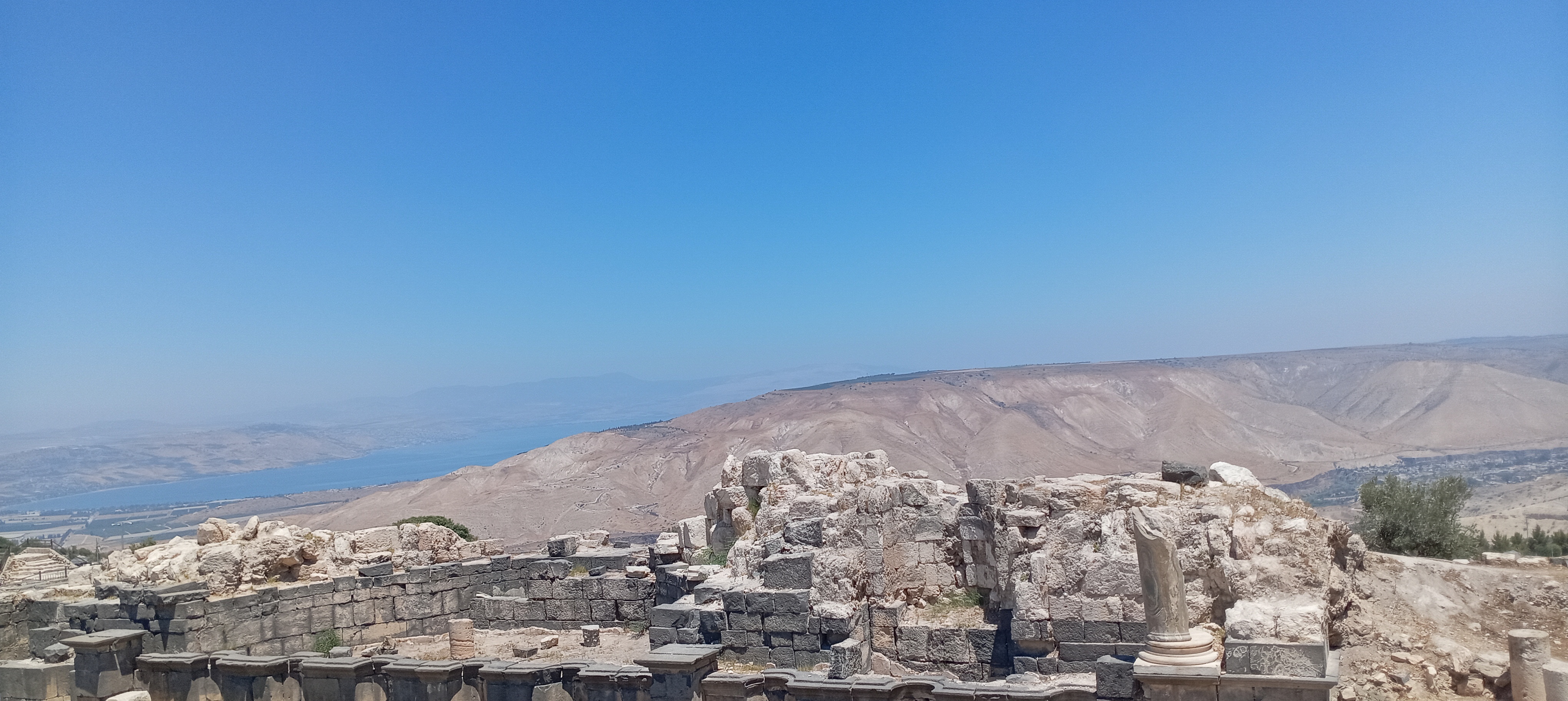
Ruins at Gadara (Umm Qais), photographed July 13, 2025.
One of the Decapolis cities, the region named in Mark’s account.
Justwiki / Wikimedia Commons · CC BY 4.0 · Original recordImage changes
Display copies resized; original downloaded JPEG preserved.
The words
All Things Well
Mark gives “He hath done all things well” as the astonished crowd’s response, followed by their words about hearing and speech after Jesus has ordered silence.
Aside
Mark says Jesus takes the man aside from the multitude before putting fingers into his ears and touching his tongue; the NET explicitly describes the withdrawal as private.
Mark 7:33 (opens a new tab) · NET Bible: Mark 7:31-37 (opens a new tab)
Deaf
Mark introduces a man who is deaf and has difficulty speaking; others bring him to Jesus and ask that Jesus put his hand on him.
Decapolis
A region whose name means “ten cities.”
Mark places Jesus’s arrival at the Sea of Galilee through the coasts of Decapolis, after his departure from Tyre and Sidon, before the man is brought to him.
Did you know?
Thayer lists Gadara, Hippo, Pella and Scythopolis among the Decapolis cities, while noting that ancient geographers differed in their lists of the ten cities.
Mark 7:31–32 (opens a new tab) · Thayer’s G1179: Decapolis (opens a new tab)
Ears
Mark mentions the man’s ears twice: Jesus puts his fingers into them, and after the command Ephphatha, Mark says they are opened immediately.
Ephphatha
Be opened; Mark’s translation of the command.
Mark places Ephphatha after Jesus looks to heaven and sighs, then translates the command as “Be opened” before describing the man’s hearing and speech.
Mark 7:34–35 (opens a new tab) · NET Bible: Mark 7:31-37 (opens a new tab)
Fingers
Mark distinguishes Jesus’s fingers in the man’s ears from his touching the tongue; both actions follow taking the man aside and precede the spoken command.
Impediment
A difficulty or hindrance in speaking.
Mark’s introduction describes an “impediment in his speech” alongside deafness; Thayer explains the Greek term as speaking with difficulty, rather than naming a particular medical condition.
Mark 7:32 (opens a new tab) · Thayer’s G3424: speech difficulty (opens a new tab)
Loosed
Loosened or released.
Mark says the string of the man’s tongue “was loosed” after Ephphatha; the same verse reports his ears opening and his speaking plainly.
Mark 7:34–35 (opens a new tab) · NET Bible: Mark 7:31-37 (opens a new tab)
Plain
Plainly; clearly, describing how he speaks.
Mark ends the description of the man’s changed speech with “he spake plain”; the NET uses “he spoke plainly,” before the command not to tell anyone.
Mark 7:35–36 (opens a new tab) · NET Bible: Mark 7:31-37 (opens a new tab)
Published
Made known publicly; spread the news.
Mark contrasts Jesus’s instruction to tell no one with the spreading news: the more he charges them to be silent, the more they publish it.
Mark 7:36 (opens a new tab) · NET Bible: Mark 7:31-37 (opens a new tab)
Sighed
Mark places Jesus’s sigh between looking up to heaven and saying Ephphatha; he then supplies the command’s meaning, “Be opened,” before describing the result.
Speech
Mark first describes difficulty in the man’s speech, then reports that he speaks plainly after Jesus’s command; the crowd responds with astonishment and its own summary.
String
A bond or restraint, in the KJV wording.
Mark’s KJV says “the string of his tongue was loosed” as the man begins speaking plainly; the NET renders the phrase simply as “his tongue loosened.”
Mark 7:35 (opens a new tab) · NET Bible: Mark 7:31-37 (opens a new tab)
Tongue
Mark says Jesus touches the man’s tongue after spitting; following Ephphatha, he describes its release and the man’s plain speech, alongside the opening of his ears.
Sources
- Mark 7:31-37 (King James Version)King James Version, passage navigation via Bible Gateway
- Mark 7:31-37 (NET Bible), translation and notesNET Bible, via Bible Gateway
- Thayer’s Greek Lexicon, G1179: DekapolisThayer’s Greek Lexicon, via Bible Hub
- Thayer’s Greek Lexicon, G3424: mogilalosThayer’s Greek Lexicon, via Bible Hub