
The Life of Jesus
Puzzle 31 · Works of Healing · Page 52 in print
The Centurion's Servant
A centurion’s request becomes an example of trust in authority: Jesus need only speak.
Jump to a word
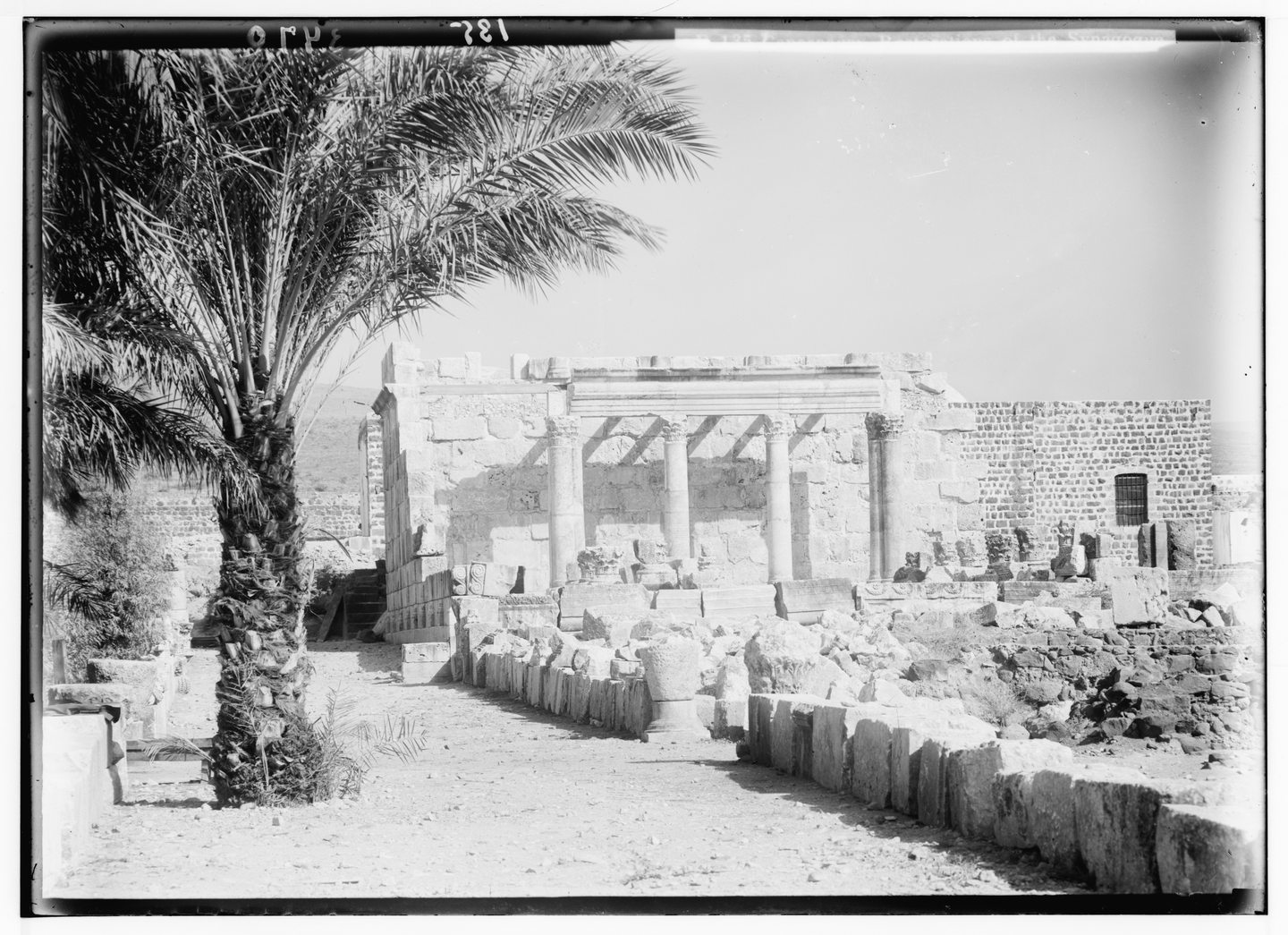
Capernaum, the restored synagogue of about the 4th–5th century AD (1920).
The town is explicitly named in the centurion account; the visible synagogue remains are later than the building mentioned by the elders.
G. Eric and Edith Matson Photograph Collection, Library of Congress · Public Domain Mark 1.0 · Original recordImage changes
Resized proportionally to at most 1440px and JPEG compressed; no crop or content alteration.
The words
Built
Luke’s elders give the centurion’s building of their synagogue as a reason to help him; the statement is part of their appeal before Jesus sets out.
Centurion
Matthew presents the centurion speaking to Jesus; Luke describes him sending Jewish elders and later friends with his request concerning the sick servant.
Did you know?
Acts 10:1 uses the same rank for Cornelius in Caesarea, naming his unit as the “Italian band”; Matthew and Luke’s Capernaum officer is unnamed.
Matthew 8:5–8 (opens a new tab) · Luke 7:3–7 (opens a new tab) · Acts 10:1 (opens a new tab)
Elders
Luke says the centurion sends “the elders of the Jews” to ask Jesus to heal his servant; they plead for him and explain his support for their community.
Gnashing
Grating or grinding one’s teeth.
Matthew records “weeping and gnashing of teeth” within Jesus’s warning about outer darkness; Luke’s centurion account instead closes with the servant found well.
Matthew 8:12 (opens a new tab) · Luke 7:10 (opens a new tab) · Strong’s G1030: gnashing (opens a new tab)
Goeth
Older form of goes.
Matthew’s “he goeth” is the soldier’s response to “Go”; the centurion pairs it with “Come” and “Do this” while explaining authority to Jesus.
Matthew 8:9 (opens a new tab) · NET Bible: Matthew 8:5-13 (opens a new tab)
Great Faith
Matthew and Luke both attribute “I have not found so great faith, no, not in Israel” to Jesus after the centurion’s words about command and obedience.
Matthew 8:9–10 (opens a new tab) · Luke 7:8–9 (opens a new tab)
Grievously
Severely or intensely.
Matthew records “grievously tormented” as part of the centurion’s description, alongside palsy; Jesus’s next response is “I will come and heal him.”
Matthew 8:6–7 (opens a new tab) · NET Bible: Matthew 8:5-13 (opens a new tab)
Instantly
Luke’s “instantly” describes the elders’ earnest request for help; the NET says they urge Jesus “earnestly,” before giving their reasons for calling the centurion worthy.
Luke 7:4–5 (opens a new tab) · NET Bible: Luke 7:1-10 (opens a new tab)
Nation
Luke’s Jewish elders say the centurion “loveth our nation” and has built a synagogue; the NET note also offers “people” for the word nation.
Luke 7:3–5 (opens a new tab) · NET Bible: Luke 7:1-10 (opens a new tab)
Servant
Luke’s KJV calls the sick man a servant; the NET uses “slave,” and Luke’s account ends with the messengers returning to find him well.
Luke 7:2–3; Luke 7:10 (opens a new tab) · NET Bible: Luke 7:1-10 (opens a new tab)
Soldiers
Matthew and Luke place soldiers under the centurion’s authority; he illustrates obedience with commands to go, come and do something, including a command to an enslaved servant.
Matthew 8:9 (opens a new tab) · Luke 7:8 (opens a new tab) · NET Bible: Matthew 8:5-13 (opens a new tab) · NET Bible: Luke 7:1-10 (opens a new tab)
Speak the Word
Matthew’s centurion asks Jesus to “speak the word only”; Luke’s message through friends similarly asks for a word, without requiring Jesus to come under the roof.
Matthew 8:8 (opens a new tab) · Luke 7:6–7 (opens a new tab)
Teeth
Matthew places “gnashing of teeth” after Jesus’s words about people coming from east and west to sit with Abraham, Isaac and Jacob in the kingdom of heaven.
Tormented
Matthew reports the centurion describing his servant as lying with palsy and being “grievously tormented”; Luke describes the servant as sick and ready to die.
Worthy
Luke’s elders call the centurion worthy of help; his later message through friends says, “I am not worthy,” specifically about Jesus entering under his roof.
Sources
- Matthew 8:5-13 (King James Version)King James Version, passage navigation via Bible Gateway
- Luke 7:1-10 (King James Version)King James Version, passage navigation via Bible Gateway
- Acts 10:1-2 (King James Version)King James Version, passage navigation via Bible Gateway
- Matthew 8:5-13 (NET Bible), translation and notesNET Bible, via Bible Gateway
- Luke 7:1-10 (NET Bible), translation and notesNET Bible, via Bible Gateway
- Strong’s Exhaustive Concordance, Greek 1030: brugmosStrong’s Exhaustive Concordance, via Bible Hub