
The Life of Jesus
Puzzle 30 · Works of Healing · Page 51 in print
Through the Roof
Friends lower a man through a roof; forgiveness and healing bring astonishment and a dispute about authority.
Jump to a word
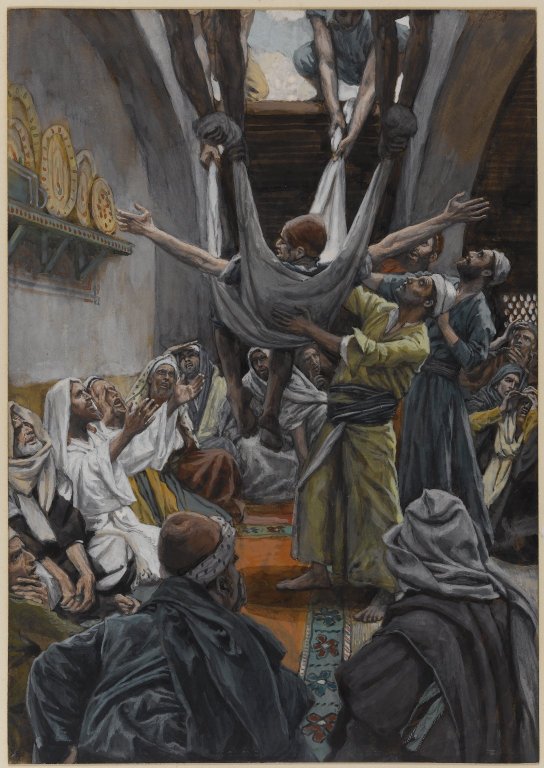
The Palsied Man Let Down through the Roof, James Tissot, opaque watercolor, 1886–1896.
James Tissot / Brooklyn Museum, Purchased by public subscription (00.159.123) · Public domain · Original recordImage changes
Display copies resized; original downloaded JPEG preserved.
The words
Blasphemies
Mark gives “blasphemies” in the scribes’ inward question about who can forgive sins; Luke attributes a similar question to scribes and Pharisees after Jesus’s words of forgiveness.
Mark 2:5–7 (opens a new tab) · Luke 5:20–21 (opens a new tab)
Borne of Four
Carried by four people.
Mark gives the number of those carrying the man as four; when blocked by the crowd, they lower his bed through an opening they make in the roof.
Mark 2:3–4 (opens a new tab) · NET Bible: Mark 2:1-12 (opens a new tab)
Couch
A bed or stretcher.
Luke describes the man being lowered with his couch into the midst before Jesus; later, Jesus tells him to take the couch and go home.
Luke 5:19; Luke 5:24 (opens a new tab) · NET Bible: Luke 5:17-26 (opens a new tab)
Easier
Mark, Luke and Matthew each record Jesus asking which is easier to say: that the man’s sins are forgiven, or that he should rise and walk.
Mark 2:9 (opens a new tab) · Luke 5:23 (opens a new tab) · Matthew 9:5 (opens a new tab)
Housetop
Luke describes the carriers going onto the housetop because the crowd prevents them from bringing the man inside; they lower him into the midst before Jesus.
Noised
Mark begins with news that Jesus is in the house after returning to Capernaum; people gather until there is no room, even around the door.
Did you know?
Mark’s KJV says “in the house”; the NET reads “at home.” Neither wording names the homeowner in the opening verse.
Mark 2:1–2 (opens a new tab) · NET Bible: Mark 2:1-12 (opens a new tab)
Palsy
Mark describes the man as “sick of the palsy”; he is carried by four people and later walks out with his bed after Jesus’s command.
Power on Earth
Authority on earth.
Mark records Jesus saying the Son of Man has “power on earth to forgive sins”; Luke likewise puts this authority claim before the instruction to rise and go home.
Mark 2:10–11 (opens a new tab) · Luke 5:24 (opens a new tab) · NET Bible: Mark 2:1-12 (opens a new tab)
Press
Mark describes so many people gathered that there is no room even by the door; this “press” prevents the man’s carriers from reaching Jesus directly.
Reasoning
Thinking or debating inwardly.
Mark describes scribes sitting and reasoning in their hearts, then Jesus perceiving their thoughts and asking why they reason that way; Luke likewise reports his response to inward thoughts.
Mark 2:6–8 (opens a new tab) · Luke 5:21–22 (opens a new tab) · NET Bible: Luke 5:17-26 (opens a new tab)
Roof
Mark describes the carriers uncovering the roof and breaking it up before lowering the bed; Luke’s parallel account describes them letting the man down through tiling.
Did you know?
NET’s note describes a flat roof reached by stairs or a ladder as regional background; the Gospel accounts do not specify how these carriers reached the roof.
Mark 2:4 (opens a new tab) · Luke 5:19 (opens a new tab) · NET Bible: Mark 2:1-12 (opens a new tab)
Strange Things
Luke gives “We have seen strange things to day” as the crowd’s words after the man leaves; the NET renders the description as “incredible” things.
Luke 5:25–26 (opens a new tab) · NET Bible: Luke 5:17-26 (opens a new tab)
Take Up Thy Bed
Mark records Jesus telling the man to rise, take his bed and go home; Luke describes him immediately getting up and taking what he had been lying on.
Mark 2:11–12 (opens a new tab) · Luke 5:24–25 (opens a new tab)
Tiling
Luke describes the man being lowered through “tiling”; the NET translates “roof tiles,” while its note acknowledges uncertainty about the Greek word and local roof construction.
Luke 5:19 (opens a new tab) · NET Bible: Luke 5:17-26 (opens a new tab)
Uncovered
Mark says the carriers “uncovered the roof where he was”; after breaking it up, they lower the bed on which the man lies, because the crowd has blocked their approach.
Sources
- Mark 2:1-12 (King James Version)King James Version, passage navigation via Bible Gateway
- Luke 5:17-26 (King James Version)King James Version, passage navigation via Bible Gateway
- Matthew 9:1-8 (King James Version)King James Version, passage navigation via Bible Gateway
- Mark 2:1-12 (NET Bible), translation and notesNET Bible, via Bible Gateway
- Luke 5:17-26 (NET Bible), translation and notesNET Bible, via Bible Gateway