
The Life of Jesus
Puzzle 23 · The First Signs · Page 42 in print
The Nobleman's Son
A father asks for his dying son’s healing and learns that recovery began at Jesus’s word.
Jump to a word
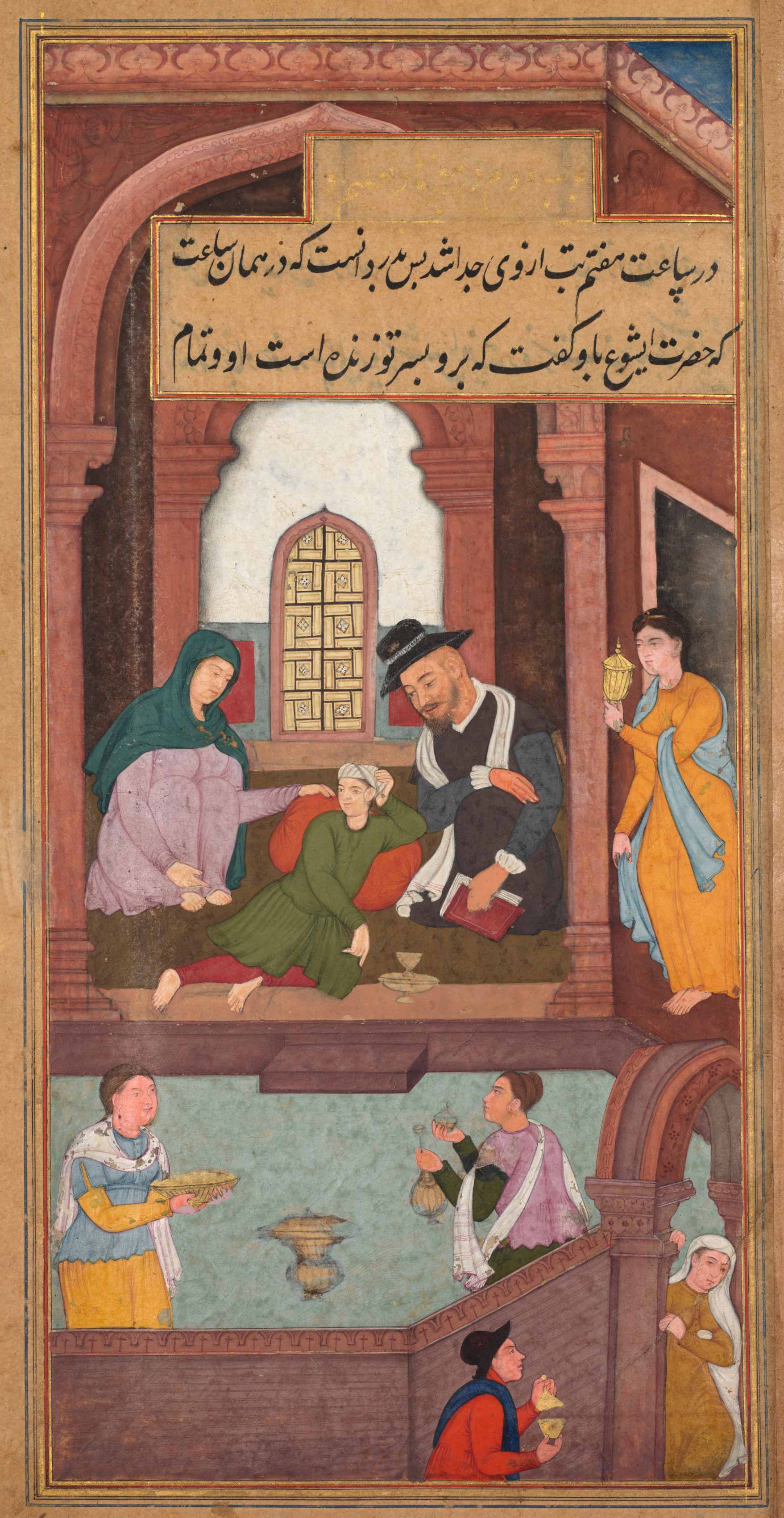
Jesus Heals the Nobleman’s Son, Mughal manuscript illustration, 1602–1604.
The Gospel account is illustrated in a Mughal interior.
Cleveland Museum of Art, John L. Severance Fund (2005.145.70.a) · CC0 · Original recordImage changes
Display copies resized; original downloaded JPEG preserved.
The words
Amend
John places “began to amend” in the father’s question about the time of recovery; the servants answer with the hour when the fever left.
Besought
Earnestly asked or pleaded.
John describes the father coming to Jesus after hearing of his arrival from Judaea, then asking him to come down to his son in Capernaum.
John 4:46–47 (opens a new tab) · NET Bible: John 4:43-54 (opens a new tab)
Child
John quotes the father’s plea, “come down ere my child die,” followed by Jesus’s words “thy son liveth” and the man believing what Jesus says.
Enquired
Asked for information.
John records the father asking his servants when the boy began to recover; he matches their answer about the fever’s departure with Jesus’s words.
John 4:52–53 (opens a new tab) · NET Bible: John 4:43-54 (opens a new tab)
Fever
John gives the servants’ report that the fever left at the seventh hour; the father connects that hour with Jesus’s words about his son living.
Galilaeans
Galileans; people from Galilee.
John reports the Galilaeans receiving Jesus because they had seen his deeds at the Jerusalem feast, before he returns to Cana and the father approaches.
Did you know?
Earlier, John 2:23 places miracles in Jerusalem at Passover and describes people believing after seeing them; chapter 4 mentions Galilaeans who had attended the feast.
John 4:45–47 (opens a new tab) · NET Bible: John 4:43-54 (opens a new tab) · John 2:23 (opens a new tab)
Honour
John gives Jesus’s saying that a prophet has no honor in his own country, then describes the Galilaeans receiving him and his return to Cana.
Liveth
Lives; is alive.
John repeats “thy son liveth” first as Jesus’s reply, then as the servants’ message; the father connects the reported recovery with Jesus’s words.
Nobleman
John introduces a nobleman whose son is sick in Capernaum; the NET calls him a “royal official,” without naming him in the passage.
Did you know?
Cleveland Museum describes the pictured painting as unfinished: the carpet border and geometric floor patterns remain unpainted, and the work appears to involve at least two artists.
John 4:46 (opens a new tab) · NET Bible: John 4:43-54 (opens a new tab) · Cleveland: Mughal Gospel illustration (opens a new tab)
Point of Death
John describes the son as “at the point of death” when the father asks Jesus to come; the father then pleads, “come down ere my child die.”
Second Miracle
John closes the account with “the second miracle” on Jesus’s return from Judaea to Galilee, having recalled the water made wine when naming Cana.
Seventh Hour
John reports the servants saying the fever left at the seventh hour; the father identifies this as the hour when Jesus said his son would live.
Sick
John places the sick son in Capernaum while Jesus is at Cana; the father comes to Jesus and asks him to come down and heal the boy.
Testified
John uses “testified” for Jesus’s saying about a prophet’s lack of honor in his own country, then places the Galilaeans’ reception beside it.
Yesterday
John gives “Yesterday at the seventh hour” as the servants’ answer about the fever; the father recognizes the time as matching Jesus’s earlier words.
Sources
- John 4:43-54 (King James Version)King James Version, passage navigation via Bible Gateway
- John 2:23-25 (King James Version)King James Version, passage navigation via Bible Gateway
- John 4:43-54 (NET Bible), translation and notesNET Bible, via Bible Gateway
- Cleveland Museum: Jesus Heals the Nobleman’s Son, folio 70 rectoCleveland Museum of Art