
The Life of Jesus
Puzzle 21 · The First Signs · Page 40 in print
Nicodemus by Night
Nicodemus visits at night, and the conversation moves from new birth to light, belief and life.
Jump to a word
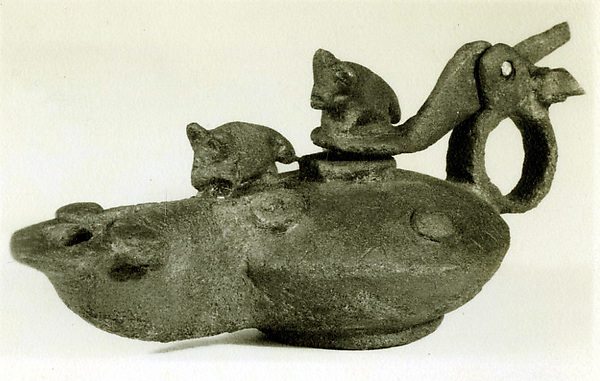
Lamp, 30 BCE–364 CE. Egypt.
The lamp gives tangible context to the passage’s contrast of night, darkness and light.
The Metropolitan Museum of Art; Rogers Fund, 1964; object 64.195. · CC0 / Public Domain · Original recordImage changes
Resized proportionally to at most 1440px and JPEG compressed; no crop or content alteration.
The words
Begotten
The KJV’s John 3:16 calls God’s Son “only begotten”; the NET uses “one and only,” giving a different English rendering of the same description.
John 3:16 (opens a new tab) · NET Bible: John 3:1-21 (opens a new tab)
Bloweth
Blows; an older verb form.
John gives Jesus’s illustration of the wind blowing where it chooses: its sound can be heard, but its source and destination are unknown to the listener.
Did you know?
The NET’s note points out that the same Greek word can be translated “wind” or “spirit,” linking the language in the two parts of Jesus’s illustration.
John 3:8 (opens a new tab) · NET Bible: John 3:1-21 (opens a new tab)
Born Again
John’s KJV text gives Jesus’s words as “born again”; the NET reads “born from above,” and its note explains that the Greek word can bear both senses.
John 3:3–4; John 3:7 (opens a new tab) · NET Bible: John 3:1-21 (opens a new tab)
Condemnation
In John 3:17–19, the Son is sent to save the world, and belief is contrasted with condemnation; the passage then connects judgment with light and people’s deeds.
Darkness
John 3:19–21 contrasts people loving darkness because their deeds are evil with the person who does truth and comes to the light.
Everlasting
John 3:16 joins “everlasting life” with belief in the Son, following the comparison with Moses’s serpent and the Son of man being lifted up.
John 3:14–15 (opens a new tab) · John 3:16 (opens a new tab)
Heavenly
John records Jesus contrasting earthly and heavenly things while answering Nicodemus, whose question was “How can these things be?” Jesus also addresses him as a “master of Israel.”
Listeth
John uses “where it listeth” for the wind in Jesus’s illustration, pairing its audible sound with uncertainty about where it comes from and where it goes.
Marvel
Be astonished.
John records Jesus telling Nicodemus “Marvel not” about being born again, before turning to the wind’s sound and the comparison with birth of the Spirit.
John 3:7–8 (opens a new tab) · NET Bible: John 3:1-21 (opens a new tab)
Nicodemus
John identifies Nicodemus as a Pharisee and “a ruler of the Jews”; he addresses Jesus as Rabbi and links the miracles with God’s presence.
Night
John marks Nicodemus’s visit as taking place at night, before his question about birth; John 19:39 later recalls him as the one who first came by night.
Reproved
Made plain; exposed.
In John 3:20, the person doing evil avoids light lest the deeds be “reproved”; the following verse depicts the person doing truth coming to the light.
John 3:20–21 (opens a new tab) · NET Bible: John 3:1-21 (opens a new tab)
Serpent
John compares the Son of man being lifted up with Moses’s serpent in the wilderness; Numbers places the brass serpent after snakebites and deaths among the people.
John 3:14–15 (opens a new tab) · Numbers 21:6–9 (opens a new tab)
Teacher
John gives Nicodemus’s words “a teacher come from God” for Jesus; Jesus later addresses Nicodemus as a “master of Israel” when answering his questions.
Did you know?
When officers return to the chief priests and Pharisees in John 7, their explanation is about speech: “Never man spake like this man.”
John 3:2 (opens a new tab) · John 3:9–10 (opens a new tab) · John 7:45–46 (opens a new tab)
Womb
John records Nicodemus asking how someone old could enter his mother’s womb a second time; Jesus’s reply speaks about birth of water and of the Spirit.
Sources
- John 3:1-8 (King James Version)King James Version, passage navigation via Bible Gateway
- John 3:9-15 (King James Version)King James Version, passage navigation via Bible Gateway
- John 3:16-21 (King James Version)King James Version, passage navigation via Bible Gateway
- John 7:45-52 (King James Version)King James Version, passage navigation via Bible Gateway
- John 19:38-42 (King James Version)King James Version, passage navigation via Bible Gateway
- Numbers 21:4-9 (King James Version)King James Version, passage navigation via Bible Gateway
- John 3:1-21 (NET Bible), translation and notesNET Bible, via Bible Gateway