
The Life of Jesus
Puzzle 20 · The First Signs · Page 39 in print
Water Made Wine
At a wedding in Cana, water in stone jars becomes wine; John calls this the beginning of Jesus’s signs.
Jump to a word
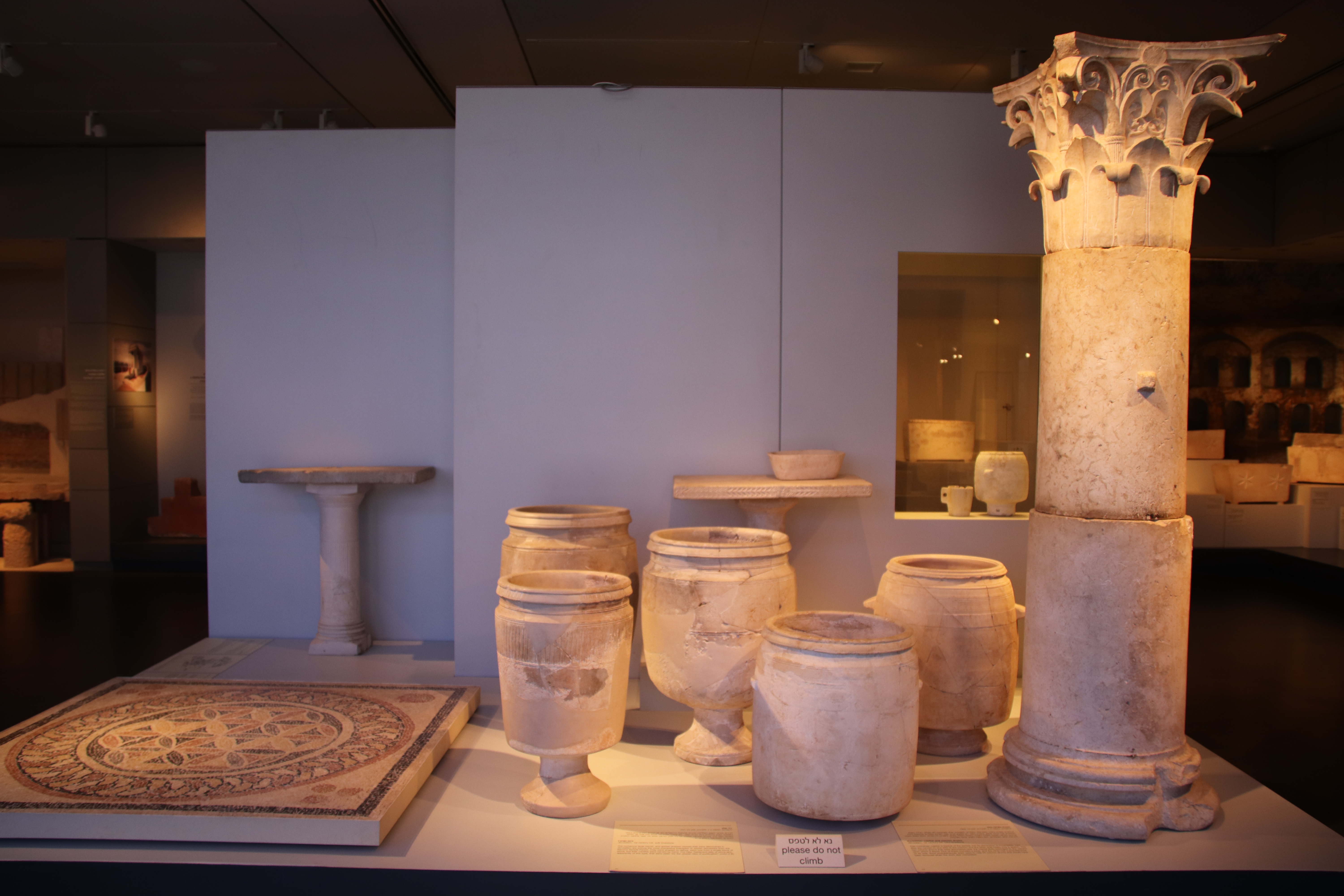
Stone jars and tables in the Israel Museum, Jerusalem, photographed July 5, 2018.
Gary Todd / Wikimedia Commons · CC0 · Original recordImage changes
Display copies resized; original downloaded JPEG preserved.
The words
Apiece
John uses “apiece” for the capacity of each stone waterpot: two or three firkins, before the servants are told to fill them with water.
Beginning
John calls this the “beginning of miracles,” describing Jesus’s glory made known and the disciples believing in him; the NET uses the wording “first of his miraculous signs.”
Did you know?
John later recalls the water made wine when Jesus returns to Cana; verse 54 calls the following episode “the second miracle,” linking the later scene with this opening one.
John 2:11 (opens a new tab) · NET Bible: John 2:1-11 (opens a new tab) · John 4:46; John 4:54 (opens a new tab)
Brim
Top edge of a vessel.
John says the servants fill the six waterpots “up to the brim” after Jesus’s instruction, then draw from them and take what they draw to the feast’s governor.
John 2:6–8 (opens a new tab) · NET Bible: John 2:1-11 (opens a new tab)
Cana
John names Cana of Galilee as the wedding’s setting, places Jesus’s mother there and says Jesus and his disciples were also called to the celebration.
Firkins
Here, measures of about 10½ US gallons (40 liters) each.
John uses firkins for each jar’s capacity, giving two or three per vessel; the six jars are for the purification practice described in the passage.
John 2:6 (opens a new tab) · NET Bible: John 2:1-11 (opens a new tab) · NIST: US gallon conversion (opens a new tab)
Good Wine
John reports the feast’s governor telling the bridegroom he has kept the good wine until then; the governor does not know its source, but the servants do.
Hour
John records “mine hour is not yet come” in Jesus’s reply to his mother; later, John 12:23 gives Jesus’s words “The hour is come.”
John 2:3–4 (opens a new tab) · John 12:20–23 (opens a new tab)
Marriage
John places Jesus’s mother at a marriage in Cana and says Jesus and his disciples were called to it; the wine shortage comes during this celebration.
Mother
John places Jesus’s mother at the wedding before mentioning Jesus and his disciples; she tells him “They have no wine,” then gives the servants an instruction.
Ruler
John’s ruler of the feast tastes the water made wine and calls the bridegroom; the servants know where it came from, while the ruler does not.
Servants
John gives the servants the tasks of filling the waterpots and drawing from them; unlike the feast’s ruler, they know where the tasted wine came from.
Stone
John identifies six waterpots as stone and relates them to Jewish purification, before describing their filling with water and the governor’s tasting of wine.
Did you know?
A 2024 Israel Antiquities Authority report describes a Mount Scopus chalk-vessel workshop dated to the first century CE; its authors link this production with Jewish purity observance.
John 2:6–9 (opens a new tab) · IAA: Mount Scopus stone vessels (opens a new tab)
Third Day
John opens the wedding scene with “the third day,” naming Cana of Galilee and Jesus’s mother; he next mentions Jesus and his disciples being invited.
Waterpots
Water jars.
John’s six waterpots stand there for purification; Jesus tells the servants to fill them with water, then to draw from them for the feast’s governor.
John 2:6–8 (opens a new tab) · NET Bible: John 2:1-11 (opens a new tab)
Whatsoever
Whatever; no matter what.
John records Jesus’s mother telling the servants, “Whatsoever he saith unto you, do it,” before Jesus gives his instructions about filling the waterpots.
John 2:5–7 (opens a new tab) · NET Bible: John 2:1-11 (opens a new tab)
Sources
- John 2:1-11 (King James Version)King James Version, passage navigation via Bible Gateway
- John 4:46-54 (King James Version)King James Version, passage navigation via Bible Gateway
- John 12:20-23 (King James Version)King James Version, passage navigation via Bible Gateway
- John 2:1-11 (NET Bible), translation and notesNET Bible, via Bible Gateway
- Seligman, Amit and Zilberbod, Mount Scopus chalk-vessel workshop (2024), abstractIsrael Antiquities Authority, Atiqot 113
- NIST Guide to the SI, Appendix B.8, US gallon to literNational Institute of Standards and Technology