
World War II
Puzzle 02 · Fighter Command and the Blitz · Page 14 in print
Bawdsey and Chain Home
Chain Home’s towers could detect approaching aircraft up to 120 miles away.
Jump to a word
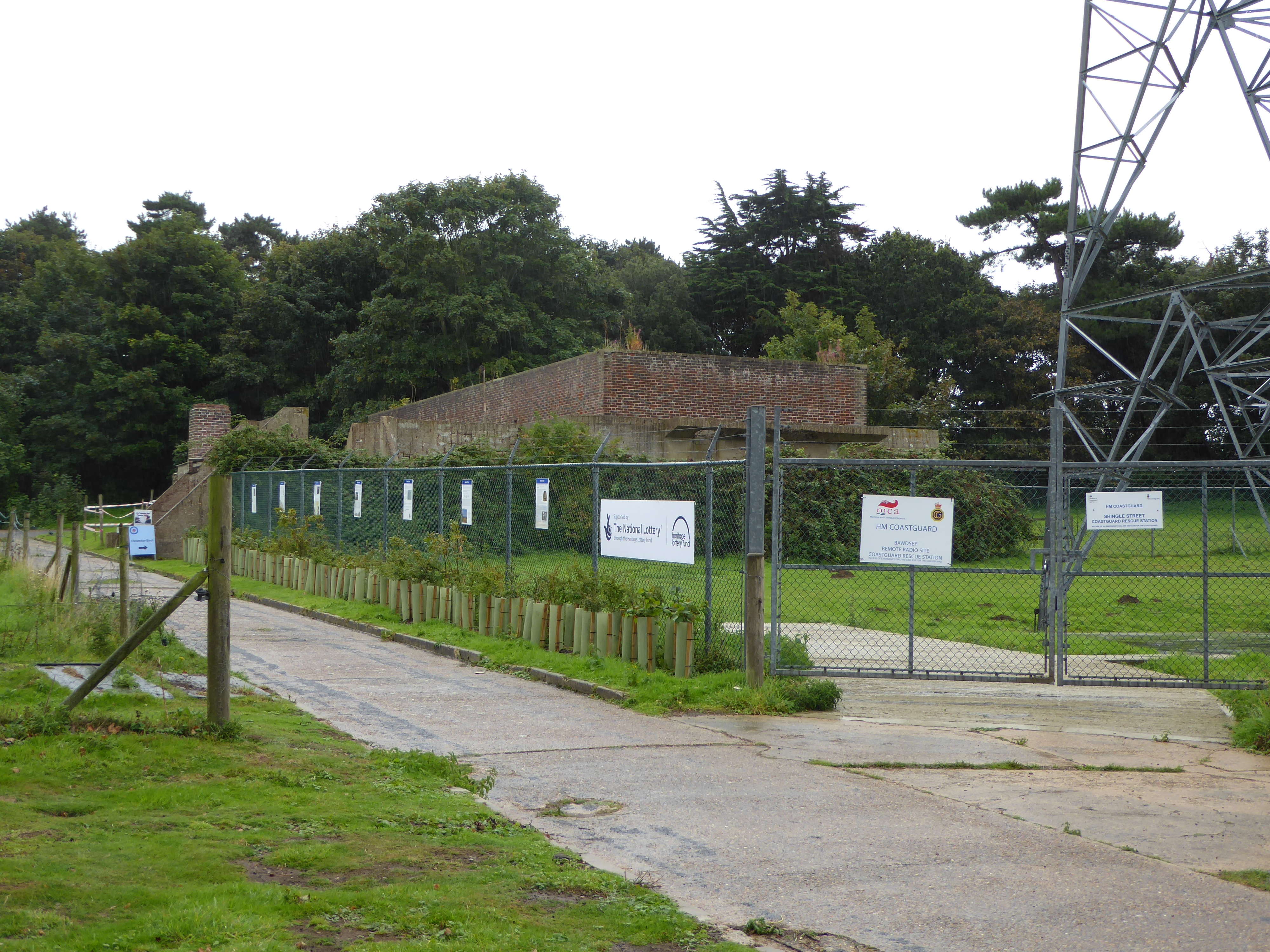
Bawdsey’s transmitter block, photographed in September 2015.
Chris Holifield / Bawdsey Transmitter Block · CC BY-SA 2.0 · Original recordImage changes
Display copies resized; original downloaded JPEG preserved.
The words
Antenna
Chain Home’s transmitting aerials were supported by tall steel towers. Historic England describes how the arrays were initially carried on the towers’ platforms and later suspended between adjacent towers.
Official list entry, History · Historic England: Chain Home tower (opens a new tab)
Bawdsey
Bawdsey in Suffolk was one of the research locations used by Robert Watson-Watt and Arnold Wilkins after the Daventry experiment. Their work helped develop the coastal Chain Home network.
Tracking radar, Daventry and coastal research · Royal Society: radar origins (opens a new tab)
Chain Home
The early network connected radar stations protecting approaches to Britain. Historic England describes its first five stations covering London’s approaches, with trials in 1937 before full operation in 1938.
Official list entry, History · Historic England: Chain Home tower (opens a new tab)
Coastal
A coastal position helped stations cover approaching aircraft, but siting needed care. The 1936 specifications called for stations set back from the shore, with smooth ground sloping toward the sea.
Official list entry, History · Historic England: Chain Home tower (opens a new tab)
Daventry
On February 26, 1935, Watson-Watt and Arnold Wilkins tested aircraft detection near Daventry in Northamptonshire. Their demonstration traced changes in a radio signal reflected by an aircraft.
Did you know?
The experiment borrowed an existing BBC broadcast signal. A Handley Page Heyford bomber loaned by the RAF flew through the test area, giving Watson-Watt and Wilkins a way to observe the reflected signal.
Tracking radar, Daventry and coastal research · Royal Society: radar origins (opens a new tab)
Detection
Radar located aircraft through reflected electromagnetic pulses. Historic England describes this as the principle behind the stations: a returning signal revealed an object’s position to receiving equipment.
Official list entry, History · Historic England: Swingate (opens a new tab)
Dover
Swingate, near Dover, was among the early Chain Home stations. Its position facing France placed it on an important approach to Britain, connecting this Kent town with the warning network.
Official list entry, History · Historic England: Swingate (opens a new tab)
Early Warning
Chain Home reports gave fighter control information about approaching aircraft. Historic England describes adjoining stations’ overlapping coverage and the onward flow of their plots to headquarters and sector operations rooms.
Did you know?
Historic England’s account links range to aircraft height: it describes coverage of aircraft at 15,000 feet (4,572 m), while noting a blind zone below 200 feet (61 m).
Official list entry, History · Historic England: Chain Home tower (opens a new tab)
Orfordness
The printed name refers to Orford Ness in Suffolk, another research location used by Watson-Watt and Wilkins. The Royal Society links work there and at Bawdsey with Chain Home’s development.
Tracking radar, Daventry and coastal research · Royal Society: radar origins (opens a new tab)
Radar
The radar stations formed part of a reporting system. Their information went to a central operations room, where controllers directed fighters toward enemy aircraft rather than leaving interception to each station.
Official list entry, History · Historic England: Swingate (opens a new tab)
Radio
The system used reflected radio waves to detect approaching aircraft. Historic England places Chain Home within the development of radio direction finding, linking the signals with information about an aircraft’s approach.
Official list entry, History · Historic England: Chain Home tower (opens a new tab)
Receiver
Early Chain Home sites separated receiving equipment from transmitting equipment. At Swingate, Historic England describes distinct parts of the station for those functions, rather than one combined apparatus building.
Did you know?
The buildings’ positions helped identify their roles. At Swingate, receiver towers stood around a central building in a roughly square arrangement, while the transmitting towers formed a line.
Official list entry, History · Historic England: Swingate (opens a new tab)
Transmitter
The transmitter supplied the outgoing signal used in aircraft detection. Historic England describes early stations with a separate transmitting site, whose towers were arranged in a line apart from the receiving functions.
Official list entry, History · Historic England: Swingate (opens a new tab)
Watson-Watt
Robert Watson-Watt worked with Arnold Wilkins on the 1935 Daventry experiment and subsequent Suffolk research. The Royal Society places their collaboration behind the development of the coastal early-warning network.
Tracking radar, Daventry and coastal research · Royal Society: radar origins (opens a new tab)
Waves
Radio waves made the aircraft detectable through a reflected signal. In the Daventry experiment, the investigators watched changes in received signal strength as the test aircraft altered the broadcast signal.
Tracking radar, Daventry and coastal research · Royal Society: radar origins (opens a new tab)
Sources
- Chain Home tower at Great Baddow, list entry 1456445Historic England
- Transmitter Tower (tower 2), former Swingate Chain Home Radar Station, list entry 1405535Historic England
- Tracking radarThe Royal Society