
World War II
Puzzle 01 · Fighter Command and the Blitz · Page 13 in print
Dowding System
Radar and ground reports guided fighters during the Battle of Britain.
Jump to a word
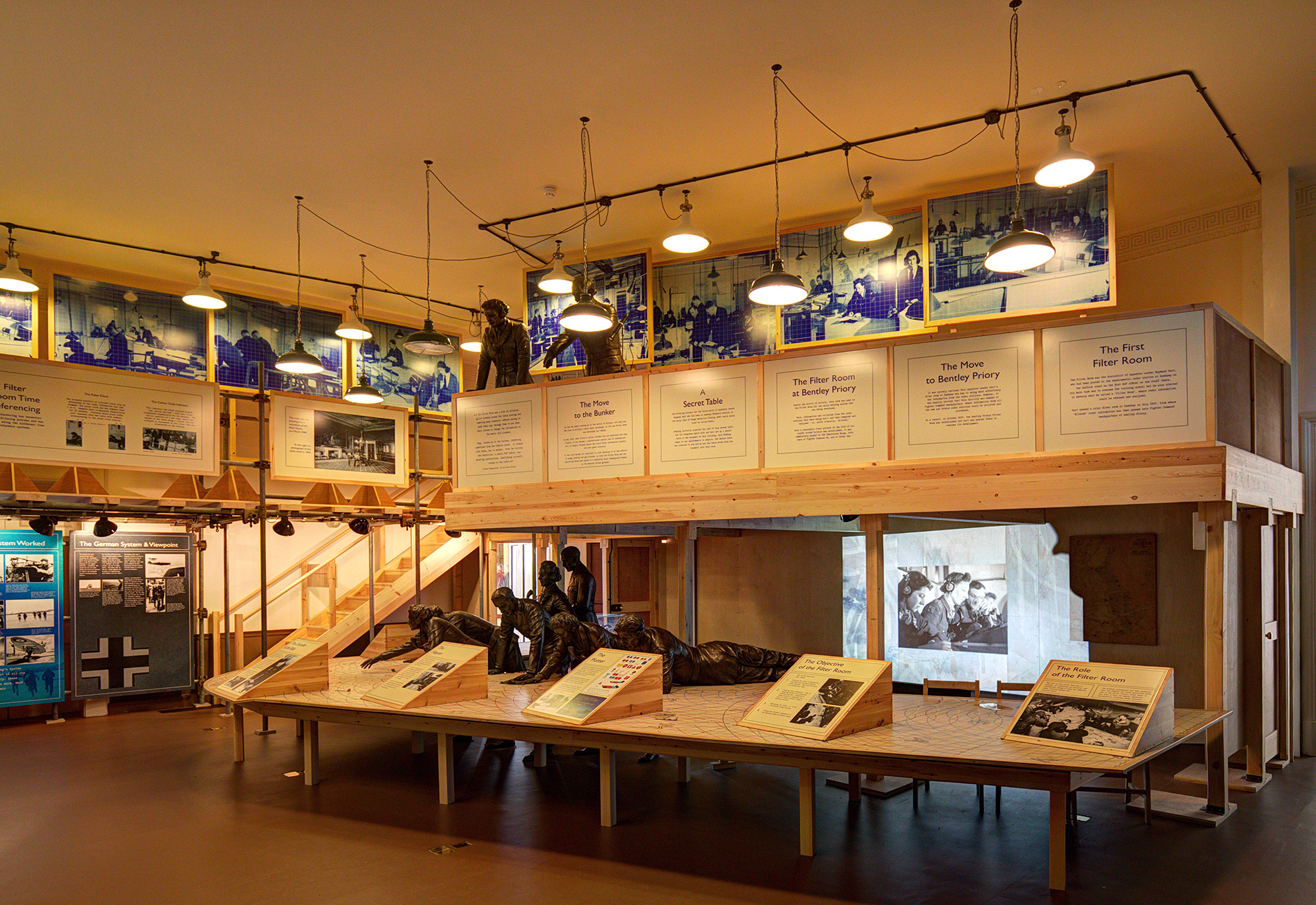
A recreated filter room at Bentley Priory, photographed in May 2015.
David P Howard / Filter Room at Bentley Priory · CC BY-SA 2.0 · Original recordImage changes
Display copies resized; original downloaded JPEG preserved.
The words
Air Defence
Dowding’s despatch speaks of the “Air Defence of Great Britain”: fighters, guns, balloons, radar and observers, all under his command. In 1990 author Derek Wood called this “the key to the system.”
Did you know?
On paper, Dowding decided where every antiaircraft gun defending Britain went. He called this “little more than a convenient fiction”: discussions on gun distribution took “a disproportionate amount” of his time.
Dowding’s despatch, paras. 48 and 57 · Dowding's despatch, p. 4546 (opens a new tab) · RAF Historical Society: Battle Re-Thought (opens a new tab)
Auxiliary
Women of the WAAF served throughout the system: they worked at radar stations, sorted plots in the Filter Room and moved raid counters on operations-room tables.
Did you know?
Dowding singled them out. Of radar stations attacked during the battle, he wrote that “the operating personnel, and particularly the women, behaved with great courage.”
Dowding’s despatch, para. 134 · Bentley Priory Museum: The Many (opens a new tab) · Wikipedia: Women's Auxiliary Air Force (opens a new tab) · RAF Museum: plotting block (opens a new tab) · Dowding's despatch, p. 4551 (opens a new tab)
Dowding
Air Chief Marshal Sir Hugh Dowding led RAF Fighter Command from its creation in 1936 through the Battle of Britain. The warning-and-control network this puzzle explores carries his name.
Did you know?
His son, Derek, flew Spitfires with No. 74 Squadron, this puzzle’s Tiger Squadron, in the battle’s opening weeks, until he was posted away to instruct on August 6, 1940.
Dowding's despatch, p. 4543 (opens a new tab) · RAF Museum: Dowding, Architect of Victory (opens a new tab) · Bentley Priory Museum: Dowding (opens a new tab) · Battle of Britain Memorial: Derek Dowding (opens a new tab)
Filter
In RAF use, sorting raw radar plots into clean tracks: marrying up reports of one raid and canceling obviously bogus ones.
Every radar plot went first to the Filter Room at Fighter Command headquarters, next door to Dowding’s operations room. Cleaned-up tracks then went by direct telephone line to command, groups and sectors at once.
Did you know?
Telling friend from foe was, Dowding wrote, “the most difficult as well as the most important task” of his Filter Room. Liaison officers from Bomber and Coastal Commands were always on duty with details of their own commands’ flights.
Dowding’s despatch, paras. 70–72 · Dowding's despatch, p. 4547 (opens a new tab) · Bentley Priory Museum: The Many (opens a new tab) · Bentley Priory Museum: ops room clock (opens a new tab) · RAF Historical Society: Battle Re-Thought (opens a new tab)
Ground Control
Controllers on the ground talked squadrons through each raid in a code simple enough to memorize (“Orbit” meant circle) until the formation leader sighted the enemy and took charge.
Did you know?
Controllers tracked their own fighters by “Pip-squeak,” a radio signal that selected fighters sent automatically for 15 seconds of every minute. To have a pilot switch it on, the sector asked, “Is your Cockerel crowing?”
Dowding’s despatch, paras. 78 and 81 · Dowding's despatch, p. 4548 (opens a new tab) · RAF Historical Society: Battle Re-Thought (opens a new tab) · Science Museum: TR9D radio (opens a new tab) · Wikipedia: Pip-squeak (opens a new tab)
Interception
A sector commander needed his own fighters’ track as well as the raid’s. With both on his table, Dowding wrote, interceptions came “in a good percentage of occasions by day.”
Did you know?
Night was another matter. Dowding admitted the system’s accuracy was “insufficient to effect interception against night raiders” not lit by searchlights, and the radar-equipped Beaufighters he fought for arrived too late to earn him credit.
Dowding’s despatch, paras. 77–80 · Dowding's despatch, p. 4548 (opens a new tab) · RAF Museum: Dowding, Architect of Victory (opens a new tab)
Observer
Volunteers of the Observer Corps watched and listened from posts across Britain. Dowding wrote that once raiders crossed the coast, the observers “constituted the sole means of tracking enemy raids.”
Did you know?
Their work in the Battle of Britain won royal recognition: on April 9, 1941, King George VI granted the Corps the title “Royal,” a change Dowding’s despatch duly notes.
Dowding’s despatch, para. 58 · Dowding's despatch, p. 4547 (opens a new tab) · English Heritage: Royal Observer Corps (opens a new tab) · Wikipedia: Royal Observer Corps (opens a new tab) · RAF Historical Society: Battle Re-Thought (opens a new tab)
Ops Room
Fighter Command headquarters, each group and each sector had an operations room. Command identified incoming raids, groups chose which sector would meet each one, and sector rooms ordered squadrons up.
Did you know?
On the walls of each group’s operations room, lights showed every squadron’s state at a glance: “Available” meant 20 minutes’ notice, “Readiness” 5 minutes and “stand-by” just 2.
Dowding’s despatch, paras. 61, 68, 75 and 76 · Dowding's despatch, p. 4547 (opens a new tab) · Dowding's despatch, p. 4548 (opens a new tab) · Bentley Priory Museum: ops room clock (opens a new tab)
Plotter
An operations-room worker who used a long rod to place and move counters on the map table as reports came in.
In Dowding’s own operations room, “Plotters” tracked every enemy raid, “whether over the land or sea.” Many were women of the WAAF, this puzzle’s Auxiliary.
Did you know?
The job was older than radar. London’s First World War air defense, set up in 1917 by Major General E. B. Ashmore, already had “a large map table with plotters.”
Dowding’s despatch, para. 61 · Dowding's despatch, p. 4547 (opens a new tab) · RAF Museum: plotting block (opens a new tab) · Wikipedia: Plotter (RAF) (opens a new tab) · RAF Museum: Dowding, Architect of Victory (opens a new tab) · RAF Historical Society: Battle Re-Thought (opens a new tab)
Plotting Table
Every operations room was built around a large map table. Controllers watched counters move across it, seeing each raid’s progress and likely target, and sent fighters to intercept.
Did you know?
Positions were read off an imaginary grid laid over the British Isles and nearby seas: a letter and four digits pinned a point to within about 0.4 square mile (1 square kilometer).
Dowding’s despatch, para. 68 · Dowding's despatch, p. 4547 (opens a new tab) · RAF Museum: plotting block (opens a new tab) · RAF Museum: sector clock (replica) (opens a new tab)
Reporting
Reports reached the operations tables by separate routes from radar stations and Observer Corps posts. Group tables then “told” observer tracks on to Fighter Command headquarters.
Did you know?
Observer Corps “Sea Plotters” received radar tracks and warned coastal posts in each raid’s path. They were not supposed to know anything about radar, author Derek Wood said in 1990, but “an awful lot of them did.”
Dowding’s despatch, paras. 69–71 · Dowding's despatch, p. 4547 (opens a new tab) · RAF Historical Society: Battle Re-Thought (opens a new tab)
Sector Clock
An operations-room wall clock ringed with red, yellow and blue triangles, each marking 5 minutes, to match the colored plotting counters.
Each plot took the color under the minute hand. Dowding wrote that the counters came in three colors so they could be cleared after 15 minutes, avoiding the confusion of “stale plots.”
Did you know?
In 2026, Bentley Priory Museum, at Fighter Command’s former headquarters, holds an original operations-room clock of wood and brass, about 16 inches (40 cm) across, which the museum says would have hung there.
Dowding’s despatch, para. 62 · Dowding's despatch, p. 4547 (opens a new tab) · Bentley Priory Museum: ops room clock (opens a new tab) · RAF Museum: sector clock (replica) (opens a new tab)
Sector Station
Each sector was run from one airfield, its sector station, where the sector commander “operated the machinery of Interception.” No. 11 Group’s sector stations included Hornchurch, home of this puzzle’s Tiger Squadron until mid-August 1940.
Did you know?
Not every sector could locate its fighters by radio. In newer ones, Dowding wrote, controllers ordered exact speeds and courses and plotted the fighters by “Dead Reckoning,” which worked only if winds at various altitudes were “correctly estimated.”
Dowding’s despatch, paras. 75, 79 and 136 · Dowding's despatch, p. 4548 (opens a new tab) · Dowding's despatch, p. 4551 (opens a new tab) · RAF Historical Society: Battle Re-Thought (opens a new tab) · Dowding's despatch, Appendix A, p. 4561 (opens a new tab) · NATO Tiger Association: 74 (F) Squadron (opens a new tab)
Tiger Squadron
No. 74 Squadron earned its “Tigers” nickname in France in 1918. In July 1940 it flew Spitfires from Hornchurch, and under its commanding officer, Adolph “Sailor” Malan, it fought over London and the Thames estuary.
Did you know?
The name outlived the war: in 1961 No. 74 was a founder member of the NATO Tiger Association, and in 1966 it hosted its first Tiger Meet, a gathering of NATO squadrons with a tiger emblem.
NATO Tiger Association: 74 (F) Squadron (opens a new tab) · Wikipedia: No. 74 Squadron RAF (opens a new tab) · Battle of Britain Memorial: Derek Dowding (opens a new tab) · Dowding's despatch, Appendix A, p. 4560 (opens a new tab) · Dowding's despatch, Appendix A, p. 4561 (opens a new tab)
Vectoring
Steering an aircraft onto a compass course given by radio. In the RAF’s code, “Vector 230” meant fly a course of 230 degrees.
Once a raid was tracked, sector controllers radioed the courses that brought squadrons onto the raiders, sparing pilots the tiring, costly standing patrols of 1930s practice.
Did you know?
Height had a code word too: “Angels” plus thousands of feet. When the Germans seemed to be listening, Dowding added a hidden margin, so “Angels 18” really meant 21,000 feet (6,400 m).
Dowding’s despatch, paras. 81–85 · Dowding's despatch, p. 4548 (opens a new tab) · RAF Historical Society: Battle Re-Thought (opens a new tab) · Science Museum: TR9D radio (opens a new tab) · Bentley Priory Museum: ops room clock (opens a new tab)
Sources
- Operations Room ClockBentley Priory Museum
- The Many: Those on the groundBentley Priory Museum
- 74 (F) SquadronNATO Tiger Association
- No. 74 Squadron RAFWikipedia
- Flying Officer Derek Hugh Tremenheere DowdingBattle of Britain Memorial Trust
- Dowding's Battle of Britain despatch, London Gazette supplement 37719, p. 4543The London Gazette
- Dowding's Battle of Britain despatch, London Gazette supplement 37719, p. 4546The London Gazette
- Dowding's Battle of Britain despatch, London Gazette supplement 37719, p. 4547The London Gazette
- Dowding's Battle of Britain despatch, London Gazette supplement 37719, p. 4548The London Gazette
- Dowding's Battle of Britain despatch, London Gazette supplement 37719, p. 4551The London Gazette
- Dowding's Battle of Britain despatch, Appendix A, London Gazette supplement 37719, p. 4560The London Gazette
- Dowding's Battle of Britain despatch, Appendix A, London Gazette supplement 37719, p. 4561The London Gazette
- The One: Air Chief Marshal Sir Hugh DowdingBentley Priory Museum
- Dowding: Architect of Victory (podcast transcript)Royal Air Force Museum
- Plotting Block, Friendly ForcesRoyal Air Force Museum
- Sector Room Clock (Replica)Royal Air Force Museum
- The Battle Re-Thought: A Symposium on the Battle of Britain (June 25, 1990)Royal Air Force Historical Society, hosted by the RAF Museum
- Transmitter/receiver type TR9DScience Museum Group
- Pip-squeakWikipedia
- Women's Auxiliary Air ForceWikipedia
- Royal Observer CorpsWikipedia
- The Royal Observer CorpsEnglish Heritage
- Plotter (RAF)Wikipedia