
Wildlife of the World
Puzzle 73 · Deserts and High Plateaus · Page 110 in print
Saiga Antelope
Saiga antelope roam the grasslands and semi-deserts of Central Asia; the Betpak-Dala population in Kazakhstan suffered a severe mass die-off during the calving season of 2015.
Jump to a word
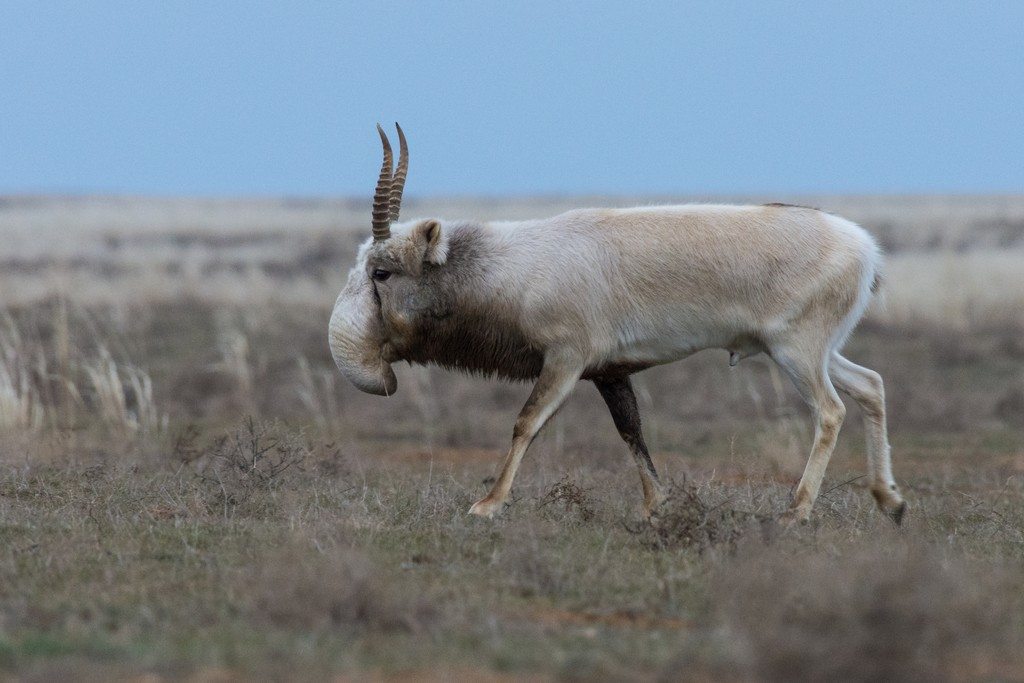
A saiga walks across open ground, its enlarged nose visible.
Species reference for Saiga Antelope. The photograph does not necessarily show the population or place named in the puzzle.
Лариса Артемьева / iNaturalist (CC0) · CC0 1.0 · Original recordImage changes
Resized and converted to JPEG for display; no subject alteration.
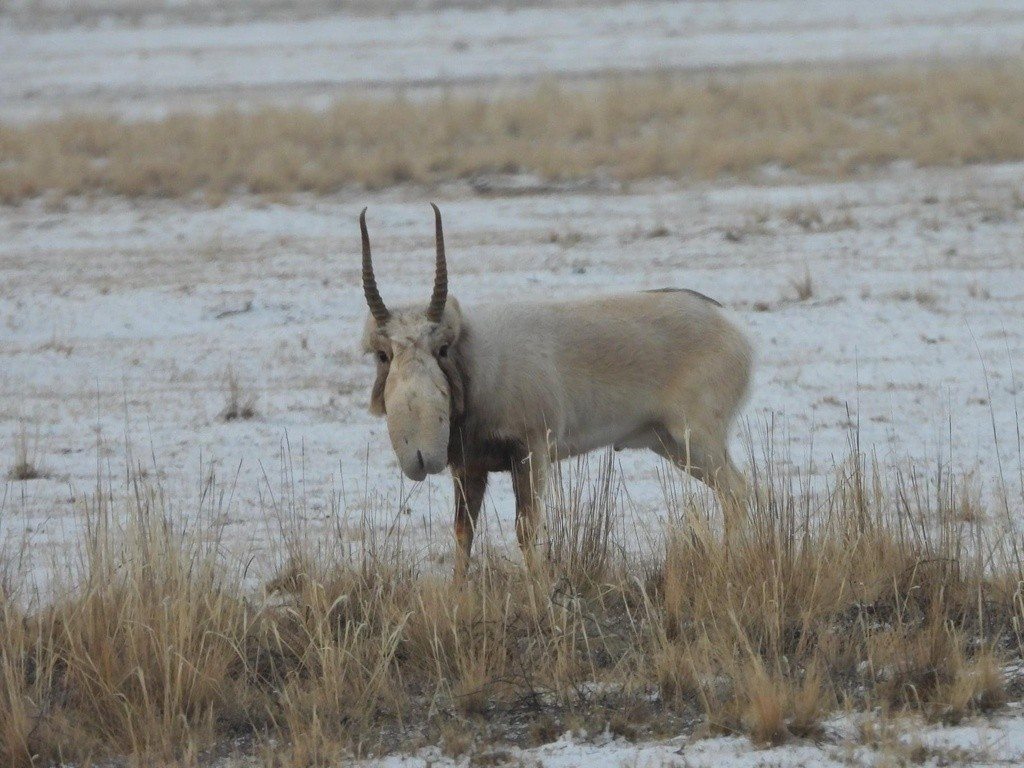
A saiga faces the camera in low grassland.
Species reference for Saiga Antelope. The photograph does not necessarily show the population or place named in the puzzle.
Лариса Артемьева / iNaturalist (CC0) · CC0 1.0 · Original recordImage changes
Resized and converted to JPEG for display; no subject alteration.
The words
Betpak-Dala
A desert plain in central Kazakhstan, between Lake Balkhash and the Chu and Sarysu rivers.
Betpak-Dala gives its name to one of the saiga's five big populations. Its herds were once the world's largest; Kazakhstan's spring 2026 aerial count put them at about 1.87 million.
Did you know?
Tracked from 2009 to 2023, Betpak-Dala's saiga made the species' longest migrations, averaging about 155 miles (250 km) a year, some over 310 miles (500 km). Scientists think the few that survived the 1993–2003 crash kept the memory of the old routes.
Wikipedia: Betpak-Dala (opens a new tab) · CMS Saiga MOU: Saiga antelope (opens a new tab) · CMS Saiga MOU overview report, 2025 (opens a new tab) · CMS: Saiga migration maps, February 2026 (opens a new tab) · CMS fact sheet: Betpak-Dala saiga, 2026 (opens a new tab) · Astana Times: 2026 saiga count (opens a new tab)
Die-Off
In May 2015 more than 200,000 saiga died within three weeks, across an area the size of the British Isles. That was over 60 percent of all the saiga then alive. Most were mothers and calves.
Did you know?
Very large die-offs have struck saiga before, twice in the 1980s, but have no parallel in other large mammals. Measured against the mother's weight, saiga calves are the heaviest newborns on record among hoofed animals, which leaves mothers physically stressed at calving time.
Royal Veterinary College, January 17, 2018 (opens a new tab) · CMS Saiga MOU overview report, 2025 (opens a new tab) · Saiga Alliance: Saiga deaths, May 2015 (opens a new tab) · Kock et al. 2018, Science Advances (opens a new tab)
Dust Filter
The saiga's big, flexible nose hangs down over its mouth and works as a filter. In summer it strains out the dust the herds kick up as they travel the dry steppe.
Did you know?
Both male and female saiga have the big nose. A 2004 study using CT scans and dissection suggested the nose can regulate incoming air so that dust collects just inside the nostrils, cleaning air bound for the lungs.
ADW: Saiga (opens a new tab) · CMS Saiga MOU: Saiga antelope (opens a new tab) · Saiga Alliance: What is a saiga? (opens a new tab) · DigiMorph: Saiga nose (Clifford & Witmer) (opens a new tab) · Yukon Beringia Centre: Saiga antelope (opens a new tab)
Ice Age
Saiga lived through the last Ice Age alongside woolly mammoths, roaming the Mammoth Steppe from England into North America. Afterward they survived for a time in Central and Eastern Europe, dying out in Ukraine in the 18th century.
Did you know?
Fossils suggest saiga crossed the Bering land bridge into Alaska about 40,000 years ago and reached Canada's Mackenzie Delta around 14,000 years ago. Ice Age saiga were about 10 to 15 percent larger than living ones.
WCS: Saiga reclassified, December 12, 2023 (opens a new tab) · NABU: Return of the saiga antelope (opens a new tab) · Yukon Beringia Centre: Saiga antelope (opens a new tab) · DigiMorph: Saiga nose (Clifford & Witmer) (opens a new tab)
Kazakhstan
Kazakhstan holds most of the world's saiga. Official counts rose from about 21,000 in 2003 to 2,833,600 in April 2024 and passed 4.6 million in spring 2026. Since 2023 the government has culled some saiga to limit their numbers.
Did you know?
In 2024 Kazakhstan's Altyn Dala (“Golden Steppe”) Conservation Initiative, which helped bring the saiga back, won a £1 million Earthshot Prize, launched by Prince William. Earlier that year it returned seven Przewalski's horses to the steppe after 200 years.
CMS Saiga MOU overview report, 2025 (opens a new tab) · CMS: Saiga in Kazakhstan, January 2023 (opens a new tab) · Altyn Dala: 2024 saiga aerial census (opens a new tab) · Astana Times: 2026 saiga count (opens a new tab) · CMS: Saiga migration maps, February 2026 (opens a new tab) · Saiga Alliance: Earthshot Prize, 2024 (opens a new tab) · Earthshot Prize: Altyn Dala (2024) (opens a new tab) · WCS: Saiga reclassified, December 12, 2023 (opens a new tab) · IUCN press release, December 11, 2023 (opens a new tab)
Mongolia
Western Mongolia is the only home of the Mongolian saiga. IUCN counts it as a subspecies; two international wildlife treaties, CMS and CITES, treat it as a separate species, Saiga borealis.
Did you know?
In the winter of 2016–17, a virus caught from livestock killed about 60 percent of Mongolia's saiga. The herds have since recovered, to an estimated 23,215 by October 2024.
Saiga Alliance: What is a saiga? (opens a new tab) · CMS Saiga MOU overview report, 2025 (opens a new tab) · Royal Veterinary College, January 17, 2018 (opens a new tab)
Pasteurella
A genus of rod-shaped bacteria; some species cause disease in people and animals.
The saiga that died in 2015 had blood poisoning caused by the bacterium Pasteurella multocida, which had probably lived harmlessly in their tonsils. A 2018 study found that unusually warm, humid weather apparently let the bacteria invade the blood.
Did you know?
The genus name, coined in 1887, honors Louis Pasteur. In 1879 Pasteur made the first laboratory-developed vaccine, against chicken cholera, which is caused by Pasteurella multocida, the species behind the saiga deaths.
Dictionary.com: pasteurella (opens a new tab) · Royal Veterinary College, January 17, 2018 (opens a new tab) · Saiga Alliance: Saiga deaths, May 2015 (opens a new tab) · History of Vaccines: Louis Pasteur (opens a new tab) · Kock et al. 2018, Science Advances (opens a new tab)
Plain
Saiga herds keep to grassy plains, away from rugged ground and hills. The saiga's low-slung head and its gait are built for traveling long distances efficiently over flat land in search of food.
Did you know?
Saiga are fast runners, reaching up to about 50 miles per hour (80 km/h). In summer the herds break into smaller groups; in the fall they gather again to move to their winter grounds.
ADW: Saiga (opens a new tab) · Yukon Beringia Centre: Saiga antelope (opens a new tab) · Saiga Alliance: What is a saiga? (opens a new tab) · CMS Saiga MOU: Saiga antelope (opens a new tab)
Saiga
The saiga is a migratory antelope, about 28 inches (70 cm) at the shoulder; females weigh about 55 pounds (25 kg) and males about 88 pounds (40 kg). Wild herds survive in Kazakhstan, Russia, Uzbekistan and Mongolia.
Did you know?
On December 11, 2023, the IUCN Red List, the global register of threatened species, moved the saiga from Critically Endangered to Near Threatened, a rare improvement. The new category reflects how quickly its status could slip again without continued conservation work.
Saiga Alliance: What is a saiga? (opens a new tab) · WCS: Saiga reclassified, December 12, 2023 (opens a new tab) · Saiga Alliance: Red List change, 2023 (opens a new tab) · CMS Saiga MOU overview report, 2025 (opens a new tab) · IUCN press release, December 11, 2023 (opens a new tab)
Snowstorms
Saiga herds sometimes migrate together to escape snowstorms and droughts. In winter they seek areas with less snow, and in central Kazakhstan how far south they travel depends on how severe the winter is.
Did you know?
A saiga usually cannot dig through snow more than about 12 inches (30 cm) deep to graze. Crusts that form when snow thaws and refreezes also cause trouble; in Kazakhstan such events are called dzhuts.
ADW: Saiga (opens a new tab) · Saiga Alliance: What is a saiga? (opens a new tab) · CMS fact sheet: Betpak-Dala saiga, 2026 (opens a new tab) · Yukon Beringia Centre: Saiga antelope (opens a new tab) · CMS Saiga MOU overview report, 2025 (opens a new tab)
Steppe
The steppe, the vast, mostly treeless grassland stretching from Eastern Europe deep into Asia, is the saiga's home. Saiga belong to it much as bison belong to the prairie, and their grazing helps keep dead plants from piling up.
Did you know?
Grazing saiga fertilize the steppe, spread plant seeds and keep the grass short. Short grass helps hunting birds such as the saker falcon spot their prey, and it makes good habitat for sandgrouse.
Dictionary.com: steppe (opens a new tab) · NABU: Return of the saiga antelope (opens a new tab) · Saiga Alliance: Why saigas matter (opens a new tab)
Ustyurt
A clay-desert tableland between the Caspian and Aral seas, shared by Kazakhstan, Uzbekistan and Turkmenistan.
The Ustyurt Plateau holds the smallest of Kazakhstan's three saiga populations, which once wintered across the border in Uzbekistan. The population fell to about 1,300 animals in 2015; a spring 2026 count put it at about 119,000.
Did you know?
Since 2015, people in Ustyurt villages, former poachers among them, have formed their own wildlife groups and trained rangers to guard the herds, with help from the German conservation group NABU.
Wikipedia: Ustyurt Plateau (opens a new tab) · CMS Saiga MOU: Saiga antelope (opens a new tab) · Altyn Dala: 2024 saiga aerial census (opens a new tab) · NABU: Return of the saiga antelope (opens a new tab) · CMS Saiga MOU overview report, 2025 (opens a new tab) · CMS fact sheet: Ustyurt saiga, 2024 (opens a new tab) · Astana Times: 2026 saiga count (opens a new tab)
Uzbekistan
Uzbekistan had only about 500 saiga in 2023, and its national Red Data list still rated them critically endangered. A border fence, railways and other barriers cut them off from Kazakhstan's herds.
Did you know?
In December 2025, conservationists reported turning an abandoned herders' well on Uzbekistan's Ustyurt Plateau into the country's first solar-powered watering hole for saiga. It runs itself, needing only two brief visits a year.
WCS: Saiga reclassified, December 12, 2023 (opens a new tab) · Saiga Alliance: Red List change, 2023 (opens a new tab) · CMS Saiga MOU overview report, 2025 (opens a new tab) · Saiga Alliance: Uzbek watering hole, 2025 (opens a new tab)
Waxy Horns
Only male saiga grow horns, which are ridged, translucent and waxy-looking. Demand for them in traditional Chinese medicine drove the poaching behind the saiga's crash of about 95 percent in the 1990s.
Did you know?
In 2019 the countries in CITES, the wildlife-trade treaty, stopped commercial exports of wild saiga and their horns. In November 2025, with Kazakhstan's herds much larger, they let Kazakhstan export up to about 22,000 pounds (10,000 kg) of horn a year for three years.
ADW: Saiga (opens a new tab) · Saiga Alliance: What is a saiga? (opens a new tab) · American Heritage Dictionary: saiga (opens a new tab) · CMS Saiga MOU: Saiga antelope (opens a new tab) · Saiga Alliance: Policy and protection (opens a new tab) · CMS Saiga MOU overview report, 2025 (opens a new tab) · WCS: CITES saiga horn decision, 2025 (opens a new tab)
Winter
Steppe winters can drop below −40°F (−40°C). The saiga's coat then grows thicker, longer and paler, and its nose warms the freezing air before it reaches the lungs.
Did you know?
Winter is also the mating season. From late November to late December, breeding males gather and guard harems of females. The calves are born about five months later, in spring, and from their second year females usually bear twins.
Royal Veterinary College, January 17, 2018 (opens a new tab) · ADW: Saiga (opens a new tab) · Saiga Alliance: What is a saiga? (opens a new tab) · CMS Saiga MOU: Saiga antelope (opens a new tab) · CMS fact sheet: Betpak-Dala saiga, 2026 (opens a new tab) · NABU: Return of the saiga antelope (opens a new tab)
Sources
- Update on Saiga Deaths in KazakhstanSaiga Conservation Alliance
- Saiga tataricaConvention on Migratory Species, Saiga MOU
- Saiga tatarica (saiga)Animal Diversity Web, University of Michigan Museum of Zoology
- Saiga Antelope: A Conservation Triumph and Ongoing ChallengesSaiga Conservation Alliance
- Return of the saiga antelopeNABU (Nature And Biodiversity Conservation Union, Germany) (Internet Archive copy)
- “Unprecedented Conservation Triumph”: Saiga Antelope Reclassified From ‘Critically Endangered’ to ‘Near Threatened’ in the IUCN Red List of Threatened SpeciesWildlife Conservation Society
- What is a saiga?Saiga Conservation Alliance
- Why saigas matterSaiga Conservation Alliance
- Saiga policy & protectionSaiga Conservation Alliance
- A New Source of Life: Uzbekistan Installs Its First Solar Powered Watering Hole for SaigaSaiga Conservation Alliance
- SCA member wins 2024 Earthshot prizeSaiga Conservation Alliance
- Altyn Dala Conservation InitiativeThe Earthshot Prize
- Scientists uncover secret of mass mortality event in remote steppe grassland of Central AsiaRoyal Veterinary College, University of London
- Saiga AntelopeYukon Beringia Interpretive Centre, Government of Yukon
- Saiga tatarica, Saiga AntelopeDigiMorph, University of Texas at Austin
- Pasteurella Definition & MeaningDictionary.com
- Steppe Definition & MeaningDictionary.com
- American Heritage Dictionary Entry: saigaThe American Heritage Dictionary of the English Language
- Louis Pasteur, ForMemRSHistory of Vaccines, College of Physicians of Philadelphia
- Betpak-DalaWikipedia
- Ustyurt PlateauWikipedia
- The Current State of Saiga Antelopes in KazakhstanCentral Asian Mammals Initiative, Convention on Migratory Species
- New Maps Reveal Saiga Migrations and Threats Across KazakhstanCentral Asian Mammals Initiative, Convention on Migratory Species
- Saiga Antelope: Betpak-Dala, Kazakhstan (fact sheet)Global Initiative on Ungulate Migration, Convention on Migratory Species
- Saiga Antelope: Ustyurt, Kazakhstan (fact sheet)Global Initiative on Ungulate Migration, Convention on Migratory Species
- Overview Report on Saiga Conservation Status and Saiga MOU Implementation (UNEP/CMS/Saiga/MOS5/Outcome 1)Convention on Migratory Species, Saiga MOU (prepared by ACBK)
- Results from the 2024 saiga aerial census in Kazakhstan are in!Altyn Dala Conservation Initiative
- Kazakhstan’s Saiga Population Surpasses 4.6 MillionThe Astana Times
- Freshwater fish highlight escalating climate impacts on species - IUCN Red ListInternational Union for Conservation of Nature (IUCN)
- Saigas on the brink: Multidisciplinary analysis of the factors influencing mass mortality eventsScience Advances, via the Saiga Resource Centre
- CITES CoP20 Decision Allows International Trade in Saiga Horn, Strongly Opposed by WCSWildlife Conservation Society