
Wildlife of the World
Puzzle 63 · Ocean Giants and Reef Life · Page 97 in print
Whale Shark
The whale shark is the largest fish in the world, reaching lengths of over 12 metres; it feeds by filtering plankton, small fish, and eggs from vast volumes of warm surface water.
Jump to a word
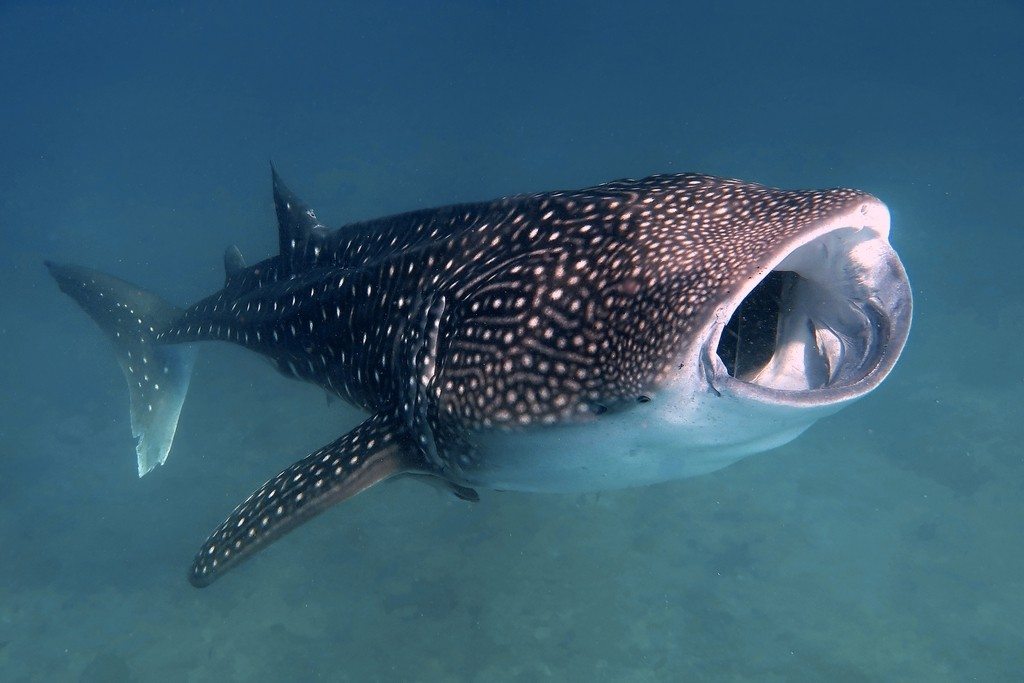
A whale shark swims with its broad mouth open.
Species reference for Whale Shark. The photograph does not necessarily show the population or place named in the puzzle.
(c) Daniel Benák, some rights reserved (CC BY) · CC BY 4.0 · Original recordImage changes
Resized and converted to JPEG for display; no subject alteration.
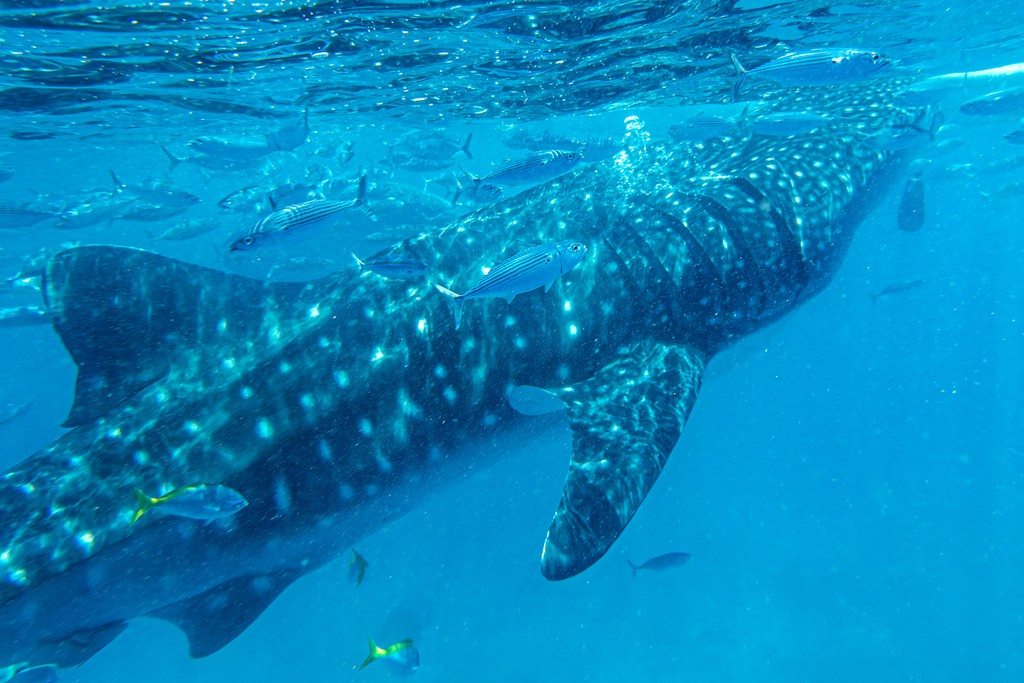
A whale shark's spotted back passes just below the surface in the Philippines.
Species reference for Whale Shark. The photograph does not necessarily show the population or place named in the puzzle.
(c) Dirk Froebel, some rights reserved (CC BY) · CC BY 4.0 · Original recordImage changes
Resized and converted to JPEG for display; no subject alteration.
The words
Checkerboard
The whale shark's markings resemble a checkerboard.
Deep Dives
Whale sharks make mainly daytime deep dives.
Donsol Bay
Donsol Bay in the Philippines is a documented whale shark gathering area.
Filter Feeding
Straining small food from water; whale sharks use this method despite being the world’s largest fish.
Isla Mujeres
Whale sharks are reliably seen near shore at Isla Mujeres, Mexico.
Largest Fish
Whale sharks are the largest fish in the ocean.
Department of Primary Industries and Regional Development (opens a new tab)
Mafia Island
Waters around Mafia Island, Tanzania, are a documented whale shark gathering area.
Mouth
The whale shark's mouth can be a metre across.
Department of Primary Industries and Regional Development (opens a new tab)
Ningaloo
Whale sharks appear at Ningaloo Reef each year after the coral spawning, and most leave Ningaloo after July.
Department of Primary Industries and Regional Development (opens a new tab)
Ram Feeding
In ram filter feeding the shark swims with its mouth open, collecting food.
Rhincodon
The whale shark is Rhincodon typus.
Spawn
Whale sharks arrive at Ningaloo after the mass spawning of coral.
Department of Primary Industries and Regional Development (opens a new tab)
Spot Pattern
Each whale shark's spot pattern is unique, like a fingerprint.
Surface
Whale sharks feed by cruising near the surface.
Department of Primary Industries and Regional Development (opens a new tab)
White Spots
Whale sharks have white spots and stripes on a dark background.
Department of Primary Industries and Regional Development (opens a new tab)
Sources
- Rhincodon Whale Shark (source capture)Animal Diversity Web, University of Michigan Museum of Zoology
- Rhincodon Whale Shark (source capture)Europe PMC (EMBL-EBI) record of Graham et al. 2006, Journal of the Royal Society Interface
- Rhincodon Whale Shark (source capture)PeerJ (peer-reviewed article, Copping et al. 2018), full text via Europe PMC
- Rhincodon Whale Shark (source capture)PLOS ONE (peer-reviewed article, McKinney et al. 2017), full text via Europe PMC
- Rhincodon Whale Shark (source capture)Department of Primary Industries and Regional Development, Government of Western Australia
- Rhincodon Whale Shark (source capture)Georgia Aquarium