
Wildlife of the World
Puzzle 45 · Australasia and Zealandia · Page 71 in print
Quokka Coast
Rottnest Island supports an abundant quokka population. These small marsupials usually shelter in vegetation during the day and forage mainly at night, feeding on leaves, stems and grasses.
Jump to a word
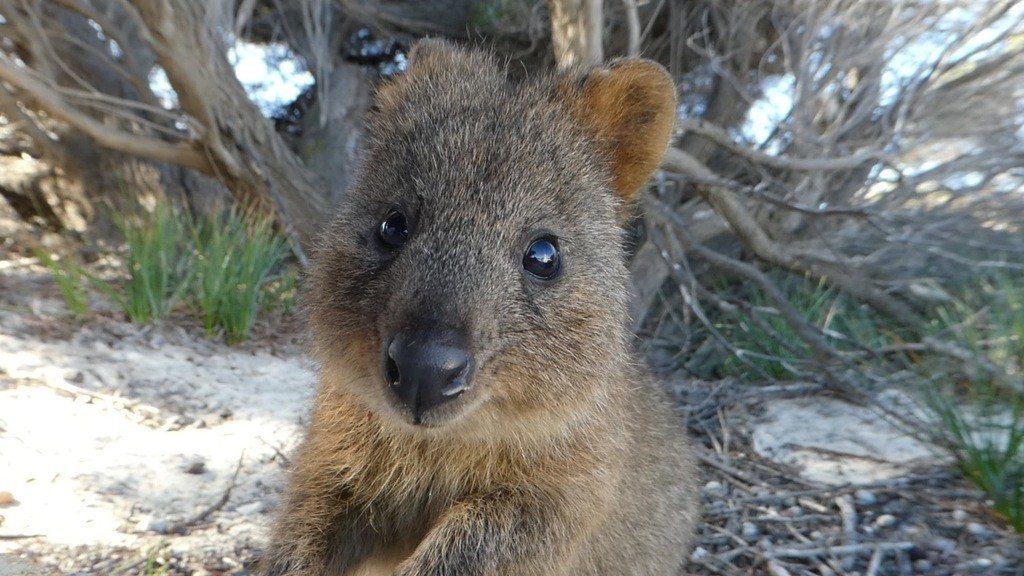
A quokka looks out from beneath low branches.
Species reference for Quokka Coast. The photograph does not necessarily show the population or place named in the puzzle.
(c) Philipp Pavelka, some rights reserved (CC BY) · CC BY 4.0 · Original recordImage changes
Resized and converted to JPEG for display; no subject alteration.
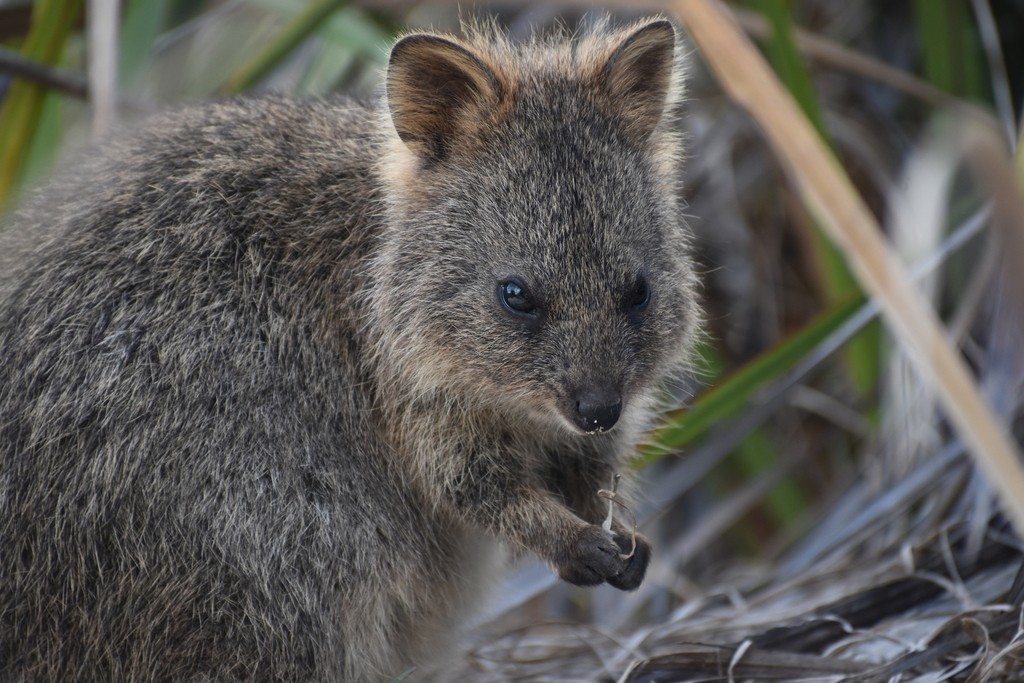
A quokka holds its forepaws close to its chest.
Species reference for Quokka Coast. The photograph does not necessarily show the population or place named in the puzzle.
Astrid Osborne / iNaturalist (CC0) · CC0 1.0 · Original recordImage changes
Resized and converted to JPEG for display; no subject alteration.
The words
Bald Island
The quokka also survives on Bald Island.
WA Dept. of Biodiversity, Conservation and Attractions (opens a new tab)
Foxes
Introduced foxes that hunt it on the mainland.
Quokka declines followed the arrival of the fox.
WA Dept. of Biodiversity, Conservation and Attractions (opens a new tab) · Animal Diversity Web (opens a new tab)
Heath
Quokkas shelter in low dense heath.
WA Dept. of Biodiversity, Conservation and Attractions (opens a new tab)
Jarrah
Mainland quokkas live in patches of Jarrah forest.
WA Dept. of Biodiversity, Conservation and Attractions (opens a new tab)
Joey
After birth the joey moves to its mother's pouch.
Macropod
A member of the kangaroo family.
The quokka is one of the macropods.
Peppermint
Peppermint is a main food in the northern Jarrah forests.
WA Dept. of Biodiversity, Conservation and Attractions (opens a new tab)
Perth
By 1960 mainland quokkas survived in swamps south of Perth.
WA Dept. of Biodiversity, Conservation and Attractions (opens a new tab)
Quokka
A small wallaby of southwestern Australia, including the well-known population on Rottnest Island.
WA Dept. of Biodiversity, Conservation and Attractions (opens a new tab)
Rottnest
The quokka is best known from Rottnest Island, where it is still abundant.
WA Dept. of Biodiversity, Conservation and Attractions (opens a new tab)
Salt Marsh
Quokkas use salt marsh and lakeside areas for refuge.
WA Dept. of Biodiversity, Conservation and Attractions (opens a new tab)
Scrubland
Quokkas move into regrowing scrubland after fire.
Setonix
The quokka is the only species in the genus Setonix.
WA Dept. of Biodiversity, Conservation and Attractions (opens a new tab)
Tea Tree
Mainland quokkas live in tea-tree thickets.
WA Dept. of Biodiversity, Conservation and Attractions (opens a new tab)
Wallaby
The quokka is a small wallaby.
WA Dept. of Biodiversity, Conservation and Attractions (opens a new tab)
Sources
- Quokka Coast (source capture)Department of Biodiversity, Conservation and Attractions, Western Australia
- Quokka Coast (source capture)Department of Biodiversity, Conservation and Attractions, Western Australia
- Quokka Coast (source capture)Animal Diversity Web, University of Michigan Museum of Zoology