
Wildlife of the World
Puzzle 01 · African Plains and Floodplains · Page 13 in print
Serengeti Wildebeest
More than a million wildebeest move through the Serengeti-Mara ecosystem, following seasonal rain and fresh grass across Tanzania and Kenya; their route and timing change with the weather.
Jump to a word
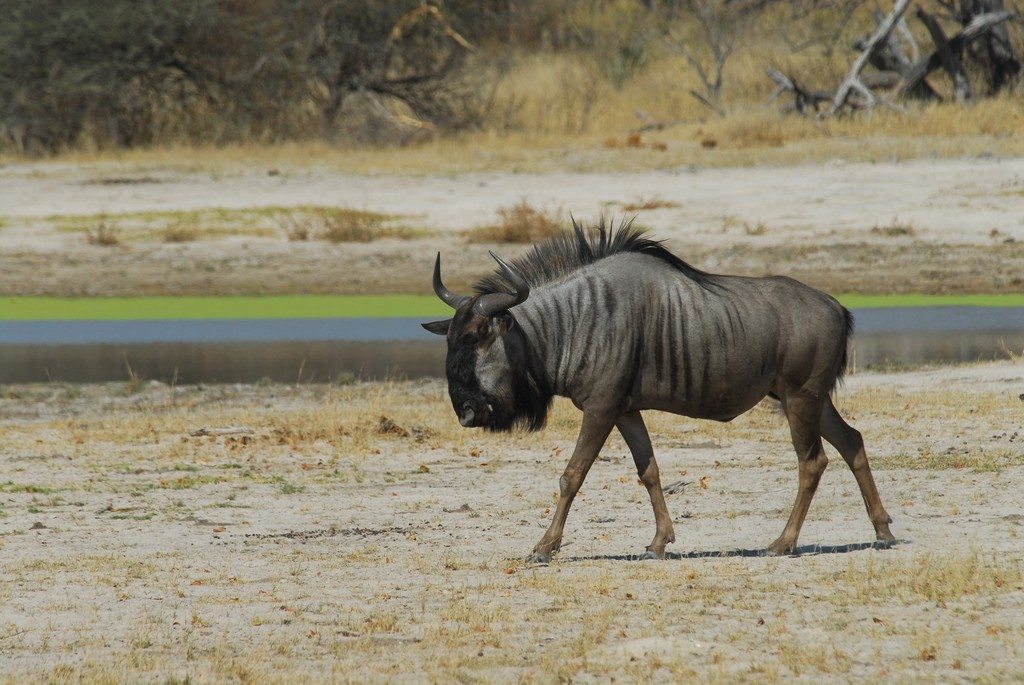
A blue wildebeest walks beside water in Botswana.
Species reference for Serengeti Wildebeest. The photograph does not necessarily show the population or place named in the puzzle.
Philipp / iNaturalist (CC0) · CC0 1.0 · Original recordImage changes
Resized and converted to JPEG for display; no subject alteration.
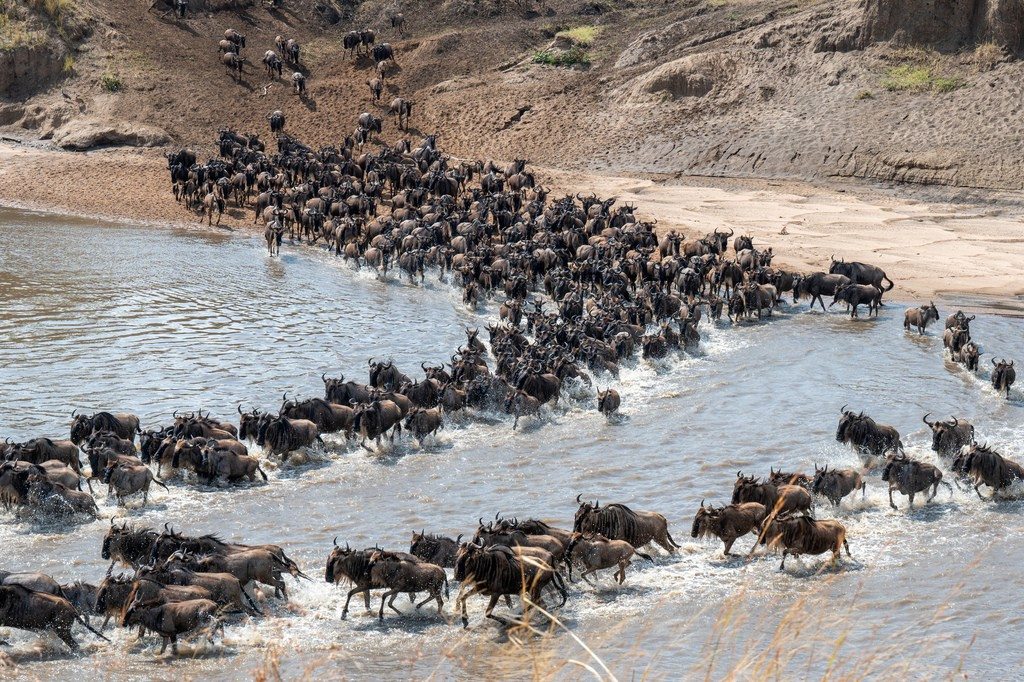
Migrating wildebeest crowd a river crossing in the Serengeti.
Species reference for Serengeti Wildebeest. The photograph does not necessarily show the population or place named in the puzzle.
(c) Dirk Froebel, some rights reserved (CC BY) · CC BY 4.0 · Original recordImage changes
Resized and converted to JPEG for display; no subject alteration.
The words
Calving
Calving opens the migration's year. In the wet season, around the start of the year, the herds gather on the southeastern Serengeti's short-grass plains to give birth, and the great loop begins right after.
Did you know?
About 80 percent of the cows give birth within the same two to three weeks, more newborns than predators can eat, so more calves survive. A calf can stand and nurse about six minutes after birth.
TAWIRI 2023 wildebeest census (opens a new tab) · AWF: Wildebeest (opens a new tab) · ADW: Blue wildebeest (opens a new tab) · San Diego Zoo: Antelope (opens a new tab)
Crossing
At the peak of the migration the herds cross the Mara River several times, and some crossings end in mass drownings of hundreds or thousands of animals.
Did you know?
Scientists think drownings like these may once have fed rivers around the world, when great herds such as bison roamed freely. The Mara River is one of the last places to study them.
Cary Institute: Mara River drownings (opens a new tab) · Subalusky et al. 2017, PNAS (opens a new tab)
Grasses
Grass is the wildebeest's main food, especially fast-growing savanna grasses. By the end of the dry season the herds have nearly exhausted the grazing, and they return to the Serengeti plains as the rains begin.
Did you know?
Thomson's gazelles trail the migrating wildebeest and zebras. The bigger grazers crop the tougher layer of grass and leave the shorter, more tender shoots behind for the gazelles.
ADW: Blue wildebeest (opens a new tab) · AWF: Wildebeest (opens a new tab) · San Diego Zoo: Antelope (opens a new tab)
Grazers
Wildebeest are grazers: they feed on grass, and turn to the leaves of shrubs and trees when grass is scarce. Their grazing and trampling help shape the Serengeti's plant life.
Did you know?
The rinderpest virus once kept the herds small: about 190,000 in 1955. After it disappeared from the Serengeti in the 1960s, numbers passed a million by the late 1970s. A 2009 study found heavier grazing left less grass to burn, so trees began recovering.
ADW: Blue wildebeest (opens a new tab) · San Diego Zoo: Antelope (opens a new tab) · TAWIRI 2023 wildebeest census (opens a new tab) · Holdo et al. 2009, PLOS Biology (opens a new tab)
Grumeti
A Tanzanian game reserve named for the seasonal Grumeti River.
The Grumeti and neighboring Ikorongo game reserves, run as one, border Serengeti National Park within the Serengeti–Mara ecosystem. The migrating herds pass through on their way north to Kenya's Maasai Mara.
Did you know?
In 2019, eastern black rhinos were brought back to the Ikorongo-Grumeti reserves, where the species had been locally extinct for years.
TAWA: Ikorongo-Grumeti Game Reserves (opens a new tab) · Grumeti Fund: Rhinos return (opens a new tab)
Herds
Where wildebeest settle in one area, a herd may be about eight cows and their calves, with territorial bulls among them. On the move, the Serengeti herds form the world's largest single herd of migrating hoofed animals.
Did you know?
Scent glands in a wildebeest's hooves leave the herd's scent on the ground. It helps the animals follow one another on migration, and lets strays find their way back.
ADW: Blue wildebeest (opens a new tab) · TAWIRI 2023 wildebeest census (opens a new tab) · San Diego Zoo: Antelope (opens a new tab)
Horns
Both male and female wildebeest carry curved horns, shaped like a pair of parentheses and thicker in males. Bulls compete for mates in the breeding season, sometimes by sparring.
Did you know?
Wildebeest horns are for defense as well as rivalry. On the move, calves keep close, ringed by adults that can face danger with their horns, and a mother can often drive off a lone hyena or cheetah.
ADW: Blue wildebeest (opens a new tab) · American Heritage Dictionary: gnu (opens a new tab) · San Diego Zoo: Antelope (opens a new tab)
Kenya
North of the border, the ecosystem reaches into southern Kenya, taking in the Maasai Mara National Reserve and the wildlife conservancies to its north and east. In the dry season, many of the herds cross into Kenya.
Did you know?
Kenya has a smaller wildebeest population of its own, which once trekked from the Loita Plains to the Mara. Researchers reported in 2019 that the number migrating fell from over 123,000 in 1977 to under 20,000 in 2016, as fences and farms spread.
TAWIRI 2023 wildebeest census (opens a new tab) · Wu et al. 2023, Nature Communications (opens a new tab) · The Conversation: Ogutu, 2019 (opens a new tab) · Mara Conservancy: Wildebeest migration (opens a new tab)
Maasai Mara
Kenya's Maasai Mara National Reserve adjoins Serengeti National Park across the border. It is the migration's northern stretch: the herds usually arrive in June or July and stay until about November.
Did you know?
In Maa, the Maasai language, mara means “spotted,” usually explained by the short, bushy trees that dot the landscape. A Maa word for “the spotted one” also names the leopard and, rarely, the cheetah.
Mara Conservancy: Wildebeest migration (opens a new tab) · Wikipedia: Maasai Mara (opens a new tab) · Payne and Ole-Kotikash, Maa Dictionary (opens a new tab)
Mara River
The Mara River is the main source of fresh water for wildlife in the Serengeti–Mara, and it lies right across the migration's path before flowing on to Lake Victoria.
Did you know?
A 2017 study found that over 6,000 wildebeest drown in the river in an average year, like adding ten blue whale carcasses. Fish and scavengers eat the soft tissue, and the bones feed the river for seven years or more.
Cary Institute: Mara River drownings (opens a new tab) · Subalusky et al. 2017, PNAS (opens a new tab)
Migration
The migration is the herds' yearly loop between Tanzania's southern Serengeti and Kenya's Maasai Mara. Scientists count it among the largest overland migrations left on Earth.
Did you know?
Estimates of the yearly loop run from about 500 to 1,000 miles (800–1,610 km). Yet Tanzania's 2023 census report says most wildebeest walk about 1,550 miles (2,500 km) a year, as they track seasonal changes in vegetation.
Wu et al. 2023, Nature Communications (opens a new tab) · Cary Institute: Mara River drownings (opens a new tab) · Subalusky et al. 2017, PNAS (opens a new tab) · TAWIRI 2023 wildebeest census (opens a new tab) · AWF: Wildebeest (opens a new tab)
Rains
Rain sets the migration's clock. On the Serengeti the wet season runs from about November to May, with the heaviest rain from March to May; June to October is dry.
Did you know?
In a 2009 computer model run on Serengeti rainfall, the simulated herds migrated only if they could track changes in grazing more than 50 to 60 miles (80–100 km) away. Going by nearby grass alone, they failed to migrate.
TAWIRI 2023 wildebeest census (opens a new tab) · Holdo et al. 2009, American Naturalist (opens a new tab)
Serengeti
The Serengeti is a plain in northern Tanzania, home to Serengeti National Park. Its ecosystem, which reaches into Kenya, is defined partly by where the migrating herds go.
Did you know?
In 2023, researchers reported software that picked out nearly 500,000 animals, mostly wildebeest, in six sets of satellite images of the Serengeti–Mara taken from 2009 to 2020. Each wildebeest was only 3 or 4 pixels long.
Dictionary.com: Serengeti (opens a new tab) · TAWIRI 2023 wildebeest census (opens a new tab) · Wu et al. 2023, Nature Communications (opens a new tab)
Tanzania
Tanzania, formed in 1964 when Tanganyika and Zanzibar united, holds the ecosystem's southern part: Serengeti National Park, the Ngorongoro Conservation Area, and game reserves such as Grumeti and Maswa.
Did you know?
In March 2023, Tanzania's wildlife researchers carried out the 25th aerial count of the herds. A camera in the floor of a small plane flying 1,000 feet (305 m) up took 4,527 photos, and volunteers counted each one three times.
American Heritage Dictionary: Tanzania (opens a new tab) · TAWIRI 2023 wildebeest census (opens a new tab)
Wildebeest
Wildebeest, a kind of antelope, make up the great Serengeti–Mara herds; these are the western white-bearded race. Tanzania's 2023 aerial count put the migrating herd at about 1.37 million.
Did you know?
“Wildebeest” came into English around 1830–40 from Afrikaans wildebees, from Dutch for “wild beast.” Its other name, gnu, is older, from the 1770s; dictionaries trace it to Khoikhoi or San words, probably first naming the black wildebeest.
AWF: Wildebeest (opens a new tab) · TAWIRI 2023 wildebeest census (opens a new tab) · Dictionary.com: wildebeest (opens a new tab) · Dictionary.com: gnu (opens a new tab) · American Heritage Dictionary: gnu (opens a new tab)
Sources
- Connochaetes taurinus (blue wildebeest)Animal Diversity Web, University of Michigan Museum of Zoology
- Wildebeest feast: Mass drownings fuel the Mara River ecosystemCary Institute of Ecosystem Studies
- Aerial Point Survey of Wildebeest in the Greater Serengeti Ecosystem, Wet Season 2023Tanzania Wildlife Research Institute (Internet Archive copy)
- WildebeestAfrican Wildlife Foundation
- Annual mass drownings of the Serengeti wildebeest migration influence nutrient cycling and storage in the Mara RiverProceedings of the National Academy of Sciences, via Europe PMC
- Opposing rainfall and plant nutritional gradients best explain the wildebeest migration in the SerengetiThe American Naturalist, via Europe PMC
- A Disease-Mediated Trophic Cascade in the Serengeti and its Implications for Ecosystem CPLOS Biology
- Deep learning enables satellite-based monitoring of large populations of terrestrial mammals across heterogeneous landscapeNature Communications
- AntelopeSan Diego Zoo Wildlife Alliance
- Wildebeest Definition & MeaningDictionary.com
- Gnu Definition & MeaningDictionary.com
- American Heritage Dictionary Entry: gnuThe American Heritage Dictionary of the English Language
- Serengeti Definition & MeaningDictionary.com
- American Heritage Dictionary Entry: TanzaniaThe American Heritage Dictionary of the English Language
- Ikorongo and Grumet Game Reserves (TAWA attraction details)Tanzania Wildlife Management Authority
- Every Rhino Represents HopeGrumeti Fund
- Wildebeest migrations in East Africa face extinction. What must be doneThe Conversation
- Wildebeest MigrationMara Conservancy
- Maasai MaraWikipedia
- Maa (Maasai) Dictionary: MDoris L. Payne and Leonard Ole-Kotikash, University of Oregon