
The Space Race
Puzzle 56 · The Road to the Moon · Page 80 in print
Recovery at Sea
A 350-pound cake, baked in their honor, awaited Apollo 9’s crew aboard their ship.
Jump to a word
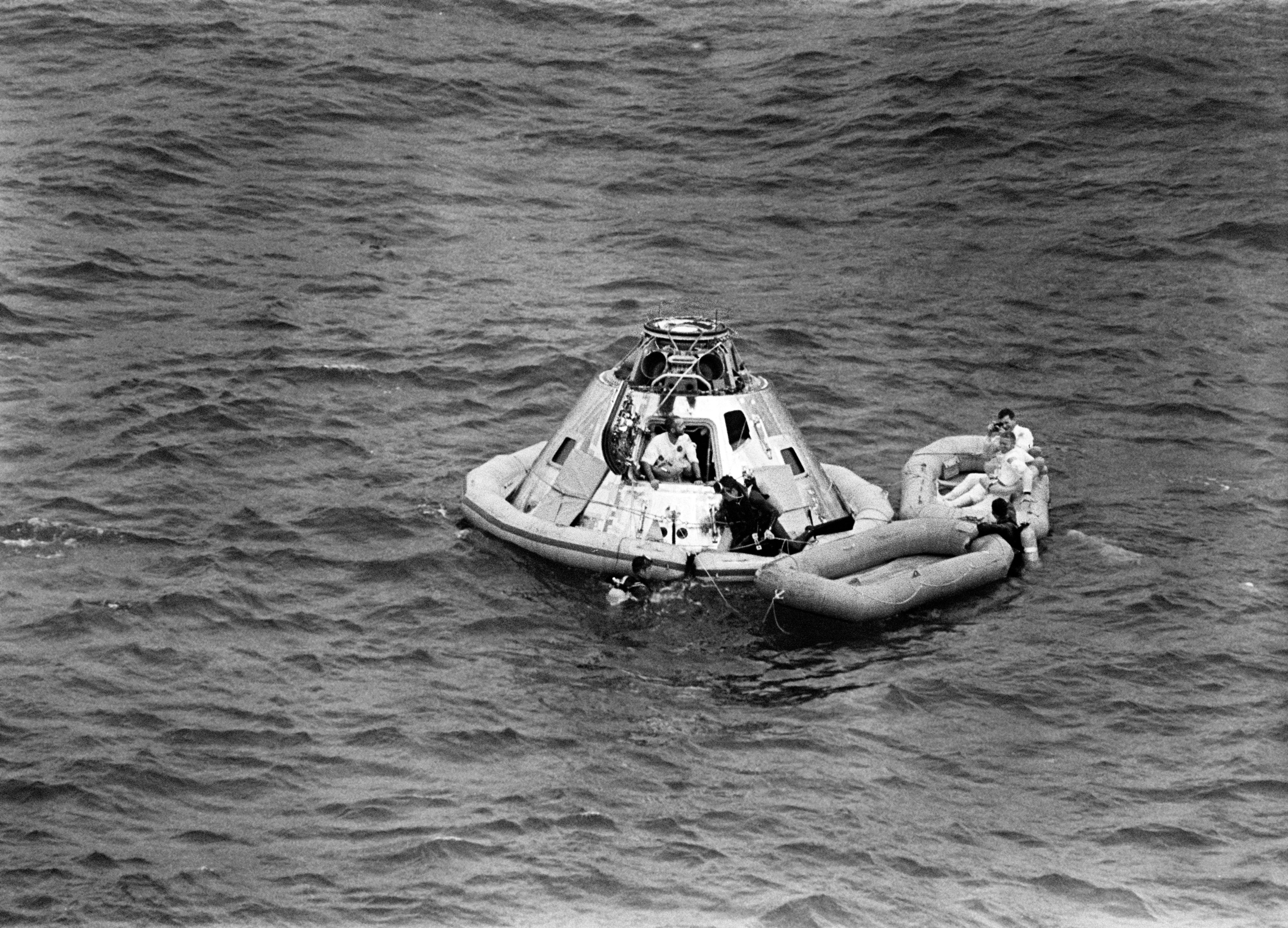
The Apollo 9 crew awaits helicopter recovery beside the floating command module.
NASA / Johnson Space Center (S69-27746) · NASA media-use guidelines · Original recordThe words
Air Boss
Air Boss was a radio call sign for a recovery aircraft. During Apollo 8’s descent, an E-1B carrying that name established voice contact with the astronauts.
Apollo 8 report, pp. 9-4, 9-6 · NASA report: Apollo 8 at splashdown (opens a new tab)
Beacon
Recovery helicopters carried radio receivers that could home on a signal from the capsule. The beacon helped crews locate the spacecraft even when it was hard to see.
Navy press kit, glossary · Navy: recovery roles and equipment (opens a new tab)
Carrier
USS Guadalcanal was Apollo 9’s prime recovery ship. On March 13, 1969, it received McDivitt, Scott and Schweickart after their Atlantic splashdown.
Did you know?
Guadalcanal also carried a quarantine trailer for a rehearsal using stand-ins. The actual Apollo 9 crew visited the participants through its window.
Daylight
Recovery teams waited for first light after Apollo 8’s nighttime splashdown. A prearranged rule allowed immediate help if needed, but otherwise delayed the pickup until daylight.
Apollo 8 report, p. 9-4 · NASA report: Apollo 8 at splashdown (opens a new tab)
Dye Marker
Sea dye spread a yellowish-green patch around the capsule, making it easier to spot from the air. It complemented radio beacons and flashing lights used to guide recovery teams.
Did you know?
Heflin’s team tested recovery equipment with an Apollo mockup aboard an old landing craft. Trips into the Gulf of Mexico supplied real sea conditions.
Heflin interview, p. 4 · Heflin: testing recovery equipment (opens a new tab)
Frogmen
Frogmen were Navy Underwater Demolition Team swimmers who worked beside floating capsules. They helped secure spacecraft with flotation collars and assisted crews during sea recovery.
Helicopter
After Apollo 7 splashed down, a recovery helicopter lifted Schirra, Eisele and Cunningham aboard. It flew the crew to USS Essex, where sailors welcomed them.
Hoist
Shipboard hoisting equipment lifted the command module out of the sea. Bringing the crew aboard and retrieving their heavy spacecraft were separate parts of the recovery.
Navy press kit, recovery procedures · Navy: recovery roles and equipment (opens a new tab)
Red Carpet
Borman, Lovell and Anders stepped onto a red carpet aboard USS Yorktown after Apollo 8’s Pacific recovery. The three astronauts waved to cheering sailors on the carrier’s flight deck.
Did you know?
The recovery ship served the Apollo 8 crew steak and eggs for breakfast. NASA’s photograph shows Borman, Lovell and Anders eating together after their return.
NASA, Man Around the Moon, pp. 20, 24 · NASA: Apollo 8’s welcome aboard Yorktown (opens a new tab)
Rescue Net
The Billy Pugh rescue net was a rope cage used to lift astronauts from a life raft into a recovery helicopter. It supported each man during the ride.
Navy press kit, glossary · Navy: recovery roles and equipment (opens a new tab)
Sea Anchor
A device shaped like a small parachute that resists movement through water.
The sea anchor slowed a capsule’s downwind drift. That gave recovery swimmers a better chance to catch up with the floating spacecraft and work beside it.
Navy press kit, recovery procedures · Navy: recovery roles and equipment (opens a new tab)
Stable Two
The capsule’s upside-down floating position, with its pointed end submerged.
Apollo 8’s flashing light disappeared from view and its beacon signal was lost in Stable II. Inflatable bags then brought the capsule back upright.
Apollo 8 report, pp. 7-22, 9-4 · NASA report: Apollo 8 at splashdown (opens a new tab)
Stullken
Donald E. Stullken led NASA’s recovery team for Apollo 11. He invented the inflatable collar that swimmers attached to the capsule to help keep it afloat.
Task Force
Navy Task Force 140 organized Atlantic recovery operations, while Task Force 130 covered the Pacific. Their commands coordinated ships, aircraft and trained recovery teams for each mission.
Navy press kit, recovery forces · Navy: recovery roles and equipment (opens a new tab)
Uprighting
Uprighting used inflatable bags to return a nose-down capsule to a nose-up position. Apollo 7 demonstrated that step before the crew was lifted to USS Essex.
Sources
- Apollo 7 Ends, “101% Successful”John Uri; NASA Johnson Space Center; October 22, 2018; splashdown, flotation bags and helicopter transfer to USS Essex; original URL redirects to the readable article
- 50 Years Ago: Apollo 9 Completes its MissionJohn Uri; NASA Johnson Space Center; March 13, 2019; USS Guadalcanal recovery, cake and separate quarantine rehearsal
- Apollo 8—Man Around the MoonNASA; 1969; Homeward Bound, p. 20 (PDF p. 22), and photograph 13 caption, p. 24 (PDF p. 26); original pages visually inspected
- 50 Years Ago: Apollo 11 Passes Countdown TestJohn Uri; NASA Johnson Space Center; July 2, 2019; Hornet recovery preparations, UDT swimmers and Donald E. Stullken’s collar
- Apollo 16 Press KitManned Spacecraft Recovery Force, Atlantic, Task Force 140; 1972; Navy Spacecraft Recovery, PDF p. 6; Recovery Procedures, PDF pp. 12–13; Glossary, PDF pp. 83–85; NASA NTRS copy
- Apollo 8 Mission ReportNASA Manned Spacecraft Center, MSC-PA-R-69-1; February 1969; pp. 7-22, 9-4 and 9-6 (PDF pp. 214, 235 and 237), entry and landing, recovery and aircraft reception
- J. Milton Heflin Oral History Interview, March 9, 1998Interview by Michelle Kelly; NASA Johnson Space Center Oral History Project; March 9, 1998; p. 4, yellowish-green sea dye and Gulf of Mexico recovery-equipment tests