
The Great Stories of the Old Testament
Puzzle 79 · Wisdom and Poetic Books · Page 115 in print
Vanity of Vanities
The Preacher examines toil, pleasure and wisdom under the recurring image of vanity: what lasting gain do human pursuits yield?
Jump to a word
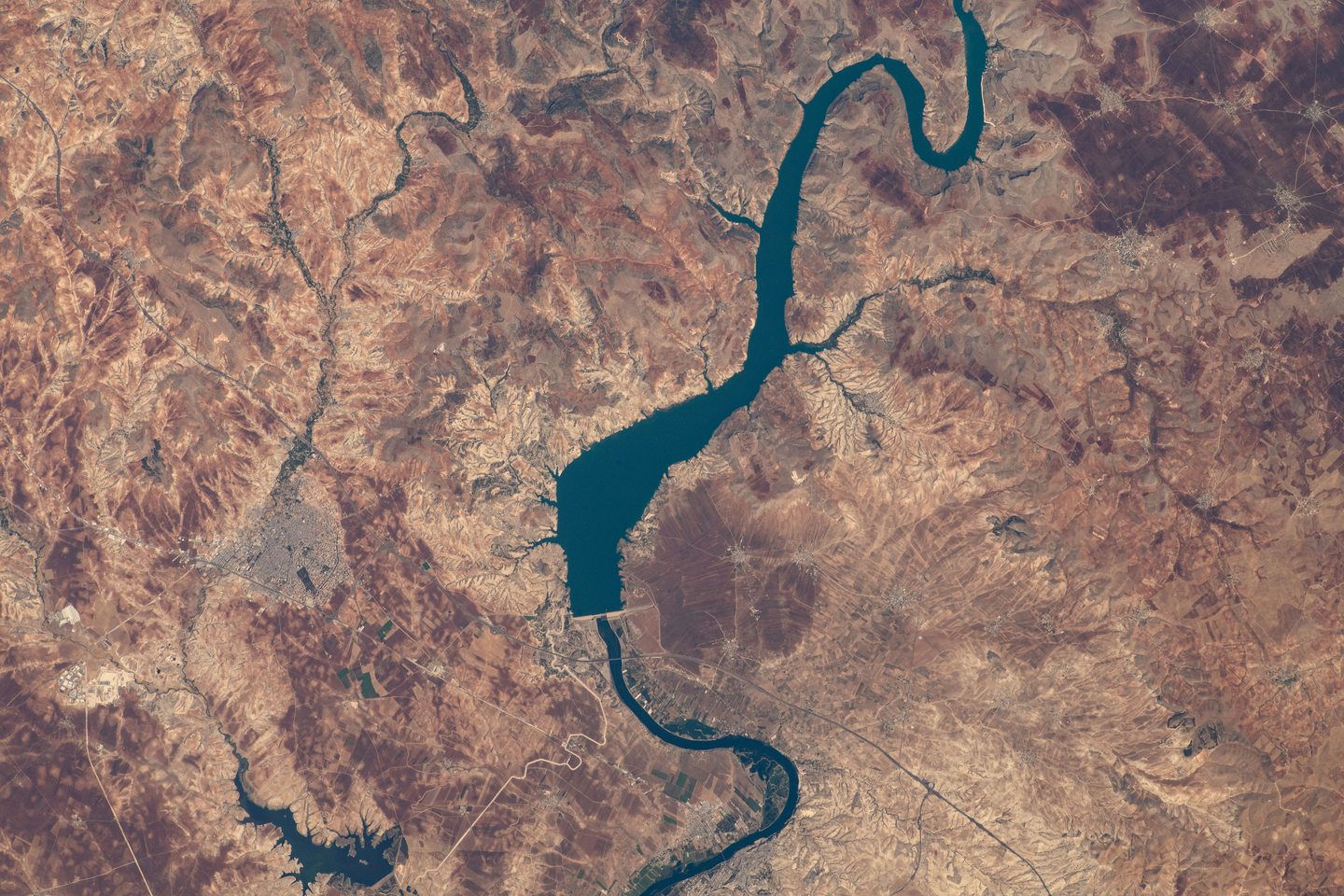
Euphrates River from the International Space Station.
The river photograph connects with the Preacher’s observation that rivers keep running to the sea.
NASA / Kjell Lindgren · NASA media guidelines · Original recordImage changes
Resized proportionally to at most 1440px and JPEG compressed; no crop or content alteration.
The words
Crooked
Wanting means lacking or missing, in the NET note.
What is crooked cannot be made straight, the Preacher says, pairing it with the observation that what is wanting cannot be numbered.
Ecclesiastes 1:15 (opens a new tab) · NET Bible: Ecclesiastes 1:12-18 (opens a new tab)
Ecclesiastes
The book opens with the Preacher’s words, identifying him as a son of David and king in Jerusalem.
Did you know?
The NET note traces the English title Ecclesiastes to a Greek term meaning member of the assembly.
Ecclesiastes 1:1 (opens a new tab) · NET Bible: Ecclesiastes 1:1-11 (opens a new tab)
Folly
The Preacher says wisdom exceeds folly like light over darkness, yet observes that the wise and foolish alike die.
Generation
A generation passes and another comes, while the earth abides; the following verses picture the sun, wind and rivers in motion.
Laughter
In the test of pleasure, the Preacher calls laughter “mad” and asks what mirth accomplishes, questioning the value of the experiment.
Madness
Madness and folly are rendered foolish behavior and ideas in the NET.
The Preacher sets out to know wisdom, madness and folly, then describes this pursuit too as vexation of spirit.
Ecclesiastes 1:17 (opens a new tab) · NET Bible: Ecclesiastes 1:12-18 (opens a new tab)
Mirth
Pleasure, in the NET’s rendering.
Mirth is tested and called vanity; later the Preacher also describes enjoying good in work as coming from the hand of God.
Ecclesiastes 2:1–2 (opens a new tab) · Ecclesiastes 2:24 (opens a new tab) · NET Bible: Ecclesiastes 2:1-11 (opens a new tab)
New Thing
The Preacher says there is “no new thing under the sun,” then asks whether anything called new has not already existed.
Preacher
Teacher, in the NET’s rendering.
The Preacher describes his search through wisdom, surveying works done under the sun before judging them vanity and vexation of spirit.
Did you know?
Near the book’s close, the Preacher is also described as teaching knowledge and arranging many proverbs.
Ecclesiastes 1:12–14 (opens a new tab) · NET Bible: Ecclesiastes 1:1-11 (opens a new tab) · Ecclesiastes 12:9–10 (opens a new tab)
Profit
The opening asks what profit comes from labor under the sun; after reviewing his works, the Preacher reports no profit from them.
Ecclesiastes 1:3 (opens a new tab) · Ecclesiastes 2:11 (opens a new tab)
Rivers
The rivers run into a sea that is never full; the verse pictures their returning flow among the chapter’s repeated motions.
Sorrow
The Preacher pairs much wisdom with much grief, then says that whoever increases knowledge increases sorrow, closing this stage of the inquiry.
Vanity
Futility, in the NET’s rendering.
Vanity frames the opening claim and returns after the survey of works, beside vexation of spirit and the question of profit.
Did you know?
The NET note traces hevel to breath or vapor, images that help explain the word’s range of figurative senses.
Ecclesiastes 1:2 (opens a new tab) · Ecclesiastes 1:14 (opens a new tab) · Ecclesiastes 2:11 (opens a new tab) · NET Bible: Ecclesiastes 1:1-11 (opens a new tab)
Vexation
Chasing the wind, in the NET’s rendering of the phrase.
The Preacher calls his survey of work “vanity and vexation of spirit,” placing frustration beside the search for gain.
Ecclesiastes 1:14 (opens a new tab) · Ecclesiastes 2:11 (opens a new tab) · NET Bible: Ecclesiastes 1:12-18 (opens a new tab)
Wind
The wind turns south and north, whirling continually and returning on its circuits, one of the chapter’s pictures of repeated motion.
Sources
- Ecclesiastes 1:1-11 (King James Version)King James Version, passage navigation via Bible Gateway
- Ecclesiastes 1:12-18 (King James Version)King James Version, passage navigation via Bible Gateway
- Ecclesiastes 2:1-11 (King James Version)King James Version, passage navigation via Bible Gateway
- Ecclesiastes 2:12-26 (King James Version)King James Version, passage navigation via Bible Gateway
- Ecclesiastes 12:9-10 (King James Version)King James Version, passage navigation via Bible Gateway
- Ecclesiastes 1:1-11 (NET Bible), translation and notesNET Bible, via Bible Gateway
- Ecclesiastes 1:12-18 (NET Bible), translation and notesNET Bible, via Bible Gateway
- Ecclesiastes 2:1-11 (NET Bible), translation and notesNET Bible, via Bible Gateway