
The Great Stories of the Old Testament
Puzzle 70 · The Twelve · Page 103 in print
Micah and Bethlehem Ephratah
Micah joins the promise of a ruler from Bethlehem with an account of restored strength and a concise statement of faithful conduct.
Jump to a word
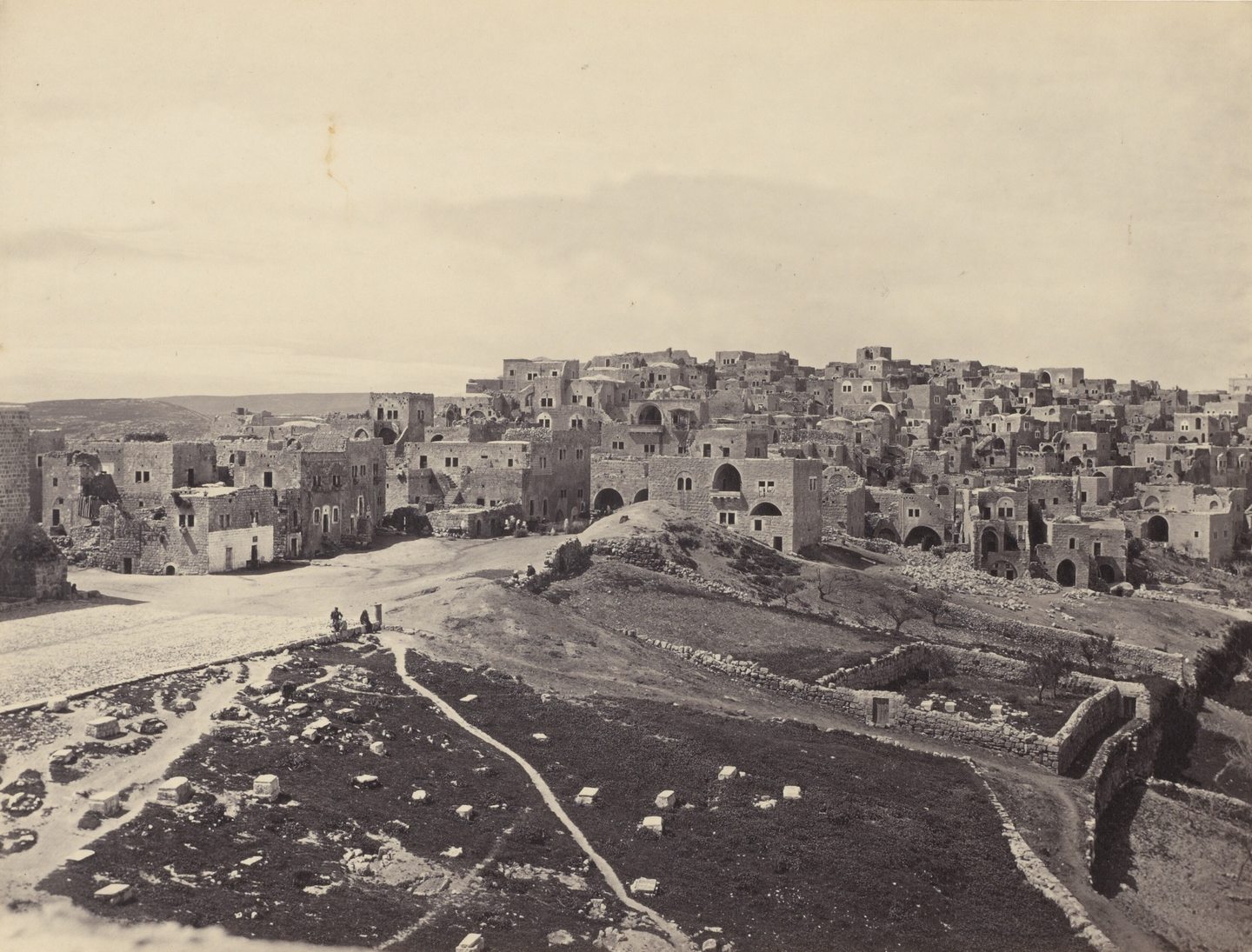
Bethlehem, from the Latin Convent.
The later town view directly connects with Bethlehem named in the ruler prophecy.
Francis Frith · CC0 1.0 · Original recordImage changes
Resized proportionally to at most 1440px and JPEG compressed; no crop or content alteration.
The words
Assyrian
The prophecy anticipates an Assyrian invasion and deliverance; its response includes laying waste Assyria and Nimrod’s land with the sword.
Bethlehem
Micah addresses Bethlehem Ephratah as small among Judah’s groups, yet says a ruler in Israel will come from it.
Did you know?
Matthew 2:4–6 later quotes the prophecy in the reply to Herod’s question about where Christ should be born.
Micah 5:2 (opens a new tab) · Matthew 2:4–6 (opens a new tab)
Do Justly
Carry out justice, in the NET.
After questions about offerings, including a firstborn child for sin, Micah’s answer names doing justly, loving mercy and walking humbly.
Micah 6:6–8 (opens a new tab) · NET Bible: Micah 6:8 (opens a new tab)
Ephratah
Ephrathah, the NET’s spelling.
The NET note treats Ephratah as either another name for Bethlehem or the district in which Bethlehem was located.
Micah 5:2 (opens a new tab) · NET Bible: Micah 5:2 (opens a new tab)
Love Mercy
Micah places loving mercy between doing justly and walking humbly with God; the NET expresses it as “love faithfulness.”
Did you know?
The NET note offers “love faithfully” as another rendering, making faithfulness describe the act of loving.
Micah 6:8 (opens a new tab) · NET Bible: Micah 6:8 (opens a new tab)
Micah
The opening places Micah’s message about Samaria and Jerusalem in the reigns of Jotham, Ahaz and Hezekiah, kings of Judah.
Peace
The KJV calls the coming figure “the peace,” then describes the Assyrian entering the land; the NET renders it “He will give us peace.”
Micah 5:5 (opens a new tab) · NET Bible: Micah 5:5 (opens a new tab)
Principal Men
Commanders, in the NET.
The eight principal men are raised alongside seven shepherds when the Assyrian enters the land and treads within its palaces.
Micah 5:5 (opens a new tab) · NET Bible: Micah 5:5 (opens a new tab)
Remnant
Survivors from Jacob, in the NET.
Jacob’s remnant receives two comparisons in successive verses: dew and showers among many peoples, then a lion among the nations.
Micah 5:7–8 (opens a new tab) · NET Bible: Micah 5:7-8 (opens a new tab)
Ruler
The ruler from Bethlehem has goings forth “from everlasting” in the KJV; the NET renders his origins “in the distant past.”
Micah 5:2 (opens a new tab) · NET Bible: Micah 5:2 (opens a new tab)
Shepherds
Shepherd-rulers, in the NET.
The response to the Assyrian calls for seven shepherds and eight principal men, followed by a promise of deliverance from the invasion.
Did you know?
The NET note explains the seven/eight pair as a way to express completeness and more than enough strength against the invader.
Micah 5:5–6 (opens a new tab) · NET Bible: Micah 5:5 (opens a new tab)
Showers
Micah compares the remnant to dew and showers on grass, describing rain that does not wait for human beings.
Thousands
Clans, in the NET’s wording.
The promised ruler comes from Bethlehem despite its small standing among Judah’s groups; the KJV names those groups “thousands.”
Micah 5:2 (opens a new tab) · NET Bible: Micah 5:2 (opens a new tab)
Walk Humbly
The KJV closes the reply with “walk humbly with thy God”; the NET reads “live obediently before your God.”
Micah 6:8 (opens a new tab) · NET Bible: Micah 6:8 (opens a new tab)
Young Lion
The remnant is pictured as a young lion among sheep, trampling and tearing; the next verse says its enemies will be cut off.
Sources
- Micah 1:1 (King James Version)King James Version, passage navigation via Bible Gateway
- Micah 5:1-4 (King James Version)King James Version, passage navigation via Bible Gateway
- Micah 5:5-9 (King James Version)King James Version, passage navigation via Bible Gateway
- Micah 6:6-8 (King James Version)King James Version, passage navigation via Bible Gateway
- Micah 5:2 (NET Bible), translation and notesNET Bible, via Bible Gateway
- Micah 5:5 (NET Bible), translation and notesNET Bible, via Bible Gateway
- Micah 5:7-8 (NET Bible), translation and notesNET Bible, via Bible Gateway
- Micah 6:8 (NET Bible), translation and notesNET Bible, via Bible Gateway
- Matthew 2:1-6 (King James Version)King James Version, passage navigation via Bible Gateway