
The Great Stories of the Old Testament
Puzzle 69 · The Twelve · Page 102 in print
Amos and the Plumbline
Amos’s visions measure Israel’s condition, while his exchange with Amaziah insists that his call came from the Lord.
Jump to a word
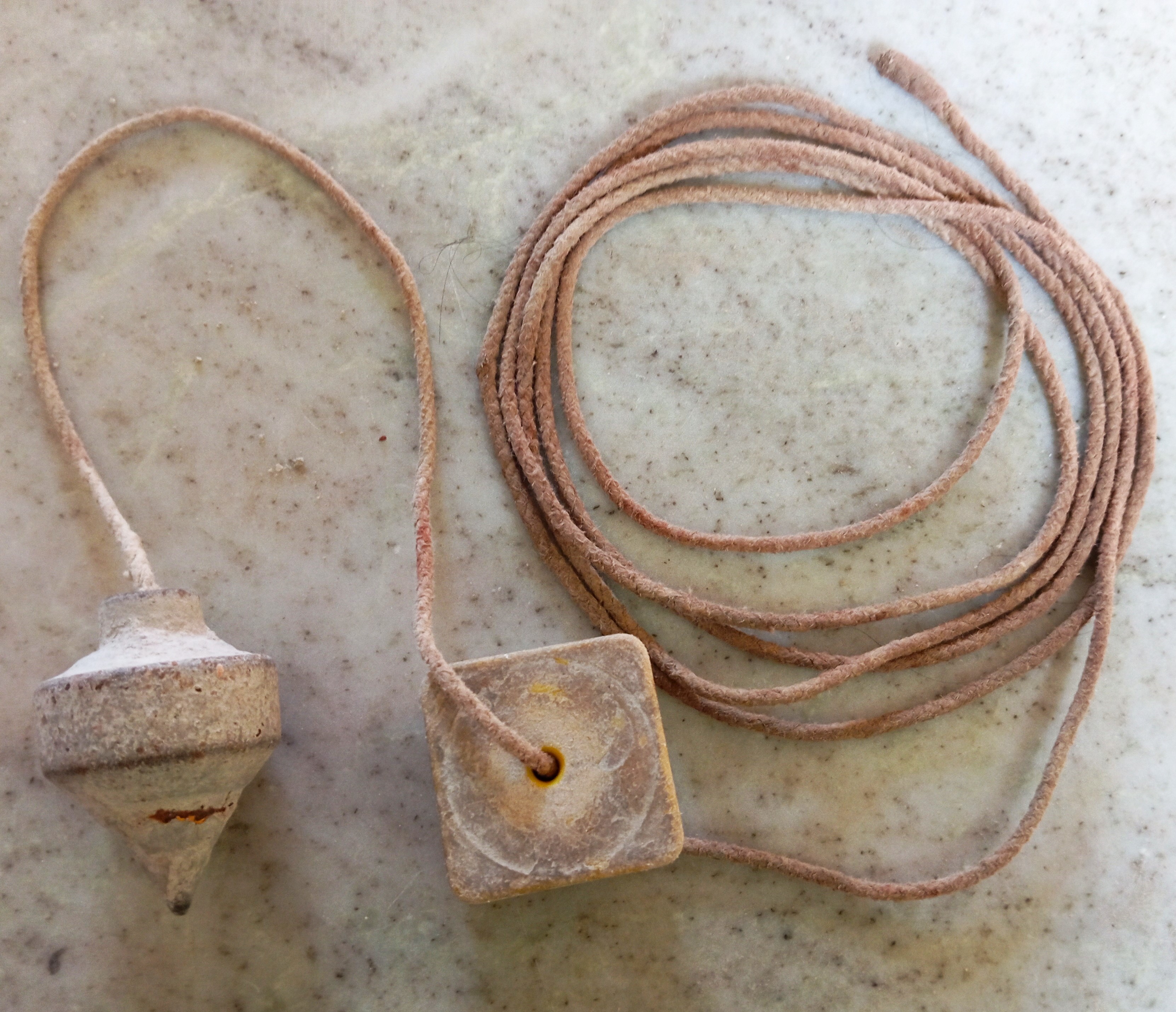
A plumb bob with its cord, photographed January 2, 2024.
Salil Kumar Mukherjee / Wikimedia Commons · CC BY-SA 4.0 · Original recordImage changes
Display copies resized; original downloaded JPEG preserved.
The words
Amaziah
Amos warns Bethel’s priest Amaziah: his wife will become “an harlot,” his children will die by the sword, and he will die in a “polluted land.”
Amos
The LORD takes Amos from following the flock and sends him to prophesy to Israel; Amos cites that call when Amaziah challenges him.
Basket of Fruit
In this vision, the NET notes that “summer fruit” and “end” sound alike in Hebrew; the following verse foretells howling and many dead bodies.
Amos 8:1–3 (opens a new tab) · NET Bible: Amos 8:2 (opens a new tab)
Earthquake
The opening dates Amos’s words to two years before an earthquake, during the reigns of Uzziah and Jeroboam son of Joash.
Grasshoppers
Locusts, as the NET renders the vision.
The first vision shows grasshoppers forming as the later crop grows; Amos pleads for Jacob, and the LORD says the destruction will not happen.
Did you know?
The vision dates this growth after “the king’s mowings”; the NET suggests a tentative connection with crops collected as taxes.
Amos 7:1–3 (opens a new tab) · NET Bible: Amos 7:1 (opens a new tab)
Great Deep
The second vision’s fire devours the great deep; Amos asks the LORD to cease, and the reply says this will not happen.
Herdman
A keeper of herds, in Webster’s definition.
Amos describes himself as a herdman and sycomore gatherer; he says the LORD took him from following the flock to prophesy.
Amos 7:14–15 (opens a new tab) · Webster’s 1828: herdman (opens a new tab)
High Places
Centers of worship, in the NET.
The LORD announces desolation for Isaac’s high places and Israel’s sanctuaries, then threatens to rise against Jeroboam’s house with the sword.
Amos 7:9 (opens a new tab) · NET Bible: Amos 7:9 (opens a new tab)
Judgment
Justice, in the NET.
The LORD rejects the people’s festivals, offerings and songs, then calls for judgment and righteousness to flow like water.
Amos 5:21–24 (opens a new tab) · NET Bible: Amos 5:24 (opens a new tab)
King's Chapel
A royal temple, in the NET.
Amaziah tells Amos not to prophesy at Bethel because it is “the king’s chapel” and “the king’s court,” tying the shrine to royal authority.
Amos 7:13 (opens a new tab) · NET Bible: Amos 7:13 (opens a new tab)
Plumbline
A weighted line for checking vertical alignment, in Webster’s definition of plumb.
The KJV shows the Lord on a wall holding a plumbline; the NET reads “tin” and discusses differing interpretations of the image.
Amos 7:7–8 (opens a new tab) · NET Bible: Amos 7:7-8 (opens a new tab) · Webster’s 1828: plumb (opens a new tab)
Prophet's Son
A prophetic guild trainee, in the NET’s explanation.
The KJV has Amos say he was neither a prophet nor “a prophet’s son”; he then recounts his call to prophesy to Israel.
Did you know?
The NET notes that the Hebrew lacks an explicit verb here, so translators differ between “I was” and “I am.”
Amos 7:14–15 (opens a new tab) · NET Bible: Amos 7:14 (opens a new tab)
Sanctuaries
The threatened sanctuaries are Israel’s places of worship; in the same message, the LORD says he will no longer pass by Israel.
Amos 7:8–9 (opens a new tab) · NET Bible: Amos 7:9 (opens a new tab)
Sycomore
The sycamore fig, as the NET names the tree.
Amos describes himself as “a gatherer of sycomore fruit”; the NET says he took care of sycamore fig trees.
Did you know?
The NET’s note gives the verb’s literal sense as gashed or pierced, adding detail behind the KJV’s gatherer.
Amos 7:14 (opens a new tab) · NET Bible: Amos 7:14 (opens a new tab)
Tekoa
The book identifies Amos among Tekoa’s herdmen, dating his words to Uzziah of Judah and Jeroboam son of Joash in Israel.
Sources
- Amos 1:1 (King James Version)King James Version, passage navigation via Bible Gateway
- Amos 5:21-24 (King James Version)King James Version, passage navigation via Bible Gateway
- Amos 7:1-6 (King James Version)King James Version, passage navigation via Bible Gateway
- Amos 7:7-9 (King James Version)King James Version, passage navigation via Bible Gateway
- Amos 7:10-17 (King James Version)King James Version, passage navigation via Bible Gateway
- Amos 8:1-3 (King James Version)King James Version, passage navigation via Bible Gateway
- Amos 7:7-8 (NET Bible), translation and notesNET Bible, via Bible Gateway
- Amos 7:14 (NET Bible), translation and notesNET Bible, via Bible Gateway
- Amos 7:13 (NET Bible), translation and notesNET Bible, via Bible Gateway
- Amos 8:2 (NET Bible), translation and notesNET Bible, via Bible Gateway
- Amos 7:1 (NET Bible), translation and notesNET Bible, via Bible Gateway
- Amos 5:24 (NET Bible), translation and notesNET Bible, via Bible Gateway
- Amos 7:9 (NET Bible), translation and notesNET Bible, via Bible Gateway
- Webster’s 1828: plumbWebster’s Dictionary 1828, online transcription
- Webster’s 1828: herdmanWebster’s Dictionary 1828, online transcription