
The Great Stories of the Old Testament
Puzzle 67 · The Twelve · Page 100 in print
Joel and the Locust Army
Devastating locusts become the language of alarm, repentance and restoration, with renewed rain and harvest answering the loss.
Jump to a word
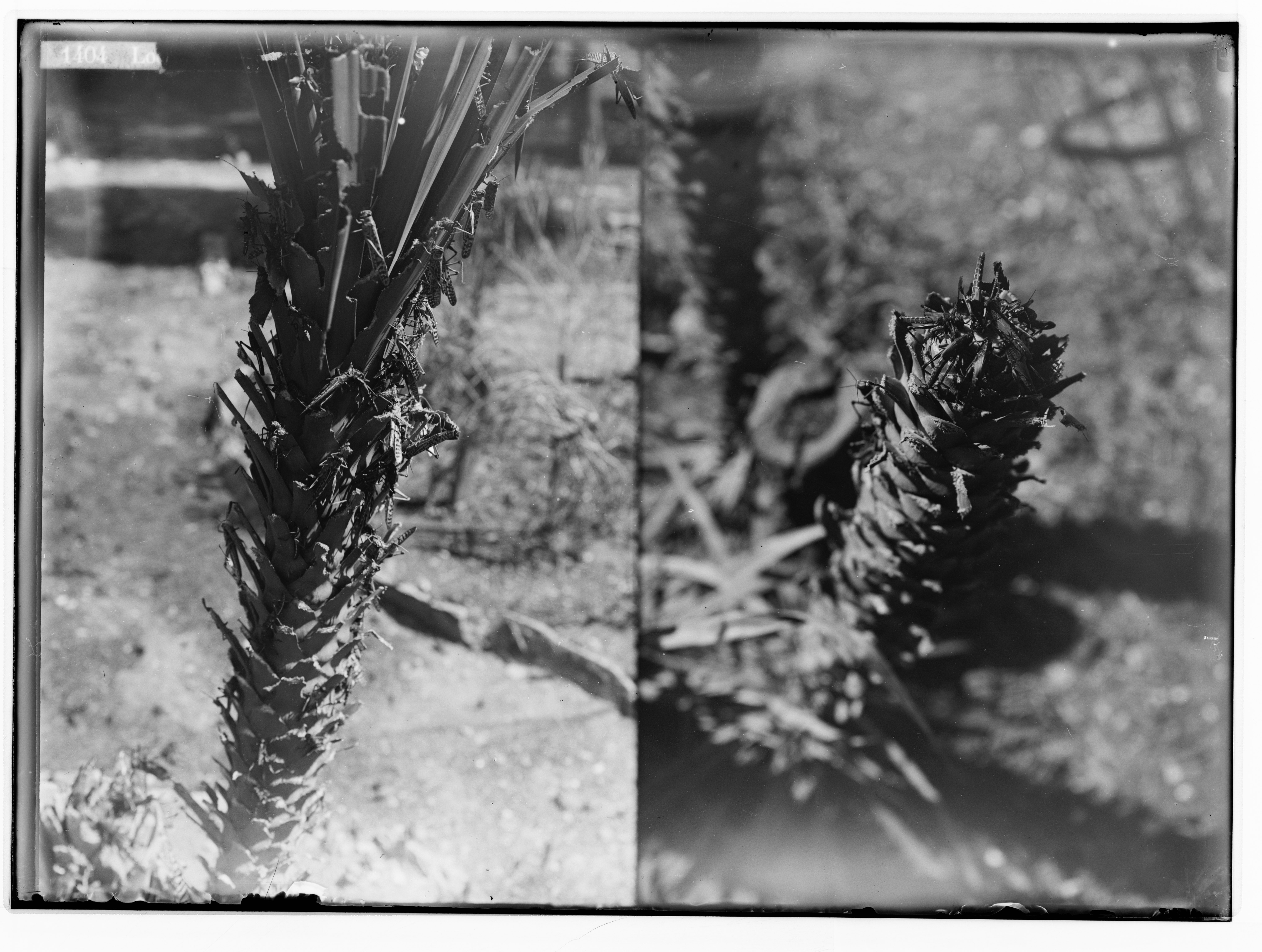
Two views of locusts feeding on palm leaves, 1915.
A later agricultural comparison for the devastation described in Joel.
Library of Congress, Prints & Photographs Division, G. Eric and Edith Matson Photograph Collection (LC-DIG-matpc-01892) · No known restrictions on publication · Original recordImage changes
Display copies resized; original downloaded JPEG preserved.
The words
Army
The advancing force is compared to horses, chariots and marching soldiers; later the LORD calls the devouring insects “my great army.”
Did you know?
The NET note leaves open whether locust plagues symbolize an army or an army image describes actual locust plagues.
Joel 2:4–7 (opens a new tab) · Joel 2:25 (opens a new tab) · NET Bible: Joel 1:4 (opens a new tab)
Cankerworm
The NET note lists “hopping locust” as one rendering; the insect’s exact identification is uncertain.
In the KJV’s sequence, the cankerworm eats what the locust leaves, before the caterpiller consumes what remains.
Joel 1:4 (opens a new tab) · NET Bible: Joel 1:4 (opens a new tab)
Caterpiller
An uncertain insect name, rendered “stripping locust” in translations cited by the NET.
The caterpiller completes the KJV’s opening sequence of devourers; it reappears when the LORD promises to restore the years they ate.
Joel 1:4 (opens a new tab) · Joel 2:25 (opens a new tab) · NET Bible: Joel 1:4 (opens a new tab)
Day of the Lord
Joel announces the day of the LORD as near, calling it destruction from the Almighty and asking who can endure it.
Desolate
The warning contrasts land like Eden with the desolate wilderness left behind; earlier, emptied storehouses and broken barns describe the ruined harvest.
Fasting
Joel calls priests, elders and inhabitants to gather at the LORD’s house for a fast and a communal cry for help.
Did you know?
The assembly call in chapter 2 includes elders, children, nursing infants and even a bride and bridegroom leaving their rooms.
Joel 1:13–14 (opens a new tab) · Joel 2:15–16 (opens a new tab)
Former Rain
Autumn’s early rains, in the NET’s explanation.
The children of Zion are told to rejoice over renewed rain; the KJV says the LORD has given “the former rain moderately.”
Did you know?
The NET notes that the word used for early rains usually means “the teacher,” but reads it as rain in this verse.
Joel 2:23 (opens a new tab) · NET Bible: Joel 2:23 (opens a new tab)
Joel
Joel is introduced as Pethuel’s son; his opening appeal asks elders and inhabitants to pass the account on to their children and later generations.
Latter Rain
Spring rains, in the NET’s seasonal explanation.
The KJV pairs latter and former rain “in the first month”; the NET instead closes the line “as formerly.”
Joel 2:23 (opens a new tab) · NET Bible: Joel 2:23 (opens a new tab)
Locusts
The locust follows the palmerworm in the opening sequence; later the LORD promises to restore the years eaten by the whole devouring army.
Mount Zion
Joel names Mount Zion and Jerusalem as places of deliverance for those who call on the LORD, among those he calls.
Palmerworm
“Cutting locust” is one rendering listed by the NET; the insect term’s meaning is uncertain.
The palmerworm begins the KJV’s chain of crop destruction; what it leaves is eaten by the locust, then by the remaining devourers.
Joel 1:4 (opens a new tab) · NET Bible: Joel 1:4 (opens a new tab)
Plenty
After the promise to restore the years eaten by the insects, the people are told they will eat, be satisfied and praise the LORD.
Rend Your Heart
Rend means tear, in Webster’s definition.
Joel says to rend hearts rather than garments and return to the LORD; the NET note explains this as genuine repentance.
Joel 2:12–13 (opens a new tab) · NET Bible: Joel 2:13 (opens a new tab) · Webster’s 1828: rend (opens a new tab)
Trumpet
The trumpet first sounds an alarm on the holy mountain; later its call in Zion summons a fast and solemn assembly.
Sources
- Joel 1:1-12 (King James Version)King James Version, passage navigation via Bible Gateway
- Joel 1:13-20 (King James Version)King James Version, passage navigation via Bible Gateway
- Joel 2:1-11 (King James Version)King James Version, passage navigation via Bible Gateway
- Joel 2:12-17 (King James Version)King James Version, passage navigation via Bible Gateway
- Joel 2:18-27 (King James Version)King James Version, passage navigation via Bible Gateway
- Joel 2:28-32 (King James Version)King James Version, passage navigation via Bible Gateway
- Joel 1:4 (NET Bible), translation and notesNET Bible, via Bible Gateway
- Joel 2:23 (NET Bible), translation and notesNET Bible, via Bible Gateway
- Joel 2:13 (NET Bible), translation and notesNET Bible, via Bible Gateway
- Webster’s 1828: rendWebster’s Dictionary 1828, online transcription