
The Great Stories of the Old Testament
Puzzle 64 · Major Prophets · Page 95 in print
The Fiery Furnace
Three men refuse the golden image and survive the furnace; the king sees a fourth figure among them. The wording follows the KJV.
Jump to a word
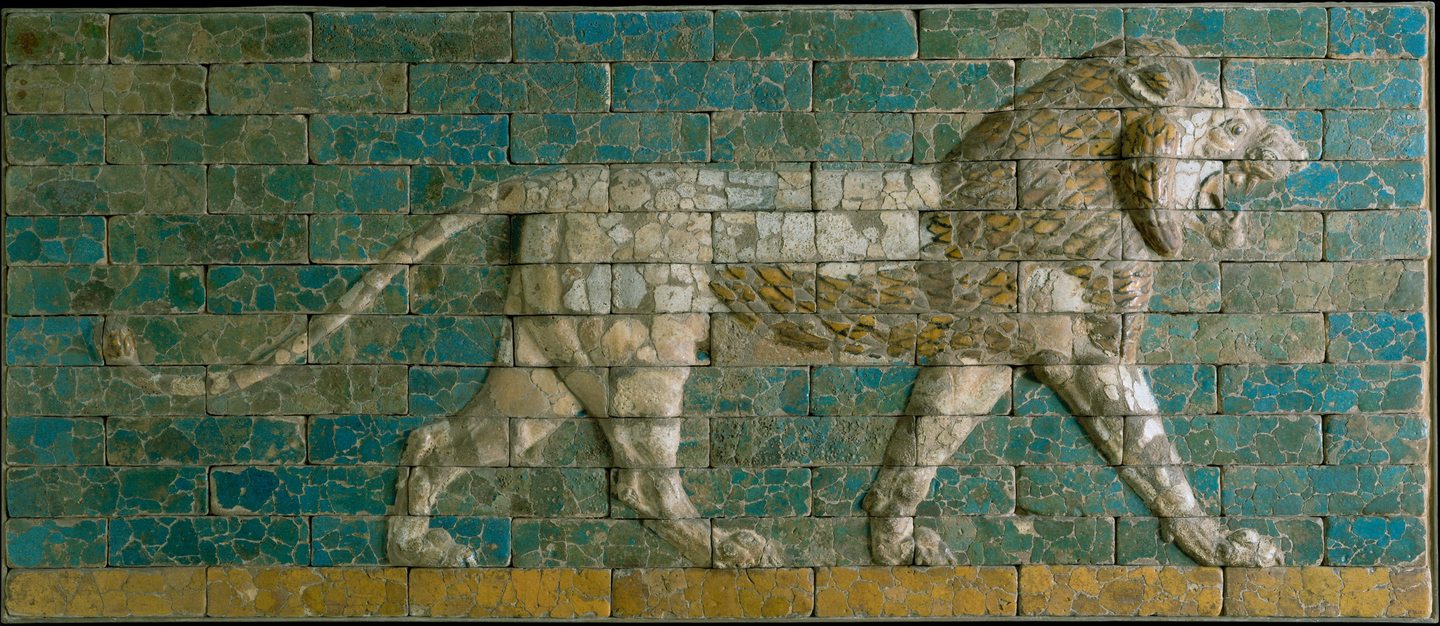
Babylonian glazed-brick lion panel.
The Babylonian architectural panel gives material context for the kingdom, not the golden image or furnace in Daniel.
The Metropolitan Museum of Art (image provider; individual photographer uncredited) · Public Domain / The Met Open Access CC0 · Original recordImage changes
Resized proportionally to at most 1440px and JPEG compressed; no crop or content alteration.
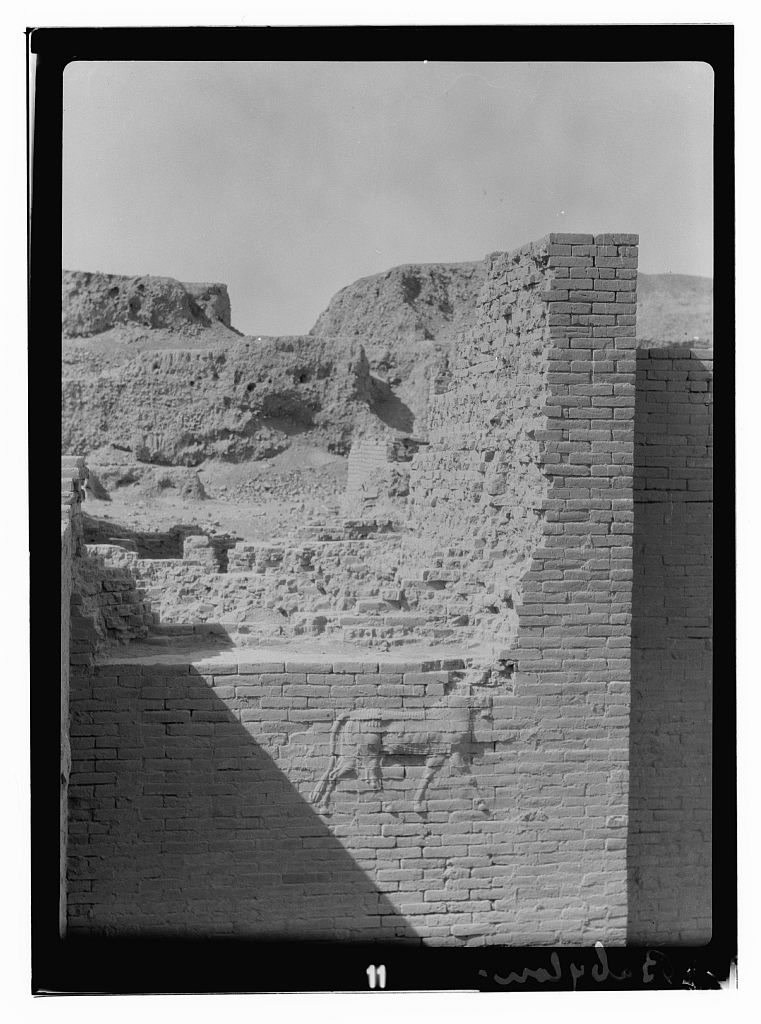
Brickwork and ruins at Babylon, 1932.
The later ruins give geographical background without identifying the plain of Dura or the furnace.
American Colony (Jerusalem). Photo Department; G. Eric and Edith Matson Photograph Collection, Library of Congress. · No known restrictions on publication · Original recordImage changes
Resized proportionally to at most 1440px and JPEG compressed; no crop or content alteration.
The words
Abed-nego
Abednego, as the KJV spells the name.
Earlier named Azariah, Abed-nego is accused with Shadrach and Meshach of refusing the king’s gods and golden image.
Daniel 1:6–7 (opens a new tab) · Daniel 3:12 (opens a new tab)
Cornet
A horn, in the NET’s instrument list.
The cornet begins the herald’s list of instruments whose sound commands the assembled peoples to fall down before the golden image.
Daniel 3:4–5 (opens a new tab) · NET Bible: Daniel 3:5 (opens a new tab)
Dulcimer
An uncertain instrument name: pipes in the NET, bagpipe or double pipe in Brown–Driver–Briggs.
The dulcimer is named in the original command and again when the accusers repeat the musical signal to the king.
Daniel 3:5 (opens a new tab) · NET Bible: Daniel 3:5 (opens a new tab) · Daniel 3:10 (opens a new tab) · Lexicons: dulcimer (opens a new tab)
Dura
Nebuchadnezzar sets up the golden image on the plain of Dura, in the province of Babylon, and summons officials to its dedication.
Fiery Furnace
Nebuchadnezzar orders the furnace heated “seven times more” than usual, then has the three men bound and thrown into it.
Fourth Man
The astonished king recalls three men being thrown in bound, yet says he sees four walking loose in the fire without injury.
Garments
The three are thrown in wearing their clothes; afterward, the officials see that their coats have not changed and their hair is unsinged.
Did you know?
The NET lists cloaks, trousers and turbans, but its note cautions that the specific ancient clothing items are uncertain.
Daniel 3:21 (opens a new tab) · Daniel 3:27 (opens a new tab) · NET Bible: Daniel 3:21 (opens a new tab)
Golden Image
The golden image stands at the center of the king’s command: worship at the musical signal or be thrown into the furnace.
Meshach
Meshach, earlier named Mishael, comes out with his companions when Nebuchadnezzar calls them from the furnace as servants of the most high God.
Daniel 1:7 (opens a new tab) · Daniel 3:26 (opens a new tab)
Mighty Men
The king’s strongest soldiers bind and throw the three men into the furnace; the narrative says the flames kill those soldiers.
Music
The herald commands peoples, nations and languages to bow when they hear the instruments; the narrative then describes the crowd obeying.
Sackbut
A lyre in Strong’s gloss, a trigon in the NET; exact identification is uncertain.
Nebuchadnezzar repeats the sackbut among the instruments when he offers the three men another chance to worship the image.
Daniel 3:5 (opens a new tab) · Daniel 3:15 (opens a new tab) · NET Bible: Daniel 3:5 (opens a new tab) · Lexicons: sackbut (opens a new tab)
Shadrach
Shadrach, earlier named Hananiah, answers with his companions that even without deliverance they will not serve the king’s gods or worship his image.
Daniel 1:7 (opens a new tab) · Daniel 3:16–18 (opens a new tab)
Smell of Fire
The officials’ inspection finds no singed hair, changed coats or smell of fire on the three men after they leave the furnace.
Son of God
The king compares the fourth figure to “the Son of God” in the KJV; later he says God sent an angel.
Did you know?
Many modern translations use a plural comparison: the ESV and NIV both read “a son of the gods.”
Daniel 3:25; Daniel 3:28 (opens a new tab) · ESV: Daniel 3:25 (opens a new tab) · NIV: Daniel 3:25 (opens a new tab)
Sources
- Daniel 1:6-7 (King James Version)King James Version, passage navigation via Bible Gateway
- Daniel 3:1-7 (King James Version)King James Version, passage navigation via Bible Gateway
- Daniel 3:8-18 (King James Version)King James Version, passage navigation via Bible Gateway
- Daniel 3:19-23 (King James Version)King James Version, passage navigation via Bible Gateway
- Daniel 3:24-30 (King James Version)King James Version, passage navigation via Bible Gateway
- Daniel 3:5 (NET Bible), translation and notesNET Bible, via Bible Gateway
- Daniel 3:21 (NET Bible), translation and notesNET Bible, via Bible Gateway
- Daniel 3:25 (English Standard Version)English Standard Version, via Bible Gateway
- Daniel 3:25 (New International Version)New International Version, via Bible Gateway
- Strong’s H5443 and Brown–Driver–BriggsStrong’s and Brown–Driver–Briggs, lexical entries via Bible Hub; excludes Topical Lexicon
- Strong’s H5481 and Brown–Driver–BriggsStrong’s and Brown–Driver–Briggs, lexical entries via Bible Hub; excludes Topical Lexicon