
The Great Stories of the Old Testament
Puzzle 55 · Divided Kingdom and Restoration · Page 83 in print
Esther Before Ahasuerus
Esther risks approaching the king to intercede for her people; reversal and remembrance shape the story’s conclusion.
Jump to a word
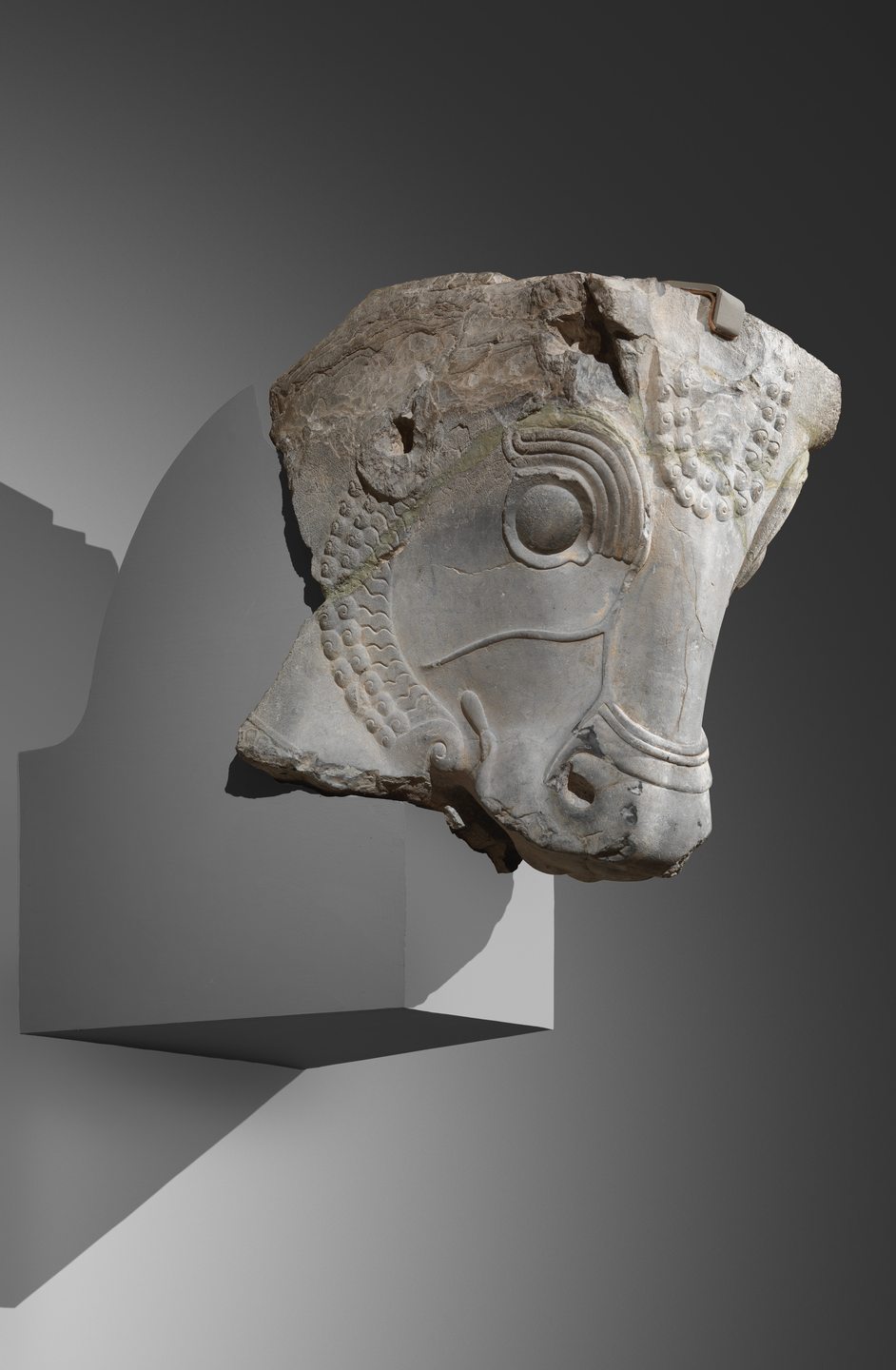
Achaemenid bull’s-head column capital.
The Achaemenid capital provides material context for the Persian court world; it is not an object proved to belong to Esther or Ahasuerus.
The Metropolitan Museum of Art (image provider; individual photographer uncredited) · Public Domain / The Met Open Access CC0 · Original recordImage changes
Resized proportionally to at most 1440px and JPEG compressed; no crop or content alteration.
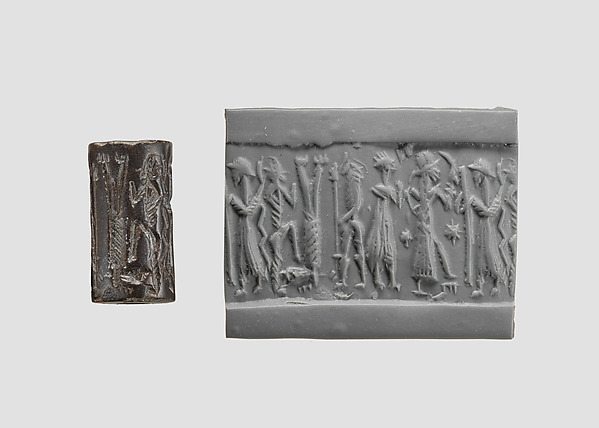
Cylinder seal, ca. early 2nd millennium BCE. Babylonian.
An older Mesopotamian seal offers a comparison for official authentication, not the signet or decree in Esther’s story.
The Metropolitan Museum of Art; Gift of Nanette B. Kelekian, in memory of Charles Dikran and Beatrice Kelekian, 1999; object 1999.325.34. · CC0 / Public Domain · Original recordImage changes
Resized proportionally to at most 1440px and JPEG compressed; no crop or content alteration.
The words
Ahasuerus
Ahasuerus authorizes Haman’s killing decree, then permits a counter-decree allowing Jewish communities to kill opponents and take their property.
Esther 3:10–13 (opens a new tab) · Esther 8:8–11 (opens a new tab)
Decree
The book describes a royal decree ordering the kingdom’s Jews killed on one day, including children and women, and their property seized.
Esther
Esther pleads for her people’s lives; she later requests a second day under their decree, when the Jews kill 300 more men in Shushan.
Esther 7:3–4 (opens a new tab) · Esther 9:13–15 (opens a new tab)
Fast
Esther asks Shushan’s Jews to fast without food or drink for three days; she and her attendants will do the same before she approaches the king.
Gallows
An execution structure, called a pole in the NIV.
Haman builds the gallows for Mordecai; the KJV says Haman himself is hanged on it at the king’s command.
Esther 5:14 (opens a new tab) · Esther 7:9–10 (opens a new tab) · NIV: Esther 7:9-10 (opens a new tab)
Golden Sceptre
A royal staff signifying authority, in Webster’s definition.
Esther risks death by approaching without being summoned; the king extends his golden scepter, and she touches its tip.
Esther 4:11 (opens a new tab) · Esther 5:1–2 (opens a new tab) · Webster’s 1828: scepter (opens a new tab)
Hadassah
Probably “myrtle,” according to the NET name note.
Mordecai raises Hadassah, also called Esther, as his daughter after her parents die; the book identifies her as his uncle’s daughter.
Esther 2:7 (opens a new tab) · NET Bible: Esther 2:7 (opens a new tab)
Haman
Haman plots to kill the Jews after Mordecai refuses to bow; he is executed, and his ten sons are later killed.
Esther 3:5–6 (opens a new tab) · Esther 7:10 (opens a new tab) · Esther 9:10 (opens a new tab)
Hegai
Esther is brought to Hegai with other women gathered into the king’s house; he provides preparations and seven attendants.
Media
Persia and Media appear together among the powers and princes at Ahasuerus’s opening feast; later advisers invoke laws of Persians and Medes.
Did you know?
The opening banquet uses gold drinking vessels; the narrator adds that the vessels differed from one another.
Esther 1:3; Esther 1:7 (opens a new tab) · Esther 1:19 (opens a new tab)
Mordecai
Mordecai, Esther’s guardian, directs the counter-decree authorizing the Jews to kill opposing forces, including “little ones and women,” in the KJV.
Esther 2:7 (opens a new tab) · Esther 4:13–14 (opens a new tab) · Esther 8:9–11 (opens a new tab)
Persia
A royal adviser invokes the laws of Persians and Medes over Vashti’s dismissal; later decrees are written for the provinces’ different languages.
Esther 1:19 (opens a new tab) · Esther 3:12 (opens a new tab)
Purim
Named after Pur, meaning “lot,” in the account.
Purim becomes an annual remembrance of deliverance; the narrative reports 75,000 enemies killed by Jews in the provinces before their rest.
Esther 9:16–17 (opens a new tab) · Esther 9:20–28 (opens a new tab) · Esther 3:7 (opens a new tab)
Shushan
Susa, in the NET Bible.
Shushan is the royal setting where Esther is gathered into the king’s house and later risks entering his inner court without being summoned.
Esther 1:2 (opens a new tab) · Esther 2:8 (opens a new tab) · Esther 4:11 (opens a new tab) · Esther 5:1 (opens a new tab) · NET Bible: Esther 1:2 (opens a new tab)
Vashti
Vashti refuses the king’s summons to display her beauty before his guests; Esther later receives the crown in her place.
Esther 1:10–12 (opens a new tab) · Esther 2:17 (opens a new tab)
Sources
- Esther 1:1-9 (King James Version)King James Version, passage navigation via Bible Gateway
- Esther 1:10-12 (King James Version)King James Version, passage navigation via Bible Gateway
- Esther 1:16-20 (King James Version)King James Version, passage navigation via Bible Gateway
- Esther 2:5-9 (King James Version)King James Version, passage navigation via Bible Gateway
- Esther 2:15-17 (King James Version)King James Version, passage navigation via Bible Gateway
- Esther 3:5-15 (King James Version)King James Version, passage navigation via Bible Gateway
- Esther 4:11-17 (King James Version)King James Version, passage navigation via Bible Gateway
- Esther 5:1-3 (King James Version)King James Version, passage navigation via Bible Gateway
- Esther 5:14 (King James Version)King James Version, passage navigation via Bible Gateway
- Esther 7:3-10 (King James Version)King James Version, passage navigation via Bible Gateway
- Esther 8:8-11 (King James Version)King James Version, passage navigation via Bible Gateway
- Esther 9:16-19 (King James Version)King James Version, passage navigation via Bible Gateway
- Esther 9:20-28 (King James Version)King James Version, passage navigation via Bible Gateway
- Esther 2:7 (NET Bible), translation and notesNET Bible, via Bible Gateway
- Esther 1:2 (NET Bible), translation and notesNET Bible, via Bible Gateway
- Esther 9:7-15 (King James Version)King James Version, passage navigation via Bible Gateway
- Esther 7:9-10 (New International Version)New International Version, via Bible Gateway
- Webster’s 1828: scepterWebster’s Dictionary 1828, online transcription