
The Great Stories of the Old Testament
Puzzle 17 · Patriarchs · Page 31 in print
Benjamin and the Silver Cup
Joseph’s cup is placed in Benjamin’s sack, creating a crisis in which Judah offers himself for his brother.
Jump to a word
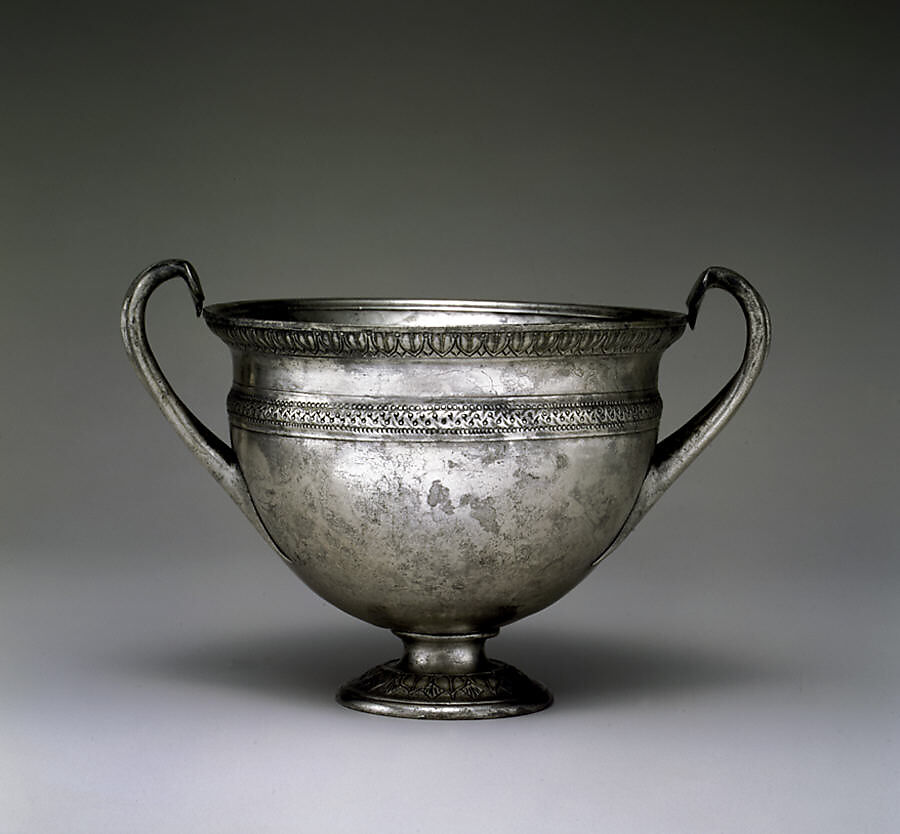
Roman silver drinking cup, mid-1st century BCE.
The Metropolitan Museum of Art, Rogers Fund, 1920 (20.49.2) · CC0 · Original recordImage changes
Display copies resized; original downloaded JPEG preserved.
The words
Benjamin
Joseph orders the cup placed in the youngest brother’s sack; it is later found in Benjamin’s sack, putting him at risk of enslavement.
Did you know?
At the earlier meal, Benjamin receives a serving five times as large as any of his brothers’ portions.
Genesis 44:2 (opens a new tab) · Genesis 44:12 (opens a new tab) · Genesis 44:17 (opens a new tab) · Genesis 43:34 (opens a new tab)
Bondmen
Enslaved men.
Before the search, the brothers offer death for the cup’s holder and their own bondage; the steward reduces this to the holder’s enslavement.
Genesis 44:9–10 (opens a new tab) · NET Bible: Genesis 44:9-10 (opens a new tab)
Corn
Grain, in the KJV’s older English.
Joseph orders the sacks filled with food and the silver cup put with the youngest brother’s corn money.
Genesis 44:1–2 (opens a new tab) · NET Bible: Genesis 44:2 (opens a new tab)
Divineth
Seeks hidden knowledge by divination.
On Joseph’s instructions, the steward says the cup is used for divination, making this claim part of the accusation after the cup is planted.
Genesis 44:1–2 (opens a new tab) · Genesis 44:4–6 (opens a new tab) · Webster’s 1828: divination (opens a new tab)
Eldest
The steward starts searching with the eldest and finishes with the youngest, finding the cup in Benjamin’s sack at the end.
Did you know?
Earlier, the brothers are seated by birth order, from the firstborn to the youngest, and look at one another in surprise.
Genesis 44:12 (opens a new tab) · Genesis 43:33 (opens a new tab)
Governor
Joseph governs Egypt and sells grain; the cup episode unfolds in his household under his instructions.
Did you know?
Genesis gives Joseph’s age as 30 when he stands before Pharaoh, before describing his journey through Egypt.
Genesis 42:6 (opens a new tab) · Genesis 44:1–2 (opens a new tab) · Genesis 41:46 (opens a new tab)
Gray Hairs
Judah says his father will die on seeing Benjamin absent; the gray hairs in his plea stand for Jacob in his old age.
Mischief
Harm or misfortune.
Judah repeats his father’s fear that mischief may befall Benjamin if he leaves home, bringing Jacob’s gray hairs to the grave in sorrow.
Genesis 44:27–29 (opens a new tab) · NET Bible: Genesis 44:29 (opens a new tab)
Overtake
Before the brothers have gone far from the city, Joseph sends his steward to catch up and accuse them over the cup.
Sack's Mouth
Joseph orders his silver cup placed at the mouth of the youngest brother’s sack together with the money paid for grain.
Search
The steward’s search ends with the cup in Benjamin’s sack, where Joseph had earlier ordered it placed.
Genesis 44:1–2 (opens a new tab) · Genesis 44:11–12 (opens a new tab)
Silver
Silver is the material Joseph names when ordering the cup planted; the steward’s accusation later describes it as his master’s drinking cup.
Did you know?
Solomon’s drinking vessels are described as gold in First Kings, which explicitly says none were silver.
Genesis 44:2 (opens a new tab) · Genesis 44:5 (opens a new tab) · 1 Kings 10:21 (opens a new tab)
Steward
The manager of Joseph’s household.
Joseph’s steward receives the order to hide the cup, pursues the departing brothers, and conducts the search that finds it.
Genesis 44:1–2 (opens a new tab) · Genesis 44:4–6 (opens a new tab) · Genesis 44:11–12 (opens a new tab) · NET Bible: Genesis 44:1 (opens a new tab)
Surety
A person who takes responsibility for another’s obligation.
Judah reminds Joseph that he promised to answer for Benjamin, then offers to stay as a bondman in his brother’s place.
Genesis 43:8–9 (opens a new tab) · Genesis 44:32–33 (opens a new tab) · Webster’s 1828: surety (opens a new tab)
Youngest
The youngest is searched last; when the cup is found in Benjamin’s sack, the brothers tear their clothes and return to the city.
Sources
- Genesis 44:1-2 (King James Version)King James Version, passage navigation via Bible Gateway
- Genesis 44:4-6 (King James Version)King James Version, passage navigation via Bible Gateway
- Genesis 44:9-13 (King James Version)King James Version, passage navigation via Bible Gateway
- Genesis 44:16-17 (King James Version)King James Version, passage navigation via Bible Gateway
- Genesis 44:27-31 (King James Version)King James Version, passage navigation via Bible Gateway
- Genesis 44:32-34 (King James Version)King James Version, passage navigation via Bible Gateway
- Genesis 43:8-9 (King James Version)King James Version, passage navigation via Bible Gateway
- Genesis 43:33-34 (King James Version)King James Version, passage navigation via Bible Gateway
- Genesis 42:6 (King James Version)King James Version, passage navigation via Bible Gateway
- Genesis 41:46 (King James Version)King James Version, passage navigation via Bible Gateway
- 1 Kings 10:21 (King James Version)King James Version, passage navigation via Bible Gateway
- Genesis 44:9-10 (NET Bible), translation and notesNET Bible, via Bible Gateway
- Genesis 44:2 (NET Bible), translation and notesNET Bible, via Bible Gateway
- Genesis 44:29 (NET Bible), translation and notesNET Bible, via Bible Gateway
- Genesis 44:1 (NET Bible), translation and notesNET Bible, via Bible Gateway
- Webster’s 1828: divinationNoah Webster, American Dictionary of the English Language (1828), via MasonSoft
- Webster’s 1828: suretyNoah Webster, American Dictionary of the English Language (1828), via MasonSoft