
The Great Stories of the Old Testament
Puzzle 16 · Patriarchs · Page 30 in print
The Coat of Many Colours
Joseph’s dreams and special coat deepen his brothers’ resentment; he is sold and his father is left to mourn.
Jump to a word
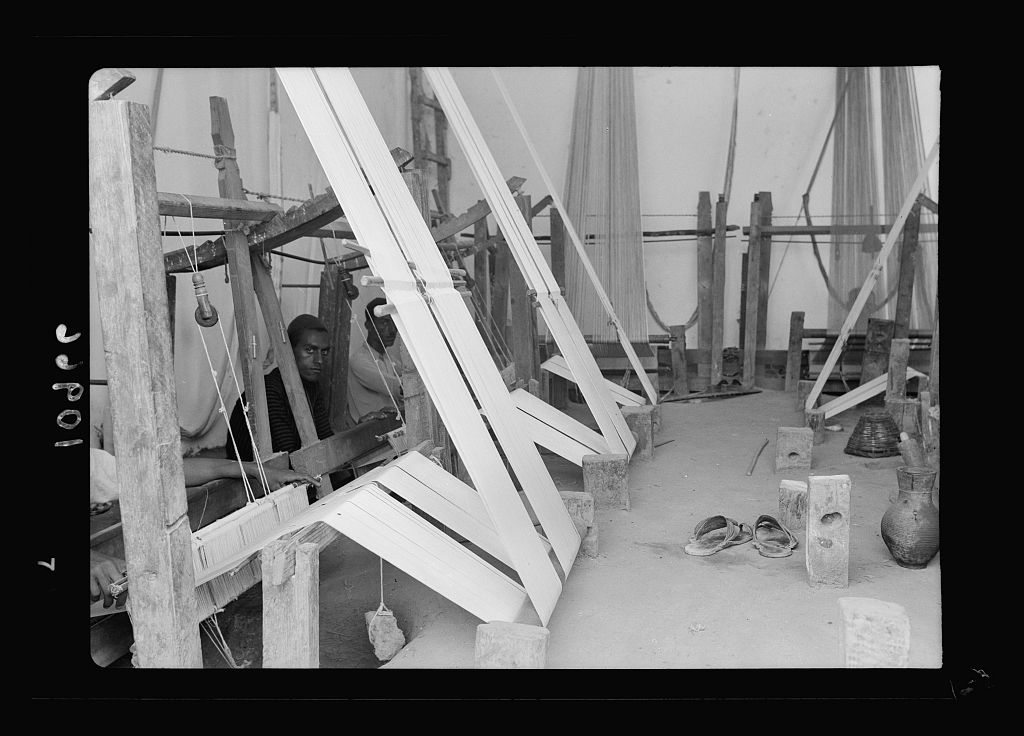
Weaving workshop in Majdel, 1934–1939.
Textile work makes the making of a distinctive garment tangible; it is not the fabric of Joseph’s coat.
American Colony (Jerusalem). Photo Department; G. Eric and Edith Matson Photograph Collection, Library of Congress. · No known restrictions on publication · Original recordImage changes
Resized proportionally to at most 1440px and JPEG compressed; no crop or content alteration.
The words
Brethren
Joseph’s brothers hate him because their father favors him; later they strip off his coat and throw him into a pit.
Genesis 37:3–4 (opens a new tab) · Genesis 37:23–24 (opens a new tab)
Coat
Genesis calls Joseph the son of Israel’s old age and says Israel loves him especially, making him a coat of many colours.
Did you know?
Pharaoh later dresses Joseph in fine linen and puts a gold chain around his neck, giving clothing another role in his story.
Genesis 37:3 (opens a new tab) · Genesis 41:42 (opens a new tab)
Colours
The KJV describes Joseph’s coat as having many colours; the NET note says the Hebrew term’s meaning is uncertain.
Genesis 37:3 (opens a new tab) · NET Bible: Genesis 37:3 (opens a new tab)
Dothan
A man tells Joseph that his brothers have left for Dothan; Joseph follows them there after searching for them near Shechem.
Dreamer
His brothers call Joseph this dreamer while proposing to kill him and throw him into a pit.
Dreams
Joseph tells his family two dreams of bowing: first sheaves in a field, then the sun, moon and eleven stars.
Did you know?
Later, Joseph interprets Pharaoh’s repeated dream and says its doubling means the matter is settled by God.
Genesis 37:5–11 (opens a new tab) · Genesis 41:25 (opens a new tab) · Genesis 41:32 (opens a new tab)
Ishmeelites
Ishmaelites, in the KJV’s spelling here.
The caravan of Ishmeelites is traveling from Gilead toward Egypt; Genesis then reports that Joseph is sold to the Ishmeelites.
Genesis 37:25–28 (opens a new tab) · NET Bible: Genesis 37:25 (opens a new tab)
Joseph
Joseph is introduced at 17, tending the flock with his brothers; later in the chapter he is taken to Egypt after being sold.
Genesis 37:2 (opens a new tab) · Genesis 37:28 (opens a new tab)
Obeisance
Bowing to show respect.
In Joseph’s dreams, his brothers’ sheaves and then the sun, moon and stars make obeisance, which his father describes as bowing down.
Did you know?
When the brothers later come to buy grain, they bow with their faces to the earth before Joseph, using the dream’s posture.
Genesis 37:7; Genesis 37:9–10 (opens a new tab) · Genesis 42:5–6 (opens a new tab) · Webster’s 1828: obeisance (opens a new tab)
Potiphar
Genesis ends the chapter with Joseph sold to Potiphar, an officer of Pharaoh and captain of the guard in Egypt.
Reuben
Reuben tells his brothers not to kill Joseph and proposes the pit, intending to return him to his father.
Sackcloth
Coarse cloth worn in mourning.
Believing Joseph has been killed, Jacob tears his clothes, puts on sackcloth and mourns his son for many days.
Genesis 37:33–34 (opens a new tab) · Webster’s 1828: sackcloth (opens a new tab)
Sheaves
Bundles of grain stalks.
In Joseph’s first dream, his sheaf stands upright while his brothers’ sheaves gather around and bow to it in the field.
Did you know?
In Ruth, Boaz tells the workers to let Ruth glean among the sheaves, placing the same farm term in a harvest scene.
Genesis 37:7 (opens a new tab) · Ruth 2:8 (opens a new tab) · Ruth 2:15 (opens a new tab) · Webster’s 1828: sheaf (opens a new tab)
Sold
Genesis reports Joseph sold into slavery to the Ishmeelites for twenty pieces of silver and taken to Egypt, while naming Midianite merchants.
Genesis 37:28 (opens a new tab) · Genesis 37:36 (opens a new tab)
Spicery
Spices or other aromatics.
The camels in the traders’ caravan carry spicery, balm and myrrh from Gilead toward Egypt when Joseph’s brothers see them.
Genesis 37:25 (opens a new tab) · Webster’s 1828: spicery (opens a new tab)
Sources
- Genesis 37:2-4 (King James Version)King James Version, passage navigation via Bible Gateway
- Genesis 37:5-11 (King James Version)King James Version, passage navigation via Bible Gateway
- Genesis 37:14-20 (King James Version)King James Version, passage navigation via Bible Gateway
- Genesis 37:21-24 (King James Version)King James Version, passage navigation via Bible Gateway
- Genesis 37:25-28 (King James Version)King James Version, passage navigation via Bible Gateway
- Genesis 37:33-36 (King James Version)King James Version, passage navigation via Bible Gateway
- Genesis 41:42 (King James Version)King James Version, passage navigation via Bible Gateway
- Genesis 41:25 (King James Version)King James Version, passage navigation via Bible Gateway
- Genesis 41:32 (King James Version)King James Version, passage navigation via Bible Gateway
- Genesis 42:5-6 (King James Version)King James Version, passage navigation via Bible Gateway
- Ruth 2:8 (King James Version)King James Version, passage navigation via Bible Gateway
- Ruth 2:15 (King James Version)King James Version, passage navigation via Bible Gateway
- Genesis 37:3 (NET Bible), translation and notesNET Bible, via Bible Gateway
- Genesis 37:25 (NET Bible), translation and notesNET Bible, via Bible Gateway
- Webster’s 1828: obeisanceNoah Webster, American Dictionary of the English Language (1828), via MasonSoft
- Webster’s 1828: sackclothNoah Webster, American Dictionary of the English Language (1828), via MasonSoft
- Webster’s 1828: sheafNoah Webster, American Dictionary of the English Language (1828), via MasonSoft
- Webster’s 1828: spiceryNoah Webster, American Dictionary of the English Language (1828), via MasonSoft