
America’s National Parks
Puzzle 37 · The Rocky Mountains · Page 57 in print
Rocky Mountain
In 1913 and 1914, before the park was established, the Estes Valley Improvement Association and the United States Forest Service transplanted 49 elk from Yellowstone National Park to this area.
Jump to a word
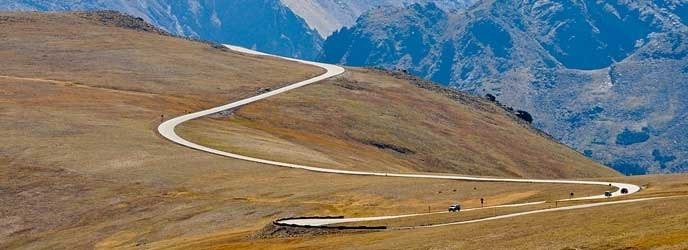
Trail Ridge Road traverses Rocky Mountain National Park.
NPS · Public domain (U.S. federal government work) · Original recordImage changes
Resized and converted to JPEG for display; no subject alteration.
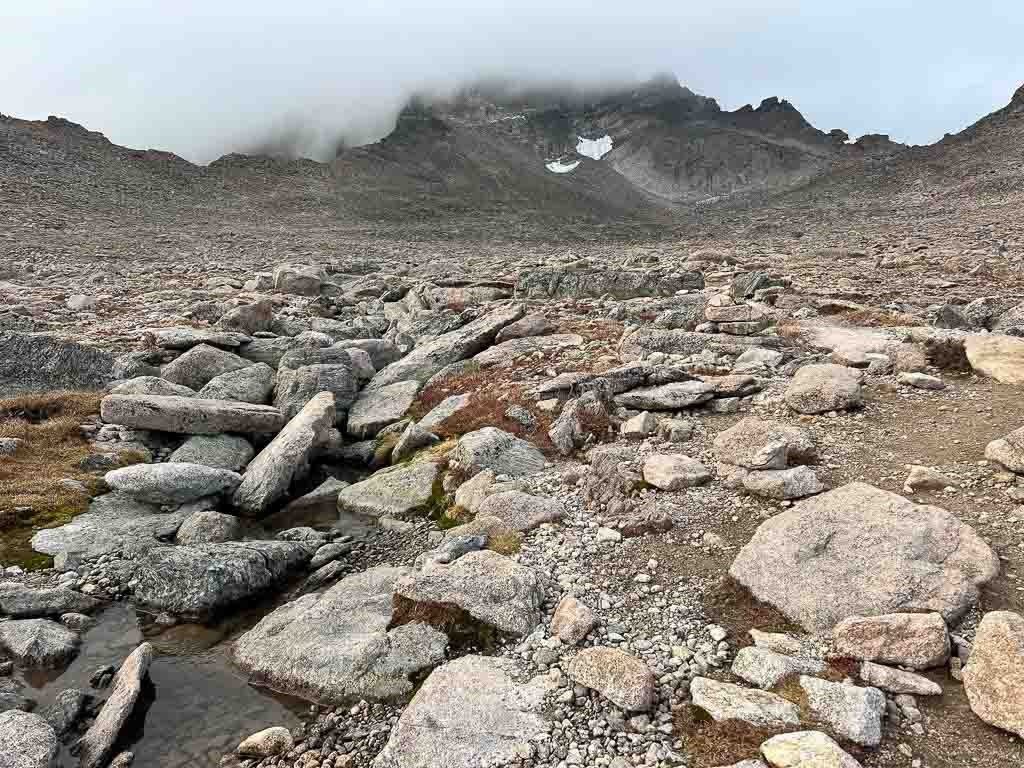
Longs Peak seen from the Boulderfield.
NPS · Public domain (U.S. federal government work) · Original recordImage changes
Resized and converted to JPEG for display; no subject alteration.
The words
Bear Lake
Bear Lake lies at the end of Bear Lake Road beneath Hallett Peak and surrounding mountain summits. Its trail network connects the lake with other high-country basins, including Dream and Emerald Lakes.
Chasm Lake
Chasm Lake fills a cirque, a steep-sided bowl carved by glacial ice beneath Longs Peak’s east face. It records the erosion that reshaped older stream-cut valleys into broader glacial troughs.
Diamond
The Diamond is the east face of Longs Peak, a steep wall approached from Chasm Lake. Its climbing routes occupy technical terrain high on the mountain.
Park Service: Longs Peak’s steep east face (opens a new tab)
Enos Mills
Enos Mills campaigned for the park through lectures, letters, articles and lobbying. His effort helped build support for protection before President Woodrow Wilson signed the park act on January 26, 1915.
Estes Park
Around Estes Park, cattle ranching helped give rise to mountain tourism before the national park was established. Some ranchers converted their properties to guest ranches and built cabins for visitors.
Park Service: Ranches and mountain tourism (opens a new tab)
Isabella Bird
Isabella Bird climbed Longs Peak during her 1873 Colorado travels. Her letters described the Estes Park landscape for readers far away, helping introduce its mountains and scenery to a wider audience.
Did you know?
Bird’s Colorado letters appeared in 1879 as A Lady’s Life in the Rocky Mountains, bringing her travel account into book form.
Kawuneeche
Kawuneeche Valley carries the upper Colorado River through a landscape historically rich in willow wetlands and beaver ponds. Draining wetlands and removing vegetation altered that water-dependent habitat.
Did you know?
A restoration partnership formed in 2020 to bring local governments, researchers, conservation groups and park managers together around the valley’s damaged wetlands.
Park Service: Kawuneeche’s changing wetlands (opens a new tab)
Keyhole
The Keyhole is a rock formation on Longs Peak that gives a mountaineering route its name. Beyond it, exposed ledges, loose rock and steep cliffs make the route hazardous.
Park Service: The Keyhole’s exposed terrain (opens a new tab)
Longs Peak
Longs Peak is the park’s highest summit, rising to 14,259 feet (4,346 m). It bears the name of Stephen H. Long, whose 1820 expedition avoided these mountains.
Park Service: Longs Peak’s steep east face (opens a new tab) · Park Service: Campaign to create the park (opens a new tab)
Milner Pass
Milner Pass marks Trail Ridge Road’s crossing of the Continental Divide. Here the ridge separates eastward and westward drainage, while the road drops below its higher stretches across alpine tundra.
Moraine Park
Moraine Park lies where several glaciers once converged and melted. They left ridges of rock debris along the valley’s sides and against Eagle Cliff, preserving the outline of the former ice.
Never Summer
The Never Summer Mountains preserve a volcanic chapter of Rocky Mountain’s history. Their lavas and underground intrusions formed about 27–29 million years ago, far later than the park’s ancient granite.
Park Service: Never Summer’s volcanic rocks (opens a new tab)
Ptarmigan
White-tailed ptarmigans live in Rocky Mountain’s high country, breeding near or above treeline. Their plumage changes from brown and gray in summer to white in winter, providing seasonal camouflage.
Did you know?
Even when its body feathers turn brown and gray in summer, the white-tailed ptarmigan keeps a white tail.
Park Service: Ptarmigan plumage and habitat (opens a new tab)
Trail Ridge
Trail Ridge Road connects Estes Park and Grand Lake across changing mountain habitats. Aspen and pine forests give way to spruce and fir, then wind-shaped trees and open alpine tundra.
Wapiti
Wapiti is another name for North American elk. Rocky Mountain’s herds follow seasonal food, feeding higher on tundra vegetation in summer and moving toward lower valleys as winter approaches.
Did you know?
Elk calves are born with spotted coats. Those spots fade by late summer, so a calf’s appearance changes during its first season.
Sources
- Two Climbers Rescued on the Diamond of Longs Peak in Rocky Mountain National Park - Rocky Mountain National ParkNational Park Service
- Brief Park History - Rocky Mountain National ParkNational Park Service
- Isabella Bird's 1873 Visit to Rocky Mountain National Park - Rocky Mountain National ParkNational Park Service
- Longs Peak-Keyhole Route: Frequently Asked Questions - Rocky Mountain National ParkNational Park Service
- Trail Ridge Road - Rocky Mountain National ParkNational Park Service
- Elk - Rocky Mountain National ParkNational Park Service
- Bear LakeNational Park Service
- Geologic Activity - Rocky Mountain National ParkNational Park Service
- The Formation of the Never Summer RangeNational Park Service
- White-tailed Ptarmigan - Rocky Mountain National ParkNational Park Service
- The Kawuneeche Valley Restoration CollaborativeNational Park Service
- Historic Buildings - Rocky Mountain National ParkNational Park Service