
The Life of Jesus
Puzzle 80 · Toward the Holy City · Page 112 in print
The Raising of Lazarus
At Bethany, Jesus meets grief with the promise of resurrection and calls Lazarus from a cave sealed by a stone.
Jump to a word
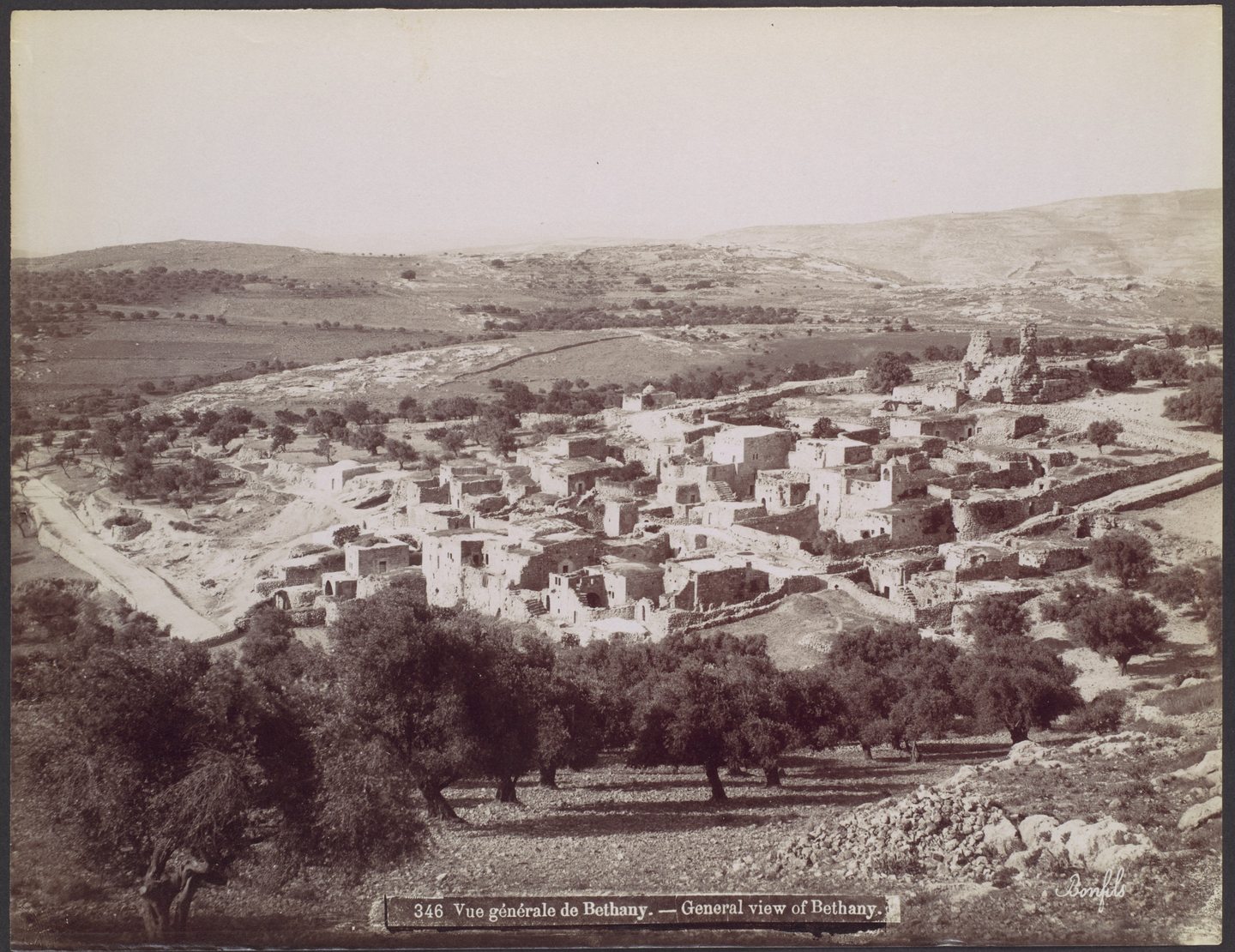
Vue générale de Bethany - General view of Bethany.
The later view gives geographical context for Bethany, the village named in John’s account.
Félix Bonfils · CC0 1.0 · Original recordImage changes
Resized proportionally to at most 1440px and JPEG compressed; no crop or content alteration.
The words
Bethany
John introduces Bethany as the village of Lazarus, Mary and Martha. The sisters send Jesus word of Lazarus’s illness; later, Martha goes out to meet Jesus while Mary remains in the house.
Did you know?
John places Bethany about fifteen furlongs from Jerusalem. The NET renders the distance as less than two miles (about 3 km), locating the village close to the city.
John 11:1–3, 18, 20 (opens a new tab) · NET Bible: John 11 (opens a new tab)
Cave
John describes Lazarus’s grave as a cave with a stone across it. Jesus tells those present to remove the stone, and the account moves from Martha’s concern to Jesus’s prayer and call to Lazarus.
Didymus
A Greek name meaning twin, used for Thomas.
John identifies Thomas as Didymus when he speaks to the other disciples about going with Jesus. His words include dying with him, following the discussion of returning to Judea.
John 11:7–8, 16 (opens a new tab) · NET Bible: John 11 (opens a new tab)
Four Days
When Jesus arrives, John says Lazarus has already been in the grave four days. Martha repeats that length of time when Jesus asks for the stone to be removed, explaining her concern about the body.
Friend
Jesus calls Lazarus their friend while speaking of waking him from sleep. The disciples understand ordinary rest, so John explains the misunderstanding before Jesus tells them plainly that Lazarus is dead.
Graveclothes
Burial cloths binding the body.
After Jesus calls Lazarus out, John describes his hands and feet still bound in graveclothes, with a cloth around his face. Jesus then tells those present to loosen the bindings and let him go.
John 11:43–44 (opens a new tab) · NET Bible: John 11 (opens a new tab)
Groaned
John says Jesus groans in spirit and is troubled when he sees Mary and the mourners weeping. Later, he describes Jesus groaning again as he comes to the grave before asking for the stone’s removal.
Lazarus
Lazarus is the brother whose illness brings the sisters’ message to Jesus. At the grave, Jesus calls him by name; John then describes the man who had died coming out, still wrapped in burial cloths.
Lovest
The sisters identify Lazarus in their message as the one Jesus loves. John then explicitly states Jesus’s love for Martha, her sister and Lazarus, before describing his remaining two more days where he is.
Martha
Martha goes out to meet Jesus and speaks with him about her brother’s death. When Jesus says Lazarus will rise again, she answers in terms of resurrection at the last day before hearing Jesus’s self-description.
Resurrection
Martha speaks of her brother rising in the resurrection at the last day. Jesus answers by identifying himself as the resurrection and the life, then asks whether she believes what he has said.
Sickness
Lazarus’s illness is the news his sisters send to Jesus at the opening of John’s account. Jesus connects the sickness with God’s glory; later he tells the disciples plainly that Lazarus has died.
Stinketh
Has a bad smell.
Martha objects when Jesus asks for the stone to be removed, saying Lazarus’s body will smell after four days. John presents this as her concern before the stone is taken away and Lazarus is called out.
John 11:39–43 (opens a new tab) · NET Bible: John 11 (opens a new tab)
Stumbleth
Jesus contrasts walking by day with walking at night, when a person stumbles without light. In John, this saying answers the disciples’ concern about returning to Judea before Jesus speaks of going to Lazarus.
Wept
John places Jesus’s tears after his seeing Mary and the mourners weeping and asking where Lazarus has been laid. Those present respond by speaking of his love for Lazarus before he comes to the grave.
Sources
- John 11 (NET Bible), translation and notesNET Bible, via Bible Gateway
- John 11:1-44 (King James Version)King James Version, passage navigation via Bible Gateway