
The Life of Jesus
Puzzle 76 · Toward the Holy City · Page 108 in print
The Pharisee and the Publican
Two men pray in the temple; the tax collector’s appeal for mercy overturns the expected comparison.
Jump to a word
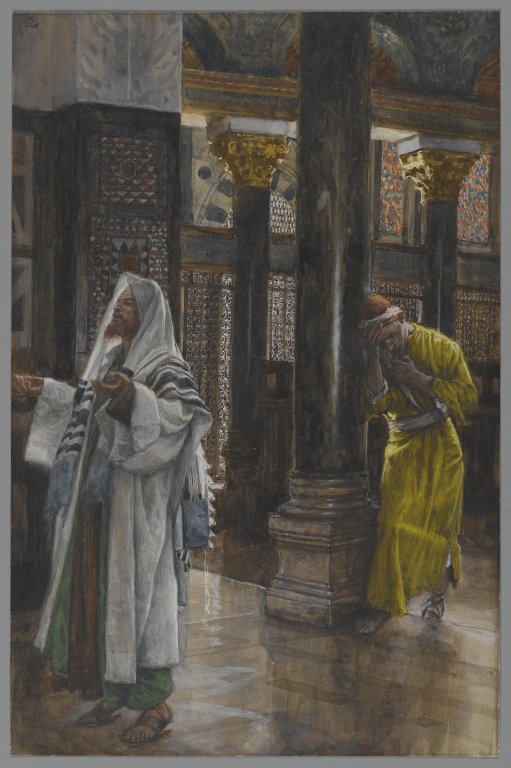
The Pharisee and the Publican, James Tissot, opaque watercolor, 1886–1894.
James Tissot / Brooklyn Museum, Purchased by public subscription (00.159.178) · Public domain · Original recordImage changes
Display copies resized; original downloaded JPEG preserved.
The words
Abased
Humbled or brought low.
Jesus ends the parable by saying that whoever exalts himself will be humbled. That reversal follows his announcement that the tax collector, rather than the other man, goes home justified.
Luke 18:14 (opens a new tab) · NET Bible: Luke 18:9–14 (opens a new tab)
Adulterers
In the Pharisee’s prayer, adulterers appear among the people he thanks God he is unlike. Luke presents this as the man’s comparison with others, alongside his dismissal of the tax collector.
Afar Off
The tax collector stands at a distance and does not raise his eyes toward heaven. Luke places that posture beside his appeal for mercy, contrasting it with the Pharisee’s account of himself.
Breast
The tax collector strikes his chest as he asks God for mercy and calls himself a sinner. His gesture accompanies the short prayer, rather than the list of observances offered by the other man.
Despised
Luke introduces the parable as addressed to people who trusted in their own righteousness and looked down on others. The opening identifies the attitude behind the comparison between the two prayers.
Exalteth
Jesus’s closing saying describes the reversal awaiting someone who raises himself above others. In the parable, the man who asks for mercy goes home justified rather than the man praising his own conduct.
Did you know?
Earlier in Luke, Jesus gives the same warning about self-exaltation while speaking to guests choosing places of honor. There he advises an invited guest to take the lowest place.
Luke 18:11–14 (opens a new tab) · Luke 14:7–11 (opens a new tab)
Extortioners
People who swindle others for gain.
The Pharisee includes extortioners in his list of people he says he is unlike. His prayer puts that accusation beside other wrongdoing before turning to his fasting and tithes.
Luke 18:11–12 (opens a new tab) · NET Bible: Luke 18:9–14 (opens a new tab)
Justified
Jesus says the tax collector goes home justified rather than the other man. This verdict follows the plea for mercy and leads into the closing saying about humbling and exalting oneself.
Pharisee
One of the two men praying in the temple is a Pharisee. In his prayer, he distinguishes himself from other people and names his twice-weekly fasting and tithes as part of that comparison.
Possess
The Pharisee says he gives tithes of all that he possesses. Luke places that claim beside his twice-weekly fasting, within the prayer in which he sets himself apart from other people.
Publican
Tax collector.
Luke’s publican stands at a distance, does not look up and asks God for mercy. Jesus then names this man, rather than the Pharisee, as the one who goes home justified.
Luke 18:10, 13–14 (opens a new tab) · NET Bible: Luke 18:9–14 (opens a new tab)
Smote
Struck or beat.
The tax collector beats his breast while asking God to be merciful to him. Luke describes that action with his lowered eyes and distant position, giving the prayer both words and posture.
Luke 18:13 (opens a new tab) · NET Bible: Luke 18:9–14 (opens a new tab)
Tithes
Gifts or payments of a tenth.
Tithes form the second observance the Pharisee names after his fasting. He says his giving covers all he possesses, continuing the account of his own conduct before the tax collector’s plea for mercy.
Luke 18:12–13 (opens a new tab) · NET Bible: Luke 18:9–14 (opens a new tab)
Trusted
Before either man speaks, Luke identifies the hearers as people relying on their own righteousness and despising others. That introduction gives the reason for Jesus’s comparison of the two men at prayer.
Twice
The Pharisee says he fasts twice each week, then adds that he gives tithes. Both claims belong to his prayer, which contrasts his own conduct with that of other people.
Sources
- Luke 18:9-14 (King James Version)King James Version, passage navigation via Bible Gateway
- Luke 18:9-14 (NET Bible), translation and notesNET Bible, via Bible Gateway
- Luke 14:7-11 (King James Version)King James Version, passage navigation via Bible Gateway