
The Life of Jesus
Puzzle 49 · Wonders by the Water · Page 74 in print
Walking on the Water
Jesus approaches the struggling boat on the water; Matthew also tells of Peter stepping out and beginning to sink.
Jump to a word
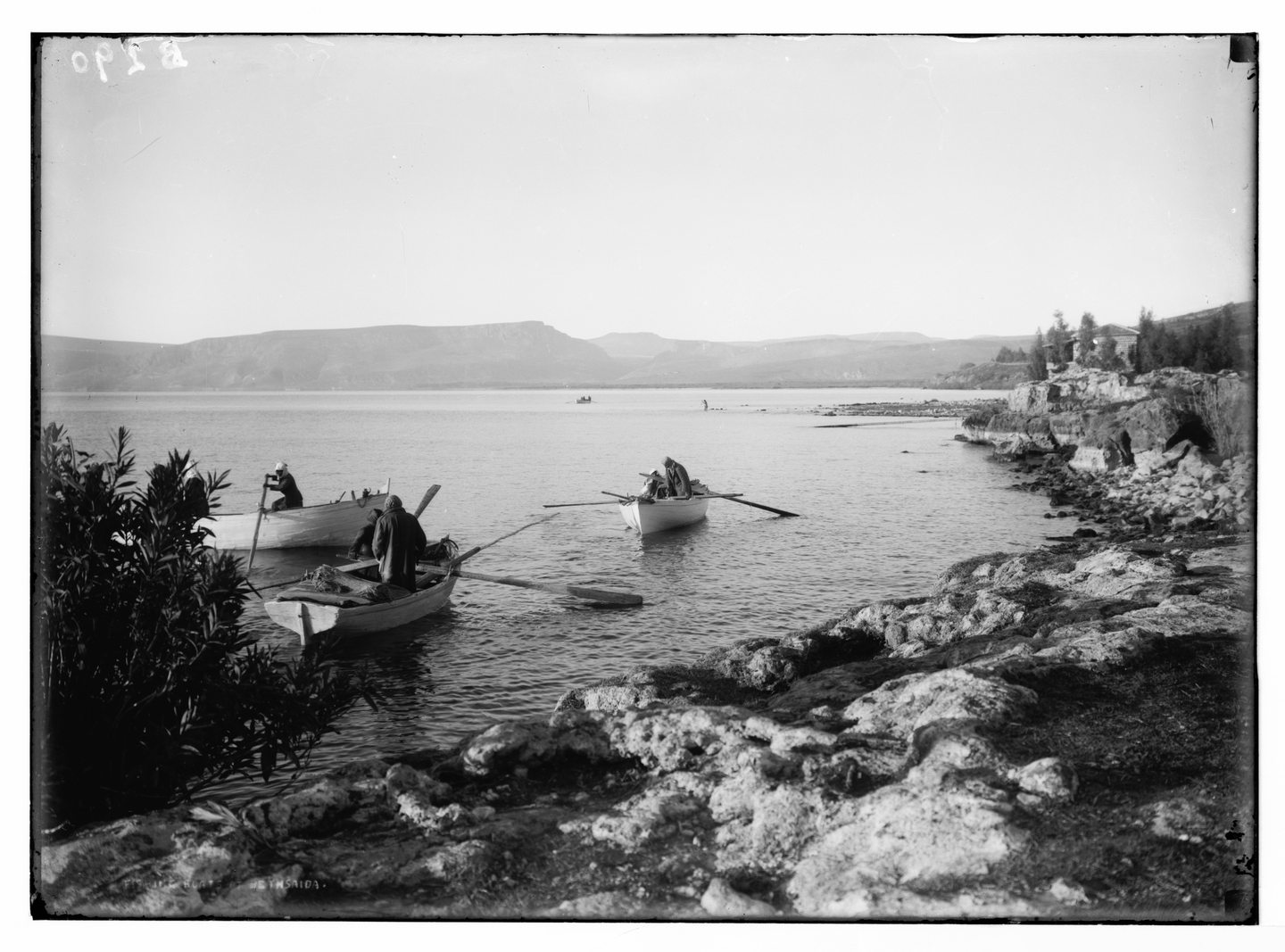
Fishing boats on the Sea of Galilee, about 1900–1920.
The boats offer a tangible comparison for rowing against the wind, without being first-century vessels.
G. Eric and Edith Matson Photograph Collection, Library of Congress · Public Domain Mark 1.0 · Original recordImage changes
Resized proportionally to at most 1440px and JPEG compressed; no crop or content alteration.
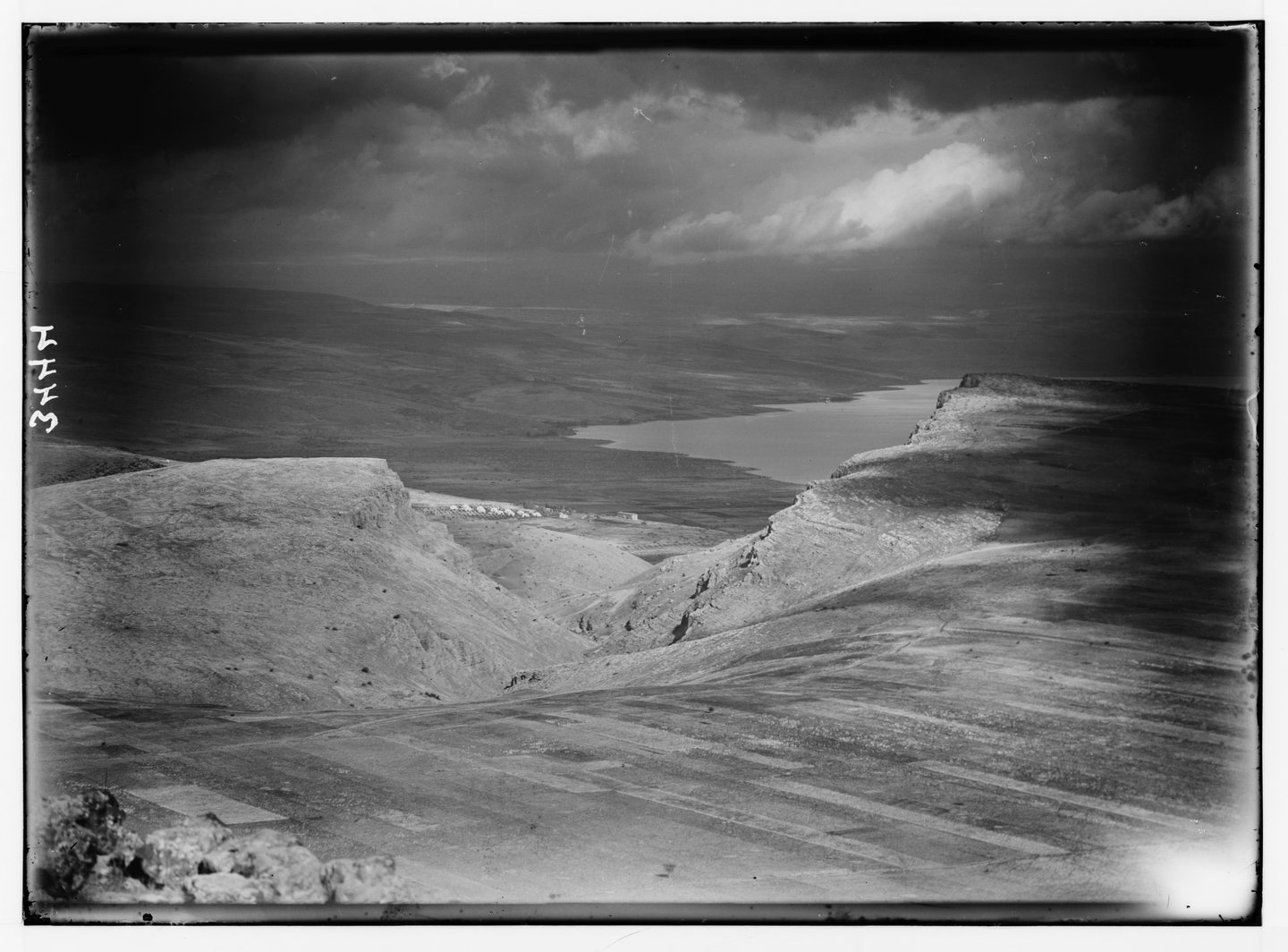
Lake Galilee from Hattin (1920).
The open water gives scale to the passage’s distance from shore and approach across the lake.
G. Eric and Edith Matson Photograph Collection, Library of Congress · Public Domain Mark 1.0 · Original recordImage changes
Resized proportionally to at most 1440px and JPEG compressed; no crop or content alteration.
The words
Alone
Matthew describes Jesus praying alone on the mountain after sending the crowd away; Mark contrasts him alone on land with the disciples’ boat out on the sea.
Matthew 14:23 (opens a new tab) · Mark 6:46–47 (opens a new tab)
Boisterous
Strong and turbulent.
Matthew’s KJV calls the wind boisterous when Peter notices it and becomes afraid; the NET says strong wind. The fear comes as he walks toward Jesus and begins to sink.
Matthew 14:29–30 (opens a new tab) · NET Bible: Matthew 14:22-33 (opens a new tab)
Caught
As Peter cries for Jesus to save him, Matthew says Jesus immediately reaches out and catches him; the question about little faith and doubt follows in the same verse.
Constrained
Made or strongly urged.
Matthew and Mark say Jesus constrained the disciples to enter the boat and go ahead while he dismissed the crowd; NET Mark says he made them get into the boat.
Matthew 14:22 (opens a new tab) · Mark 6:45 (opens a new tab) · NET Bible: Mark 6:45-52 (opens a new tab)
Contrary
Blowing against them.
Matthew and Mark describe the wind as contrary; Mark directly links it with the disciples’ hard rowing. The NET renders the wind as against them, explaining the older expression.
Matthew 14:24 (opens a new tab) · Mark 6:48 (opens a new tab) · NET Bible: Mark 6:45-52 (opens a new tab)
Doubt
Jesus asks Peter why he doubted after reaching out and catching him; Matthew places the question between Peter’s cry for help and their return to the boat.
Fourth Watch
The final night watch, about 3–6 a.m.
Matthew places Jesus’s approach in the fourth watch, and Mark says about that watch; the NET notes explain this as roughly 3–6 a.m., near the end of the night.
Matthew 14:25 (opens a new tab) · Mark 6:48 (opens a new tab) · NET Bible: Matthew 14:22-33 (opens a new tab)
Furlongs
Ancient distance units, about 607 feet (185 m) each.
John’s KJV gives about twenty-five or thirty furlongs of rowing before they see Jesus; the NET renders the distance as roughly 3–4 miles (5–6 km), using ancient stades.
John 6:19 (opens a new tab) · NET Bible: John 6:15-21 (opens a new tab)
Good Cheer
Courage; reassurance.
In Matthew and Mark, Jesus tells the frightened disciples to be of good cheer and identifies himself; the NET’s Have courage brings out the reassurance as he approaches the boat.
Matthew 14:26–27 (opens a new tab) · Mark 6:49–50 (opens a new tab) · NET Bible: Mark 6:45-52 (opens a new tab)
Midst of the Sea
Mark contrasts the boat in the midst of the sea with Jesus alone on land. Matthew’s KJV also says midst; its NET rendering places the boat far from land.
Did you know?
In Job’s speech about God’s power, Job 9:8 says God “treadeth upon the waves of the sea”—another biblical use of the image of walking on the sea.
Mark 6:47 (opens a new tab) · Matthew 14:24 (opens a new tab) · NET Bible: Matthew 14:22-33 (opens a new tab) · Job 9:1–10 (opens a new tab)
Rowing
Mark places the disciples’ rowing in an opposing wind while Jesus sees their struggle from land; John also describes rough water caused by a strong wind before the approach.
Mark 6:47–48 (opens a new tab) · John 6:18–19 (opens a new tab)
Sink
Matthew’s account includes Peter walking toward Jesus, becoming afraid of the wind and beginning to sink; his next words are a plea for Jesus to save him.
Toiling
Straining; working hard.
Mark’s phrase toiling in rowing describes the disciples’ effort against the wind; the NET renders it as straining at the oars, before Jesus comes toward them on the water.
Mark 6:48 (opens a new tab) · NET Bible: Mark 6:45-52 (opens a new tab)
Tossed
Battered by waves.
Matthew’s KJV describes the boat as tossed with waves because the wind is contrary; the NET says it was taking a beating from the waves before Jesus approaches.
Matthew 14:24–25 (opens a new tab) · NET Bible: Matthew 14:22-33 (opens a new tab)
Willingly
John’s KJV says they willingly received Jesus into the ship; the NET describes them wanting to take him aboard. Both then describe the boat reaching its destination immediately.
John 6:21 (opens a new tab) · NET Bible: John 6:15-21 (opens a new tab)
Sources
- Matthew 14:22-33 (King James Version)King James Version, passage navigation via Bible Gateway
- Mark 6:45-52 (King James Version)King James Version, passage navigation via Bible Gateway
- John 6:15-21 (King James Version)King James Version, passage navigation via Bible Gateway
- Matthew 14:22-33 (NET Bible), translation and notesNET Bible, via Bible Gateway
- Mark 6:45-52 (NET Bible), translation and notesNET Bible, via Bible Gateway
- John 6:15-21 (NET Bible), translation and notesNET Bible, via Bible Gateway
- Job 9:1-10 (King James Version)King James Version, passage navigation via Bible Gateway