
The Life of Jesus
Puzzle 26 · The First Signs · Page 45 in print
The Pool of Bethesda
At Bethesda, Jesus tells a man long ill to rise, carry his bed and walk, provoking a Sabbath dispute.
Jump to a word
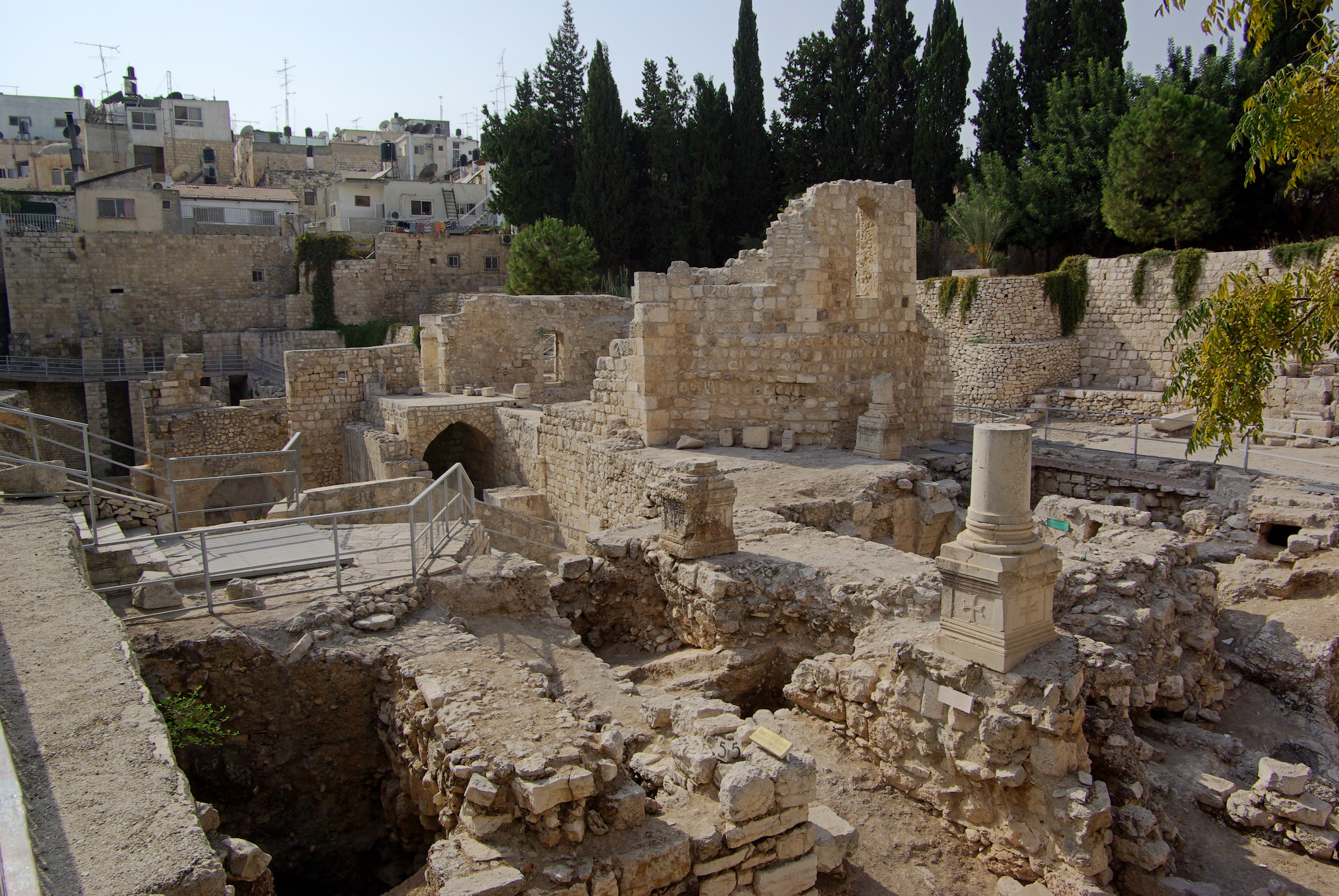
Excavations at the Bethesda pool complex, Jerusalem, photographed September 24, 2010.
The site includes later church ruins above the pools.
Berthold Werner / Wikimedia Commons · CC BY-SA 3.0 · Original recordImage changes
Display copies resized; original downloaded JPEG preserved.
The words
Bethesda
Often explained as Aramaic for “house of mercy.”
John sets this healing at a Jerusalem pool called Bethesda. Old manuscripts differ on the name: the NRSVue reads “Beth-zatha,” and its footnote gives “Bethesda or Bethsaida.”
Did you know?
Bethesda, Maryland, was a crossroads called Darcy’s Store until 1871, when it took the name of its Presbyterian church, Bethesda Meeting House. The church was named for this pool.
John 5:2 (opens a new tab) · NRSVue: John 5:1–18 (opens a new tab) · NIV: John 5:1–18 (opens a new tab) · Bible Odyssey: Bethzatha (opens a new tab) · Strong’s G964 (Bethesda) (opens a new tab) · Wikipedia: Bethesda, Maryland (opens a new tab) · MACo: Bethesda named for a church (opens a new tab) · WETA Boundary Stones: Bethesda (opens a new tab)
Certain Season
From time to time; at certain times.
In the KJV, an angel “went down at a certain season” and “troubled the water.” The King James Version follows later manuscripts here; many modern Bibles, following older ones, read differently or put these words in a footnote.
Did you know?
New York remembers this verse in bronze. At the 1873 dedication of Central Park’s Bethesda Fountain, sculptor Emma Stebbins said this angel inspired her Angel of the Waters.
John 5:4 (opens a new tab) · Strong’s G2540 (kairos) (opens a new tab) · Bible Odyssey: Holmes on KJV-only verses (opens a new tab) · NIV: John 5:1–18 (opens a new tab) · ESV: John 5:1–18 (opens a new tab) · NRSVue: John 5:1–18 (opens a new tab) · Central Park Conservancy: Bethesda Fountain (opens a new tab) · Wikipedia: Bethesda Terrace and Fountain (opens a new tab)
Conveyed
Withdrawn: Jesus had slipped quietly away.
John explains why the man could not tell his questioners who had healed him: “Jesus had conveyed himself away, a multitude being in that place.”
Did you know?
Thayer’s lexicon traces John’s Greek verb to one meaning to bend aside or withdraw, but notes that others derive it from a verb meaning “to swim away” or “to escape, slip away secretly.”
John 5:13 (opens a new tab) · Strong’s G1593 (ekneuo) (opens a new tab)
Equal with God
John writes that the religious leaders opposing Jesus “sought the more to kill him”: he had broken the sabbath, they held, and called God his Father, “making himself equal with God.”
Did you know?
The phrase appears only once more in the King James Bible. Paul writes that Christ Jesus, “being in the form of God, thought it not robbery to be equal with God.”
John 5:18 (opens a new tab) · ESV: John 5:1–18 (opens a new tab) · KJV search: “equal with God” (opens a new tab) · Philippians 2:5–6 (opens a new tab)
Five Porches
Covered walkways where people could stand, protected from weather and sun.
John describes the pool as “having five porches,” where the sick lay. The NIV calls them “five covered colonnades,” the NRSVue “five porticoes.”
Did you know?
Around 333, a pilgrim from Bordeaux described Jerusalem’s “twin pools with five porticoes,” called Bethsaida, a variant of the name. The pools beside St. Anne’s Church are traditionally identified as Bethesda: Byzantine and Crusader Christians marked the site with churches.
John 5:2 (opens a new tab) · NIV: John 5:1–18 (opens a new tab) · NRSVue: John 5:1–18 (opens a new tab) · Strong’s G4745 (stoa) (opens a new tab) · Wolf, Onomasticon note 291 (opens a new tab) · Wolf, Onomasticon introduction (opens a new tab) · Wikipedia: Pool of Bethesda (opens a new tab) · BAS: The Bethesda Pool (opens a new tab)
Halt
Lame; limping.
Among the sick in the porches, the KJV lists “blind, halt, withered.” Modern Bibles render the three words as the blind, the lame and the paralyzed.
Did you know?
Elijah uses the word figuratively: “How long halt ye between two opinions?” Brown-Driver-Briggs gives his Hebrew verb the sense “limp,” and lists a verb spelled the same for “passing over,” used of the first Passover.
John 5:3 (opens a new tab) · NIV: John 5:1–18 (opens a new tab) · NRSVue: John 5:1–18 (opens a new tab) · Strong’s G5560 (cholos) (opens a new tab) · 1 Kings 18:21 (opens a new tab) · Strong’s H6452 (pacach) (opens a new tab)
Hebrew Tongue
Here probably Aramaic, as the NIV and ESV translate it.
John gives the pool’s local name, “called in the Hebrew tongue Bethesda.” He does the same at Jesus’s trial and crucifixion for Gabbatha, “the Pavement,” and Golgotha, “the place of a skull.”
Did you know?
The phrase “in the Hebrew tongue” appears in six KJV verses. When Paul used that language to address the people, Acts says, “they kept the more silence.” Revelation names Armageddon “in the Hebrew tongue.”
John 5:2 (opens a new tab) · NIV: John 5:1–18 (opens a new tab) · ESV: John 5:1–18 (opens a new tab) · NRSVue: John 5:1–18 (opens a new tab) · Strong’s G1447 (Hebraisti) (opens a new tab) · John 19:13, 17 (opens a new tab) · KJV search: “in the Hebrew tongue” (opens a new tab) · Acts 21:40–22:2 (opens a new tab) · Revelation 16:16 (opens a new tab)
Hitherto
Up to this time; until the present.
Jesus answers those who persecuted him for healing on the sabbath: “My Father worketh hitherto, and I work.” The ESV reads, “My Father is working until now.”
Did you know?
Samuel used the word when he set up a stone and named it Ebenezer, “saying, Hitherto hath the LORD helped us.” That Ebenezer is the one in Robert Robinson’s hymn “Come Thou Fount of Every Blessing.”
John 5:16–17 (opens a new tab) · ESV: John 5:1–18 (opens a new tab) · Strong’s G737 (arti) (opens a new tab) · 1 Samuel 7:12 (opens a new tab) · Wikipedia: Come Thou Fount (opens a new tab)
Impotent Folk
Sick or disabled people. John’s Greek word means to be weak or without strength.
John says “a great multitude of impotent folk” lay in the porches. The man Jesus heals is called “the impotent man,” with “no man” to help him into the pool.
Did you know?
The KJV uses “impotent” again for a man at Lystra, “impotent in his feet,” who had never walked. When Paul healed him, the people called Barnabas Jupiter and Paul Mercurius.
John 5:3, 7 (opens a new tab) · Strong’s G770 (astheneo) (opens a new tab) · Acts 14:8–12 (opens a new tab)
Infirmity
“A certain man was there, which had an infirmity thirty and eight years.” Jesus, John says, knew “he had been now a long time in that case.”
Did you know?
“Thirty and eight years” occurs only once more in the KJV: Deuteronomy 2:14 gives that span for Israel’s journey from Kadeshbarnea until they crossed the brook Zered.
John 5:5–6 (opens a new tab) · KJV search: “thirty and eight years” (opens a new tab) · Deuteronomy 2:14 (opens a new tab)
Moving
The KJV says the sick lay “waiting for the moving of the water.” The King James Version follows later manuscripts here; many modern Bibles, following older ones, read differently or put these words in a footnote.
Did you know?
The Greek word behind “moving” here is kinēsis, “a stirring.” English “kinetic,” as in kinetic energy, has its roots in the same word, meaning “motion.”
John 5:3 (opens a new tab) · Bible Odyssey: Holmes on KJV-only verses (opens a new tab) · NIV: John 5:1–18 (opens a new tab) · ESV: John 5:1–18 (opens a new tab) · Strong’s G2796 (kinesis) (opens a new tab) · Wikipedia: Kinetic energy (opens a new tab)
Rise
Jesus’s command is “Rise, take up thy bed, and walk,” and the healed man “took up his bed, and walked.” “Take up thy bed, and walk” is repeated twice more as he is questioned.
Did you know?
Cross-references in modern Bibles tie the objection, “it is not lawful for thee to carry thy bed,” to Jeremiah 17:21: “bear no burden on the sabbath day, nor bring it in by the gates of Jerusalem.”
John 5:8–12 (opens a new tab) · NIV: John 5:1–18 (opens a new tab) · ESV: John 5:1–18 (opens a new tab) · Jeremiah 17:21–22 (opens a new tab)
Sheep Market
Probably the Sheep Gate. John’s Greek says only “sheep”; the KJV supplies “market.”
The KJV places the pool “by the sheep market.” Many modern Bibles read “Sheep Gate,” the gate that Nehemiah says “Eliashib the high priest” and his fellow priests built and sanctified.
Did you know?
Eusebius, writing about 330, passed on a story: of twin pools shown in his day, one turned red, “bearing the traces of the sacrificial victims formerly washed in it,” hence the name “sheep.”
John 5:2 (opens a new tab) · Strong’s G4262 (probatikos) (opens a new tab) · NIV: John 5:1–18 (opens a new tab) · ESV: John 5:1–18 (opens a new tab) · Nehemiah 3:1 (opens a new tab) · Eusebius, Onomasticon: Bezatha (opens a new tab) · Wolf, Onomasticon introduction (opens a new tab)
Whole
Healthy, sound in body; “made whole” means restored to health.
Jesus first asks, “Wilt thou be made whole?” Later, finding the man in the temple, he warns him: “Behold, thou art made whole: sin no more, lest a worse thing come unto thee.”
Did you know?
Later in John, Jesus defends his “one work” with the word again: “are ye angry at me, because I have made a man every whit whole on the sabbath day?”
John 5:6, 14 (opens a new tab) · Strong’s G5199 (hugies) (opens a new tab) · John 7:21–23 (opens a new tab) · ESV: John 5:1–18 (opens a new tab)
Wist
Knew: the old past tense of “wit,” to know.
Questioned about who told him to carry his bed, “he that was healed wist not who it was.” Only after their meeting in the temple did he tell them it was Jesus.
Did you know?
Moses is another who “wist not.” Coming down from Sinai with the two tables, he “wist not that the skin of his face shone.”
John 5:12–15 (opens a new tab) · Dictionary.com: wit, wist (opens a new tab) · Exodus 34:29 (opens a new tab)
Sources
- John 5:1-18 (King James Version)King James Version, passage navigation via Bible Gateway
- John 5:1-18 (New International Version)New International Version, passage navigation via Bible Gateway
- John 5:1-18 (English Standard Version)English Standard Version, passage navigation via Bible Gateway
- John 5:1-18 (New Revised Standard Version Updated Edition)New Revised Standard Version Updated Edition, passage navigation via Bible Gateway
- John 7:21-23 (King James Version)King James Version, passage navigation via Bible Gateway
- John 19:13-17 (King James Version)King James Version, passage navigation via Bible Gateway
- Nehemiah 3:1 (King James Version)King James Version, passage navigation via Bible Gateway
- 1 Kings 18:21 (King James Version)King James Version, passage navigation via Bible Gateway
- 1 Samuel 7:12 (King James Version)King James Version, passage navigation via Bible Gateway
- Acts 14:8-12 (King James Version)King James Version, passage navigation via Bible Gateway
- Acts 21:40-22:2 (King James Version)King James Version, passage navigation via Bible Gateway
- Revelation 16:16 (King James Version)King James Version, passage navigation via Bible Gateway
- Deuteronomy 2:14 (King James Version)King James Version, passage navigation via Bible Gateway
- Exodus 34:29 (King James Version)King James Version, passage navigation via Bible Gateway
- Philippians 2:5-6 (King James Version)King James Version, passage navigation via Bible Gateway
- Jeremiah 17:21-22 (King James Version)King James Version, passage navigation via Bible Gateway
- Keyword search: "equal with God", King James VersionBible Gateway
- Keyword search: "thirty and eight years", King James VersionBible Gateway
- Keyword search: "in the Hebrew tongue", King James VersionBible Gateway
- Strong’s Greek 964: BethesdaBible Hub
- Strong’s Greek 1447: Hebraisti (in Hebrew)Bible Hub
- Strong’s Greek 1593: ekneuo (to withdraw)Bible Hub
- Strong’s Greek 2540: kairos (time, season)Bible Hub
- Strong’s Greek 2796: kinesis (moving)Bible Hub
- Strong’s Greek 4262: probatikos (relating to sheep)Bible Hub
- Strong’s Greek 4745: stoa (portico, colonnade)Bible Hub
- Strong’s Greek 5199: hugies (sound, whole)Bible Hub
- Strong’s Greek 5560: cholos (lame)Bible Hub
- Strong’s Greek 737: arti (now, hitherto)Bible Hub
- Strong’s Greek 770: astheneo (to be weak, sick)Bible Hub
- Strong’s Hebrew 6452: pacach (to pass over; to limp)Bible Hub
- What Are English Translations of the Christian Bible Based On? (Michael W. Holmes)Bible Odyssey, Society of Biblical Literature
- Bethzatha (HarperCollins Bible Dictionary)Bible Odyssey, Society of Biblical Literature
- Pool of BethesdaWikipedia
- The Bethesda Pool, Site of One of Jesus’ MiraclesBiblical Archaeology Society, Bible History Daily
- Eusebius, Onomasticon, tr. C. Umhau Wolf (1971): BezathaTertullian.org (Roger Pearse)
- Eusebius, Onomasticon, tr. C. Umhau Wolf (1971): IntroductionTertullian.org (Roger Pearse)
- Eusebius, Onomasticon, tr. C. Umhau Wolf (1971): Notes, note 291Tertullian.org (Roger Pearse)
- Bethesda, MarylandWikipedia
- Fun Fact: This Popular Spot in Montgomery County Was Named After a Church – Not the Other Way AroundMaryland Association of Counties, Conduit Street
- What’s in a Name? BethesdaWETA, Boundary Stones
- Bethesda FountainCentral Park Conservancy
- Bethesda Terrace and FountainWikipedia
- Come Thou Fount of Every BlessingWikipedia
- Kinetic energy: History and etymologyWikipedia
- WIT Definition & MeaningDictionary.com