
The Life of Jesus
Puzzle 16 · The Forerunner · Page 32 in print
Come and See
The first followers encounter Jesus through an invitation to come and see; names and confessions accumulate.
Jump to a word
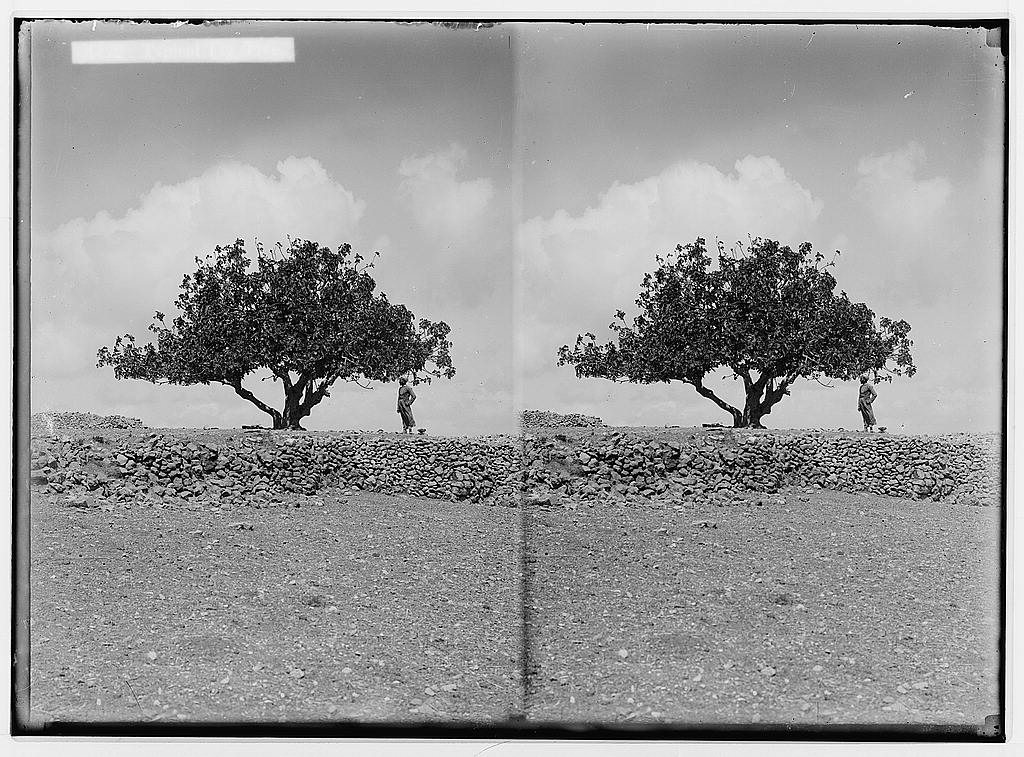
Fig tree before locust damage, photographed in 1915.
A photographed fig tree makes the tree in Jesus’s words to Nathanael concrete; it is not the tree in the account.
American Colony (Jerusalem). Photo Department; G. Eric and Edith Matson Photograph Collection, Library of Congress. · No known restrictions on publication · Original recordImage changes
Resized proportionally to at most 1440px and JPEG compressed; no crop or content alteration.
The words
Andrew
John names Andrew as one of the Baptist’s two disciples who follow Jesus; Andrew then finds his brother Simon and brings him to Jesus.
Did you know?
John later gives Andrew a part in the bread scene: he points out a boy with five barley loaves and two small fish, while questioning their sufficiency.
John 1:35–42 (opens a new tab) · John 6:8–9 (opens a new tab)
Ascending
John closes the scene with Jesus speaking of heaven opening and angels of God ascending and descending upon the Son of man, after his promise of greater things.
Did you know?
Genesis 28 uses “ascending and descending” in Jacob’s dream of a ladder reaching to heaven; John’s scene places the angels upon the Son of man.
John 1:50–51 (opens a new tab) · Genesis 28:10–12 (opens a new tab)
Cephas
An Aramaic name translated as Peter.
John records Jesus giving Simon the name Cephas, which the KJV interprets as “A stone”; the NET gives Peter as its translation.
John 1:42 (opens a new tab) · NET Bible: John 1:35-42 (opens a new tab)
Dwellest
Are staying.
In John’s account, the Baptist’s two disciples ask Jesus “where dwellest thou?” He replies “Come and see,” and they stay with him that day.
John 1:37–39 (opens a new tab) · NET Bible: John 1:35-42 (opens a new tab)
Fig Tree
John records Jesus saying he saw Nathanael under the fig tree before Philip called him; Nathanael then addresses Jesus as Rabbi, Son of God and King of Israel.
Greater Things
John records Jesus answering Nathanael with a promise of greater things, then speaking of heaven opening and angels ascending and descending upon the Son of man.
Guile
John places Jesus’s “no guile” description as Nathanael approaches, before Nathanael asks how Jesus knows him and hears the reply about the fig tree.
Israelite
John reports Jesus calling Nathanael “an Israelite indeed” and adding “in whom is no guile”; Nathanael then asks how Jesus knows him.
Jona
Jonah, the name used here in the KJV.
John’s KJV text calls Simon “the son of Jona” when Jesus gives him the name Cephas; the NET reads “son of John” at this point.
John 1:42 (opens a new tab) · NET Bible: John 1:35-42 (opens a new tab) · Strong’s: Jona / Jonah (opens a new tab)
King of Israel
John gives “King of Israel” as Nathanael’s words to Jesus, paired with “Son of God” after Jesus’s statement that he saw him under the fig tree.
Messias
Messiah, meaning “the anointed one.”
John reports Andrew telling Simon “We have found the Messias,” then explains the title as Christ; Andrew brings his brother to Jesus.
Did you know?
John uses “Messias” again in a woman’s conversation with Jesus in chapter 4; there too the text explains the title with “Christ.”
John 1:41–42 (opens a new tab) · NET Bible: John 1:35-42 (opens a new tab) · John 4:25–26 (opens a new tab)
Nathanael
John presents Nathanael receiving Philip’s invitation, approaching Jesus and asking how Jesus knows him, before answering with titles that include Son of God and King of Israel.
Did you know?
John names Nathanael again in the scene at the sea of Tiberias, this time identifying him as “of Cana in Galilee” among the disciples gathered there.
John 1:45–49 (opens a new tab) · John 21:1–2 (opens a new tab)
Philip
John says Jesus calls Philip to follow him; Philip then finds Nathanael, identifies Jesus of Nazareth and answers Nathanael’s question with “Come and see.”
Rabbi
A title meaning “teacher.”
John translates Rabbi as Master when the two disciples address Jesus; Nathanael later uses the same title before calling Jesus Son of God and King of Israel.
John 1:38 (opens a new tab) · John 1:49 (opens a new tab) · NET Bible: John 1:35-42 (opens a new tab)
Tenth Hour
John says it was “about the tenth hour” when the two disciples came, saw where Jesus stayed and remained with him that day.
Sources
- John 1:35-42 (King James Version)King James Version, passage navigation via Bible Gateway
- John 1:43-51 (King James Version)King James Version, passage navigation via Bible Gateway
- Genesis 28:10-17 (King James Version)King James Version, passage navigation via Bible Gateway
- John 4:25-26 (King James Version)King James Version, passage navigation via Bible Gateway
- John 21:1-4 (King James Version)King James Version, passage navigation via Bible Gateway
- John 6:5-9 (King James Version)King James Version, passage navigation via Bible Gateway
- John 1:35-42 (NET Bible), translation and notesNET Bible, via Bible Gateway
- Strong’s G2495: Iónas (Jonah)Strong’s and Thayer’s lexicons, via Bible Hub