
Wildlife of the World
Puzzle 59 · Polar and Subpolar Worlds · Page 90 in print
Emperor Penguin
The emperor penguin is the largest living penguin; through the Antarctic winter, males protect a single egg on their feet beneath a fold of skin, relying on stored fat during incubation.
Jump to a word
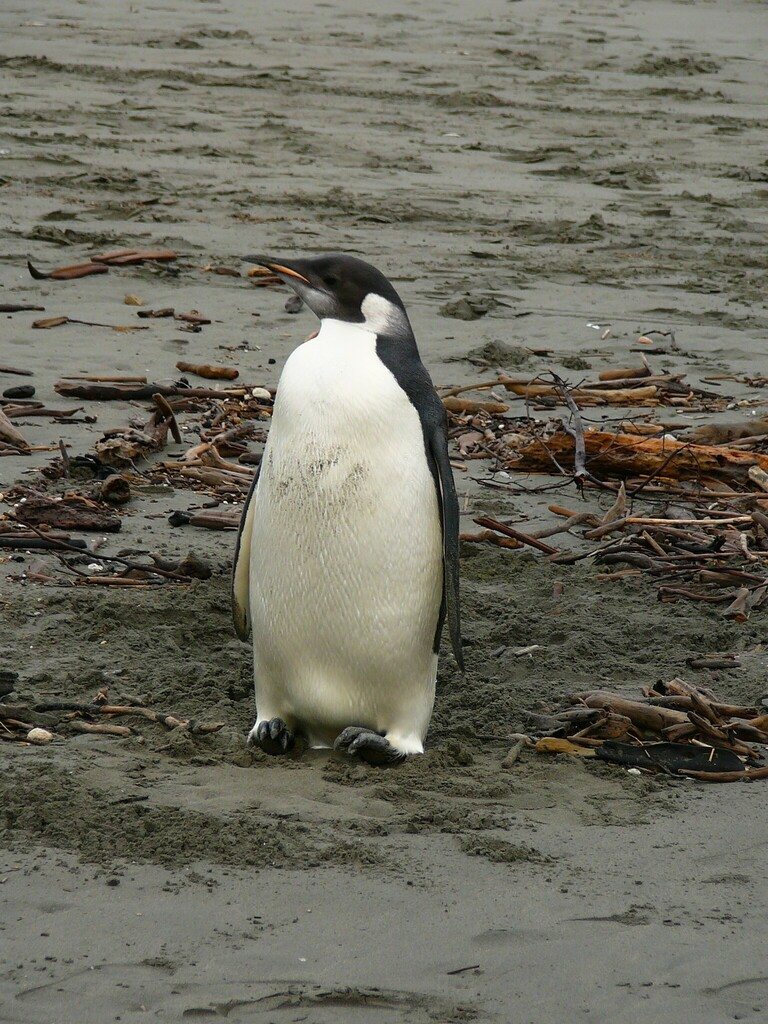
A young emperor penguin photographed on a New Zealand shore, away from its Antarctic breeding range.
Species reference for Emperor Penguin. The photograph does not necessarily show the population or place named in the puzzle.
(c) mattward, some rights reserved (CC BY-SA) · CC BY-SA 4.0 · Original recordImage changes
Resized and converted to JPEG for display; no subject alteration.
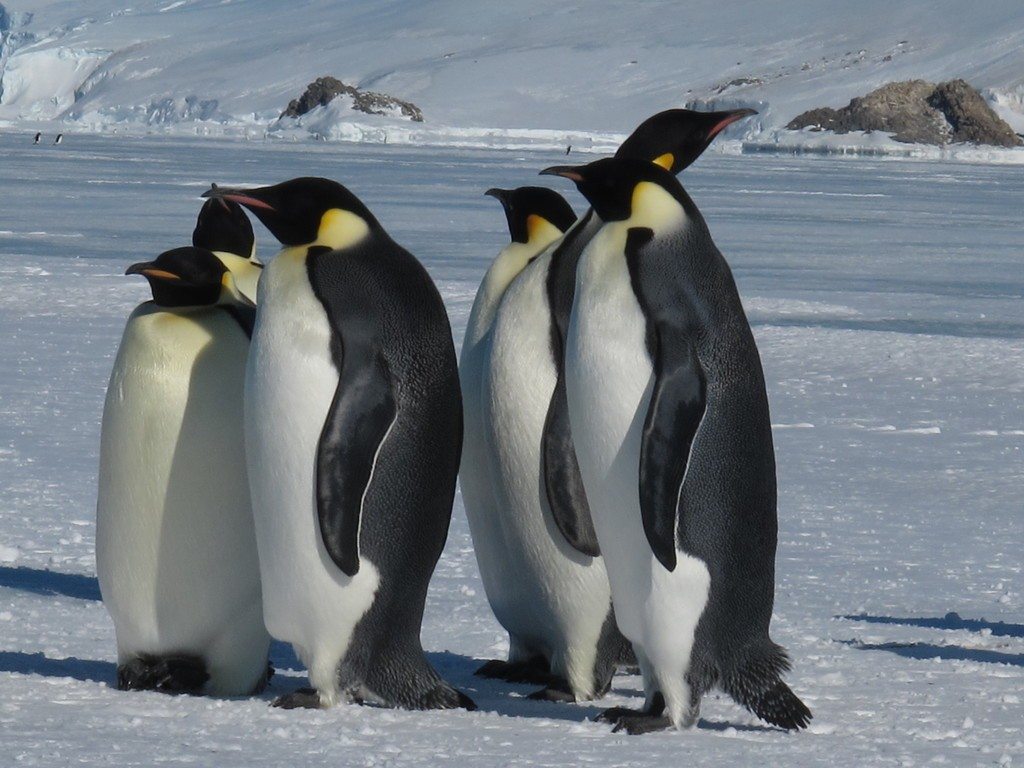
Emperor penguins stand together on ice.
Species reference for Emperor Penguin. The photograph does not necessarily show the population or place named in the puzzle.
(c) John Barkla, some rights reserved (CC BY) · CC BY 4.0 · Original recordImage changes
Resized and converted to JPEG for display; no subject alteration.
The words
Aptenodytes
The emperor penguin is Aptenodytes forsteri.
Blubber
A thick layer of blubber insulates emperors.
Chick
Chicks weigh 150–200 g at hatching.
Colony
Emperors breed in colonies around Antarctica.
Creche
Emperor chicks gather in groups called crèches.
Emperor
The emperor is the largest penguin.
Halley Bay
Halley Bay once held the world's second-largest emperor colony. Early sea-ice breakup meant almost no chicks survived in 2016–2018, and many adults moved 34 miles (55 km) south. By 2024 the colony had re-formed 19 miles (30 km) east.
Fretwell & Trathan 2019, Antarctic Science (opens a new tab) · BAS: Halley Bay breeding failure (2019) (opens a new tab) · BAS: Four new emperor colonies (2024) (opens a new tab)
Huddle
Emperors huddle together to keep warm.
Penguin
The emperor is a penguin: a flightless seabird whose wings are adapted for swimming.
Rookery
A breeding colony; emperor penguins gather in colonies to raise their chicks.
Ross Sea
Two emperor penguin colonies in the Ross Sea.
Silverfish
Antarctic silverfish is one of its most frequent prey.
Skin Fold
The male covers the egg with a skin fold.
Tobogganing
Sliding on its belly over the ice.
Emperors travel by tobogganing on their bellies.
Winter Fast
The male's months without food.
Males live on body fat through the long winter fast.
Sources
- Emperor Penguin (source capture)British Antarctic Survey
- Emperor Penguin (source capture)NOAA Ocean Today
- emperor-eggswww.antarctica.gov.au
- Emperor Penguin (source capture)Australian Antarctic Division
- Emperor Penguin (source capture)Animal Diversity Web, University of Michigan Museum of Zoology
- Emperor Penguin (source capture)Antarctic Science (peer-reviewed article, Kooyman et al. 2007), author reprint
- Emperor Penguin (source capture)British Antarctic Survey
- Emperors on thin ice: three years of breeding failure at Halley BayAntarctic Science (Cambridge University Press)
- “Catastrophic” breeding failure at one of world’s largest emperor penguin coloniesBritish Antarctic Survey
- Four new emperor penguin colonies found by satelliteBritish Antarctic Survey