
Wildlife of the World
Puzzle 12 · African Forests and Highlands · Page 27 in print
Bonobo
Bonobos live in forests south of the Congo River in the Democratic Republic of the Congo; alliances among females can help them outrank males, although social power varies between groups.
Jump to a word
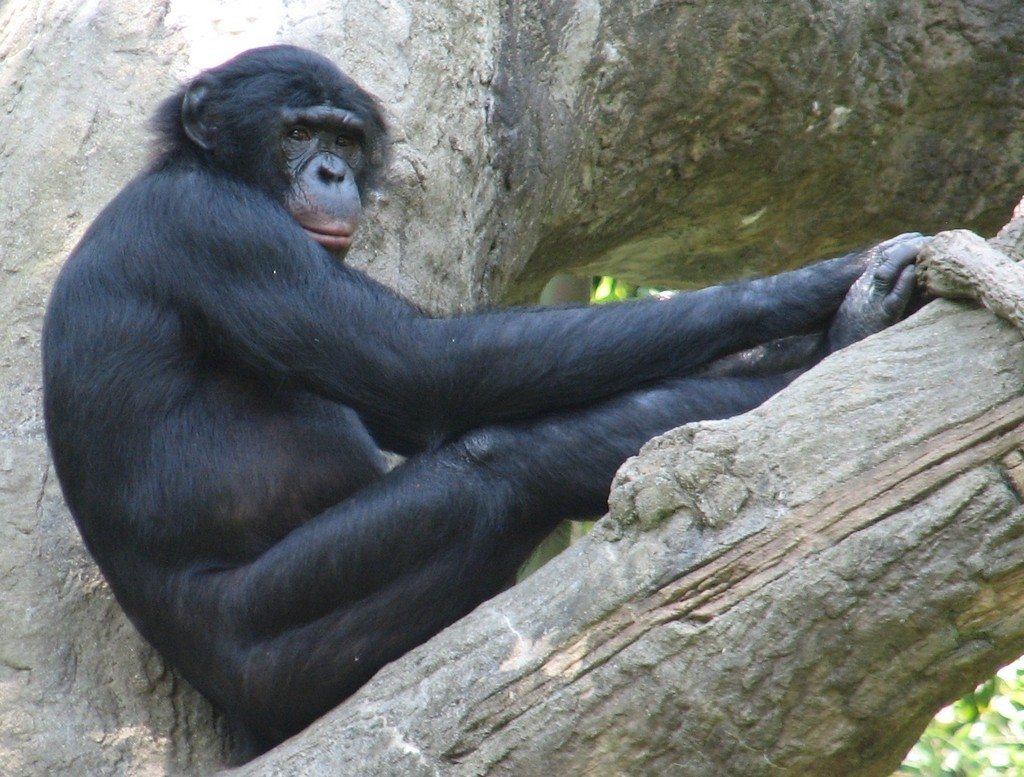
A bonobo rests against a rock at Cincinnati Zoo.
Species reference for Bonobo. The photograph does not necessarily show the population or place named in the puzzle.
(c) Ltshears, some rights reserved (CC BY) · CC BY 3.0 · Original recordImage changes
Resized and converted to JPEG for display; no subject alteration.
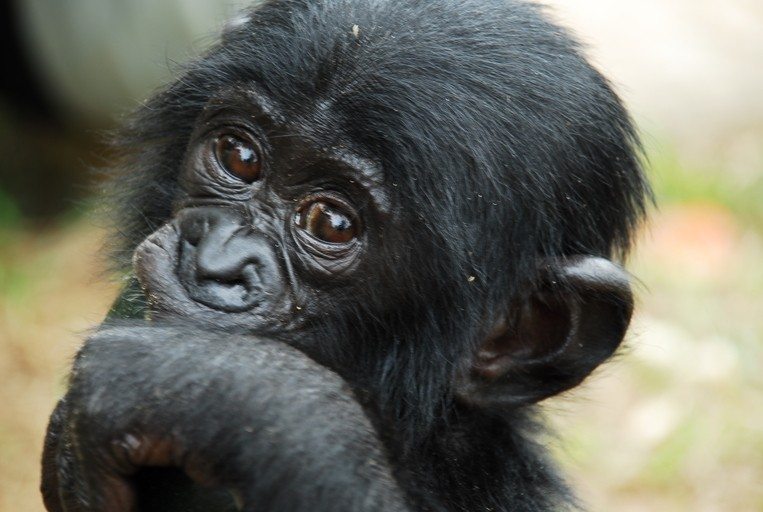
A close view of a young bonobo’s face.
Species reference for Bonobo. The photograph does not necessarily show the population or place named in the puzzle.
Pierre Fidenci · CC BY-SA 2.5 · Original recordImage changes
Resized and converted to JPEG for display; no subject alteration.
The words
Bonobo
A great ape of the forests of the Democratic Republic of the Congo, south of the Congo River.
Coalition
Females teaming up against males.
An alliance between individuals; female bonobos can gain social power by supporting one another.
Congo River
Bonobo habitat lies south of an arc formed by the Congo River.
Earthworms
A favourite snack it digs for.
Bonobos spend hours hunting for earthworms.
Female Bonds
Adult female bonobos form strong bonds with each other.
Food Call
A bonobo that finds good food tells the others with a food call.
Food Sharing
Bonobos often share the food they find.
Leopard
Bonobos sleep together to watch for predators such as leopards.
Lomako
Wamba and Lomako are the most frequently researched bonobo study populations.
Python
Bonobos watch for snakes as predators.
Animal Diversity Web (opens a new tab) · San Diego Zoo Wildlife Alliance (opens a new tab)
Rain Hat
Bonobos have been seen making a rain hat out of leaves.
Salonga
Salonga, Africa's largest protected forest park, holds the largest bonobo population.
Swamp Forest
Bonobos also use swamp forests.
Tree Nests
Bonobos build sturdy nests in tree forks each evening.
Wamba
The longest semi-continuous bonobo study began at Wamba in 1976.
Sources
- Bonobo (source capture)Animal Diversity Web, University of Michigan Museum of Zoology
- Bonobo female coalitionsSpringer Nature, publisher-deposited abstract via Crossref
- Bonobo (source capture)San Diego Zoo Wildlife Alliance
- Bonobo (source capture)Max Planck Society