
The Space Race
Puzzle 78 · Stations and Handshakes · Page 108 in print
The Human Computers
John Glenn asked that Langley’s Katherine Johnson check the computer’s math by hand.
Jump to a word
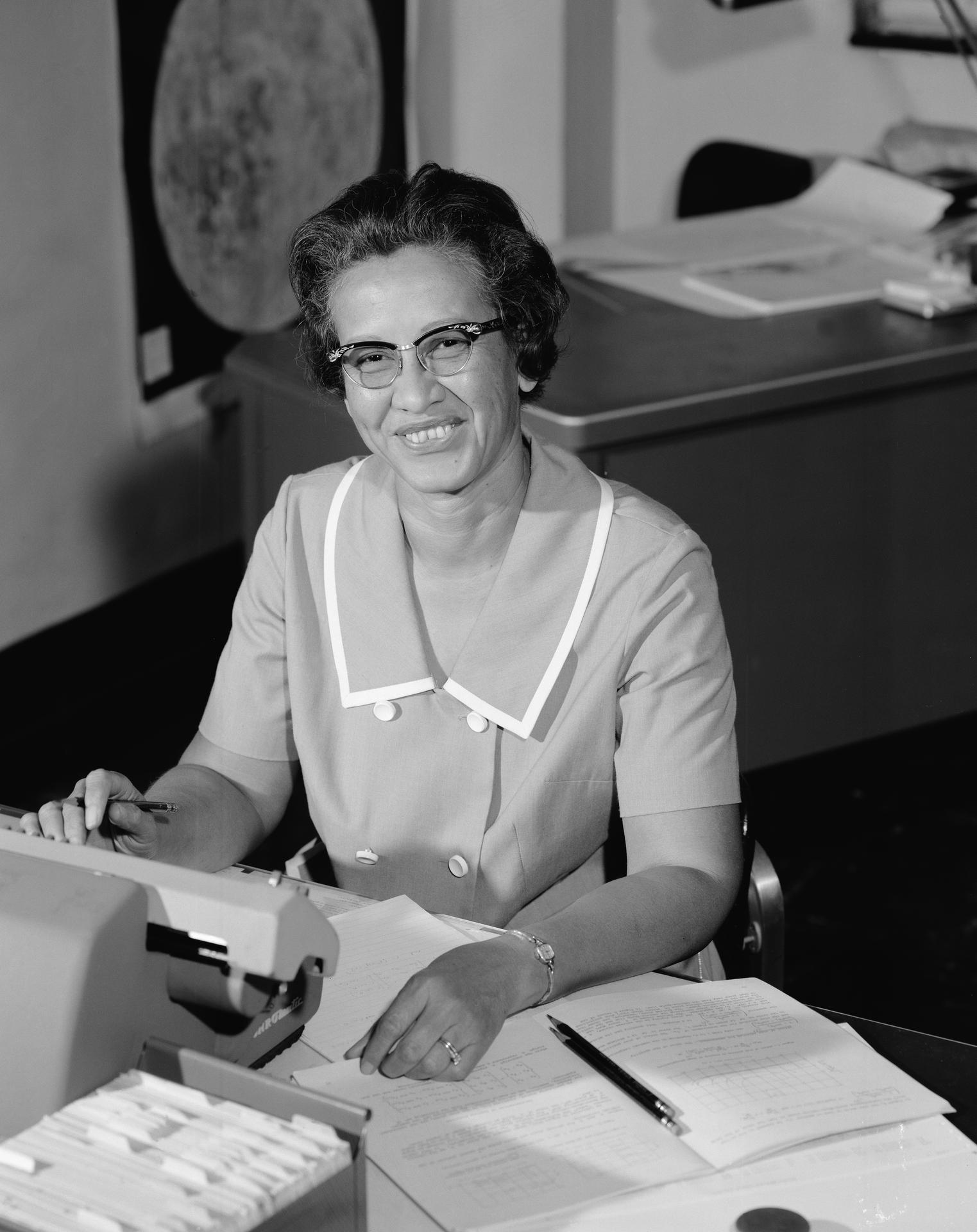
Katherine Johnson at her desk at NASA’s Langley Research Center.
NASA / Bob Nye (LRC-1966-B701_P-06717) · NASA media-use guidelines · Original recordThe words
Annie Easley
Annie Easley began computing at NACA’s Cleveland laboratory in 1955. She later developed computer code for propulsion and energy research, including work on the Centaur upper-stage rocket.
Did you know?
A newspaper article about twin sisters working as computers introduced Easley to the laboratory. Two weeks after reading it, she began her own career there.
Darden
Christine Darden joined Langley’s computing staff in 1967. After challenging unequal job assignments, she moved into engineering and developed methods for predicting and reducing sonic booms.
Fortran
A programming language designed to express mathematical calculations in computer programs.
Dorothy Vaughan became an expert FORTRAN programmer as Langley moved toward electronic computing. Her work in the integrated Analysis and Computation Division carried her mathematical skills into a new form of calculation.
NASA: Dorothy Vaughan and West Computing (opens a new tab) · IBM history: Fortran and mathematical code (opens a new tab)
Friden
Friden was a popular calculating-machine brand at Langley. Computers used these machines alongside slide rules, curves and magnifying glasses to analyze experimental data and prepare graphs for engineers.
Johnson
Katherine Johnson recalled being asked to check the calculations for John Glenn’s 1962 orbital flight. She worked through the programmed equations using a desktop mechanical calculator.
Did you know?
In 1960, Johnson and Ted Skopinski coauthored a report on placing a satellite over a selected Earth position. It was the first research report in her division to credit a woman as an author.
Langley
Langley formed its first computing pool in 1935 with five women. Their calculations supported aircraft testing and later spaceflight research, turning experimental measurements into results that engineers could use.
Marchant
Marchant calculators were another tool used by Langley’s human computers. Staff combined machine-assisted arithmetic with handwritten worksheets and graphs, then checked their results before sending them back to the engineers.
Mary Jackson
Mary Jackson needed special permission to attend engineering courses at a segregated school. After completing the training, she became NASA’s first Black woman engineer in 1958, working on supersonic aerodynamics.
Mathematician
The mathematicians turned raw instrument readings into engineering results. At Langley, this included reducing flight-test data, solving equations and checking calculations that engineers used in their research.
Miriam Mann
Miriam Mann worked among Langley’s Black women computers. Her daughter recalled Mann bringing home a segregated cafeteria sign and finding it replaced the next day.
NASA history: Langley’s human computers (opens a new tab) · Mann’s daughter: a family recollection (opens a new tab)
Segregation
Black computers at Langley were required to use separate dining and bathroom facilities. The segregated West Computing office and facilities were abolished in 1958, when NACA became NASA.
Vaughan
Dorothy Vaughan became NACA’s first Black supervisor in 1949, leading Langley’s West Area Computing unit. She assigned mathematicians to research projects and advocated for employees seeking promotions and better pay.
West Computers
The West Area Computing unit was an all-Black group of women mathematicians at Langley. Their calculations supported research throughout the laboratory, despite the racial barriers imposed on their working lives.
Wind Tunnel
Langley’s wind-tunnel tests recorded pressure changes on boards of liquid-filled tubes. Computers read photographic film of these readings, then used the numbers to calculate and graph the results.
Sources
- When the Computer Wore a Skirt: Langley’s Computers, 1935–1970Sarah McLennan and Mary Gainer; NASA Langley Research Center; reprinted November 25, 2016 from NASA History News & Notes 29(1), first quarter 2012; first computing pool, segregated facilities and test-data workflow
- Dorothy VaughanMargot Lee Shetterly; NASA; biography originally published November 2016; West Computing, 1949 promotion, segregated facilities and later FORTRAN work
- Annie EasleyAnne K. Mills and Robert S. Arrighi; NASA Glenn Research Center; May 4, 2022; Cleveland career, programming and newspaper introduction
- Standing on the Shoulders of a ComputerDenise Lineberry; NASA Langley Research Center; March 29, 2013; 1967 computing appointment, unequal assignments and sonic-boom research
- Mary W. JacksonNASA; May 25, 2017; engineering training, segregated classes, 1958 promotion and Hidden Figures book/film paragraph
- Katherine G. JohnsonNASA; May 25, 2017; raw-data calculations, 1960 Skopinski report and Johnson’s recollection of Glenn’s request
- From Computers to Leaders: Women at NASA LangleyJoe Atkinson; NASA Langley Research Center; March 27, 2014; opening account of Margot Lee Shetterly’s parents and book research
- Miriam Daniel Mann: Family BiographyMiriam Mann Harris, daughter of Miriam D. Mann; September 12, 2011; hosted by The Feminist Wire; PDF p. 1, first-person recollection of cafeteria sign
- FortranIBM historical collection; opening and Born of necessity sections, formula translation and mathematical notation; accessed October 25, 2026