
The Space Race
Puzzle 76 · Stations and Handshakes · Page 106 in print
Skylab's Solar Observatory
On Skylab Four, Ed Gibson became the first to watch a solar flare from start to end.
Jump to a word
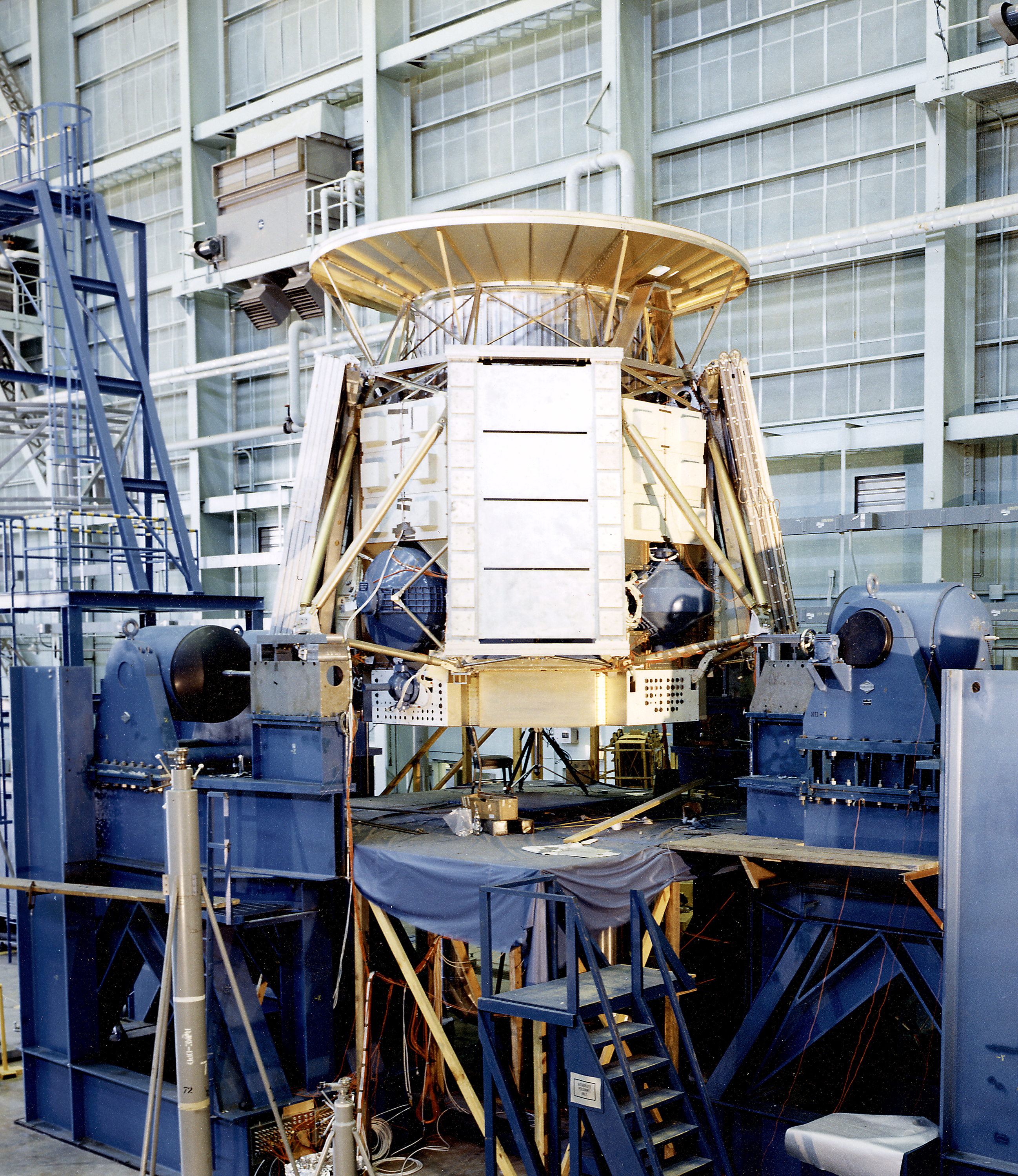
Skylab’s Apollo Telescope Mount undergoing vibration testing.
NASA / Marshall Space Flight Center (7019987) · NASA media-use guidelines · Original recordThe words
Bill Pogue
Bill Pogue helped Gibson reload the Apollo Telescope Mount’s cameras during their November 22, 1973 spacewalk. Fresh film kept the solar instruments ready for further observations.
Comet Kohoutek
When Comet Kohoutek moved beyond the telescope instruments’ view in January 1974, the Skylab 4 crew continued watching it with binoculars. Gibson sketched changes in its tail.
Did you know?
On December 28, 1973, the crew held a televised conference with astronomer Luboš Kohoutek. They discussed the comet with the scientist who had discovered it.
Coronagraph
Skylab’s coronagraph used disks to block the brilliant solar surface. This artificial eclipse allowed the much fainter corona, the Sun’s outer atmosphere, to be photographed.
Coronal Hole
A region where the Sun’s magnetic field opens outward into space.
Skylab’s X-ray images helped identify coronal holes as sources of fast solar wind in 1973. These regions appear dark and are cooler than the surrounding corona.
Ed Gibson
On January 21, 1974, Edward Gibson watched a solar flare through its entire development at Skylab’s instrument panel. His continuous observations captured the event from its beginning to its end.
Garriott
Owen Garriott served as Skylab 3’s science pilot. His work included solar observations and spacewalks to replace telescope film and bring exposed cassettes back inside for return to Earth.
Did you know?
Before his flight, Garriott recorded his wife Helen’s voice. With Mission Control’s Bob Crippen in on the prank, the crew played the recording as though she were speaking from Skylab.
NASA: Garriott and an eruptive prominence (opens a new tab) · NASA: Garriott’s recorded-voice prank (opens a new tab)
Gyroscopes
Large control-moment gyroscopes steadied the whole Skylab station. A separate, finer pointing system kept the telescope instruments aimed at their targets despite disturbances such as movement by the crew.
Joystick
A joystick on the crew’s control panel adjusted where the solar instruments pointed. It worked through the fine pointing system, allowing astronauts to select features away from the Sun’s center.
Prominence
Prominences are clouds of solar material above the Sun’s surface. Skylab recorded an eruptive prominence in ultraviolet light, showing material surging outward and disturbing the surrounding corona.
Skylab Four
Gerald Carr, Edward Gibson and William Pogue spent 84 days aboard Skylab on its final crewed mission. They studied the Sun, Earth and life in orbit before returning on February 8, 1974.
Solar Flare
A solar flare is a sudden, intense burst of light from the Sun. That radiation spans many wavelengths, including visible light, ultraviolet and X-rays, giving solar observatories several ways to study an event.
Spar
The Apollo Telescope Mount’s spar was the aluminum platform supporting its instruments. The frame held the observatory’s equipment together, giving the telescopes a shared structure inside their mount.
Did you know?
The Smithsonian’s telescope mount was a backup, rather than the one flown on Skylab. Volunteers restored its aging Kapton covering in 2014–2015, leaving repairs visible on close inspection.
Spectrograph
The Naval Research Laboratory’s S082B recorded the Sun’s ultraviolet spectrum. Its wavelength patterns helped scientists investigate conditions in solar gas, including its composition and temperature.
NRL: telescope pointing and instruments (opens a new tab) · NASA history: Skylab’s solar observatory (opens a new tab)
Windmill
Four solar panels spread around the Apollo Telescope Mount like windmill sails. These arrays deployed successfully after launch, providing electricity while the workshop’s larger solar panels were damaged or trapped.
X-Rays
The S056 experiment used an X-ray telescope with changeable film magazines to photograph the Sun. Its exposures gave researchers a photographic record across Skylab’s observing missions.
Sources
- 50 Years Ago: Skylab 4 Astronauts Begin Record-Breaking Third Month in SpaceJohn Uri; NASA Johnson Space Center; January 11, 2024; January solar-flare and comet observations, December 28 conference
- Parker Solar Probe and the Birth of the Solar WindNASA; July 30, 2018; Skylab X-ray observations and open-corona explanation
- Part II – Life on SkylabNASA; complete recorded-voice prank paragraph and telescope-film caption
- Restoring the Apollo Telescope MountScott Willey; Smithsonian National Air and Space Museum; December 10, 2015; backup spar and 2014–2015 restoration
- Saving SkylabBob Craddock; Smithsonian National Air and Space Museum; May 12, 2023; four deployed ATM solar arrays
- ATM, Telescope, X-raySmithsonian National Air and Space Museum; object A19840408000; engineering prototype and S056 flight instrument description
- Living and Working in Space: A History of SkylabW. David Compton and Charles D. Benson; NASA SP-4208; 1983; printed pp. 166–168, 302–303 and 317–318 / PDF pp. 181–183, 317–318 and 332–333; spectra, coronagraph and November 22 film reload
- The SKYLAB Apollo Telescope MountU.S. Naval Research Laboratory; adapted from R. Tousey, Apollo Telescope Mount of Skylab: an overview, Applied Optics 16(4), 825 (1977); Historical and ATM Solar Observatory sections
- Skylab 3: A Record 59 Days in SpaceJohn Uri; NASA Johnson Space Center; September 25, 2018; Garriott’s role, film changes and ultraviolet prominence caption
- 50 Years Ago: Skylab 4 Astronauts Return From Record-Breaking SpaceflightJohn Uri; NASA Johnson Space Center; February 7, 2024; opening crew, duration, research program and February 8 recovery
- Solar Storms and FlaresNASA Science; What is a solar flare? section; accessed October 25, 2026