
The Great Stories of the Old Testament
Puzzle 28 · Conquest and Settlement · Page 49 in print
The Jordan Crossing
Israel crosses the Jordan on dry ground and carries twelve stones to its lodging as a sign for later generations.
Jump to a word
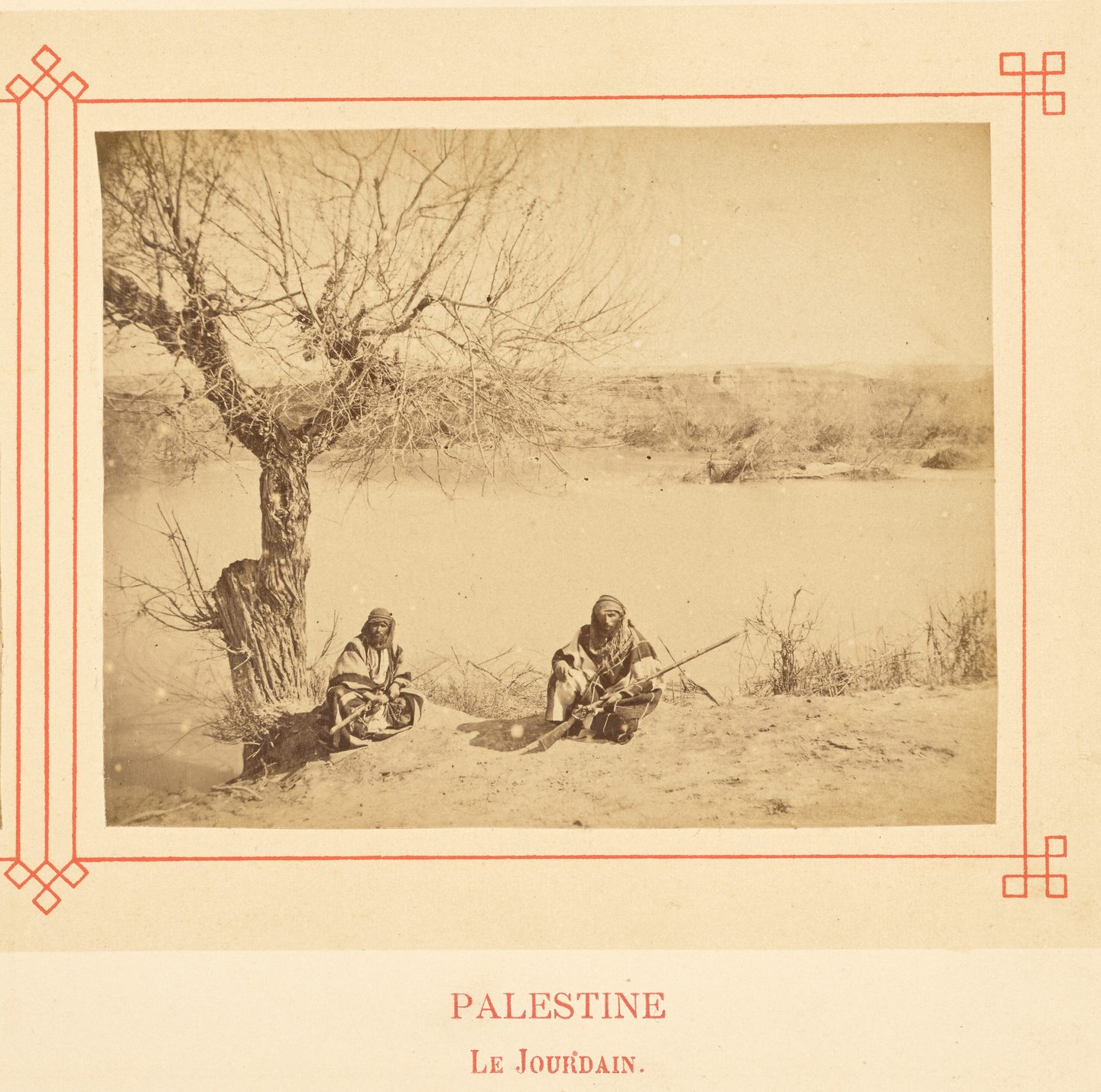
Le Jourdain.
The named river provides geographical context for the crossing, not proof of its exact point.
Félix Bonfils · CC0 1.0 · Original recordImage changes
Resized proportionally to at most 1440px and JPEG compressed; no crop or content alteration.
The words
Brink
Joshua is to command the ark-bearing priests to stand still in the Jordan when they reach the water’s brink.
Cut Off
Joshua says waters flowing toward the sea of the plain, the Salt Sea, fail and are cut off as Israel crosses.
Dry Ground
Joshua describes all Israel crossing on dry ground while the priests remain in the riverbed, holding the ark of the covenant.
Encamp
After crossing, Israel encamps at Gilgal on the tenth day of the first month, on Jericho’s eastern border.
Feet
Joshua says the priests’ feet dip into the water before the waters above stand in a heap and the people cross.
Did you know?
The narrative also marks the priests’ exit by their feet: once their soles touch dry land, the Jordan returns to its course.
Joshua 3:15–16 (opens a new tab) · Joshua 4:18 (opens a new tab)
Firm
The ark-bearing priests remain “firm on dry ground” in the river until the people have completed the crossing.
Gilgal
Joshua sets up the twelve stones brought from the Jordan at Gilgal, the camp named on Jericho’s eastern border.
Heap
Joshua describes the waters coming down from above as standing and rising in a heap, while Israel crosses opposite Jericho.
Jordan
Israel crosses the Jordan on dry ground while priests carrying the ark remain in the river’s midst until everyone has passed.
Did you know?
Psalm 114 addresses both the sea and the Jordan, asking the sea why it fled and the river why it was driven back.
Joshua 3:17 (opens a new tab) · Psalm 114:3–5 (opens a new tab)
Lodging
The twelve stones are to be carried from the Jordan to the lodging place where Israel will camp that night.
Memorial
The stones are a memorial for Israel’s descendants, prompting children to ask their fathers what the stones mean.
Overfloweth
Joshua notes that the Jordan overflows all its banks during harvest, placing the crossing in a season of high water.
Sanctify
Joshua tells the people to “sanctify yourselves” before the crossing, saying the LORD will do wonders among them the following day.
Twelve
Joshua selects twelve men, one from each tribe, to carry twelve stones from the priests’ standing place in the Jordan to the camp.
Did you know?
Alongside the stones carried to Gilgal, Joshua 4:9 describes twelve stones set up where the priests stood in the Jordan.
Joshua 4:2–5; Joshua 4:8–9 (opens a new tab) · Joshua 4:20 (opens a new tab)
Zaretan
Zarethan in the NET Bible.
Joshua names Zaretan as a place beside Adam while describing the stopped waters; the people cross opposite Jericho.
Joshua 3:16 (opens a new tab) · NET Bible: Joshua 3:16 (opens a new tab)
Sources
- Joshua 3:5 (King James Version)King James Version, passage navigation via Bible Gateway
- Joshua 3:7-8 (King James Version)King James Version, passage navigation via Bible Gateway
- Joshua 3:14-17 (King James Version)King James Version, passage navigation via Bible Gateway
- Joshua 4:1-9 (King James Version)King James Version, passage navigation via Bible Gateway
- Joshua 4:18 (King James Version)King James Version, passage navigation via Bible Gateway
- Joshua 4:19-24 (King James Version)King James Version, passage navigation via Bible Gateway
- Psalm 114:3-5 (King James Version)King James Version, passage navigation via Bible Gateway
- Joshua 3:16 (NET Bible), translation and notesNET Bible, via Bible Gateway