
America’s National Parks
Puzzle 40 · The Rocky Mountains · Page 60 in print
Craters of the Moon
On August 22, 1969, Apollo 14 astronauts Alan Shepard, Edgar Mitchell, Joe Engle and Eugene Cernan landed at the airport in Arco to study the lava, since much of the moon’s surface is covered by volcanic materials.
Jump to a word
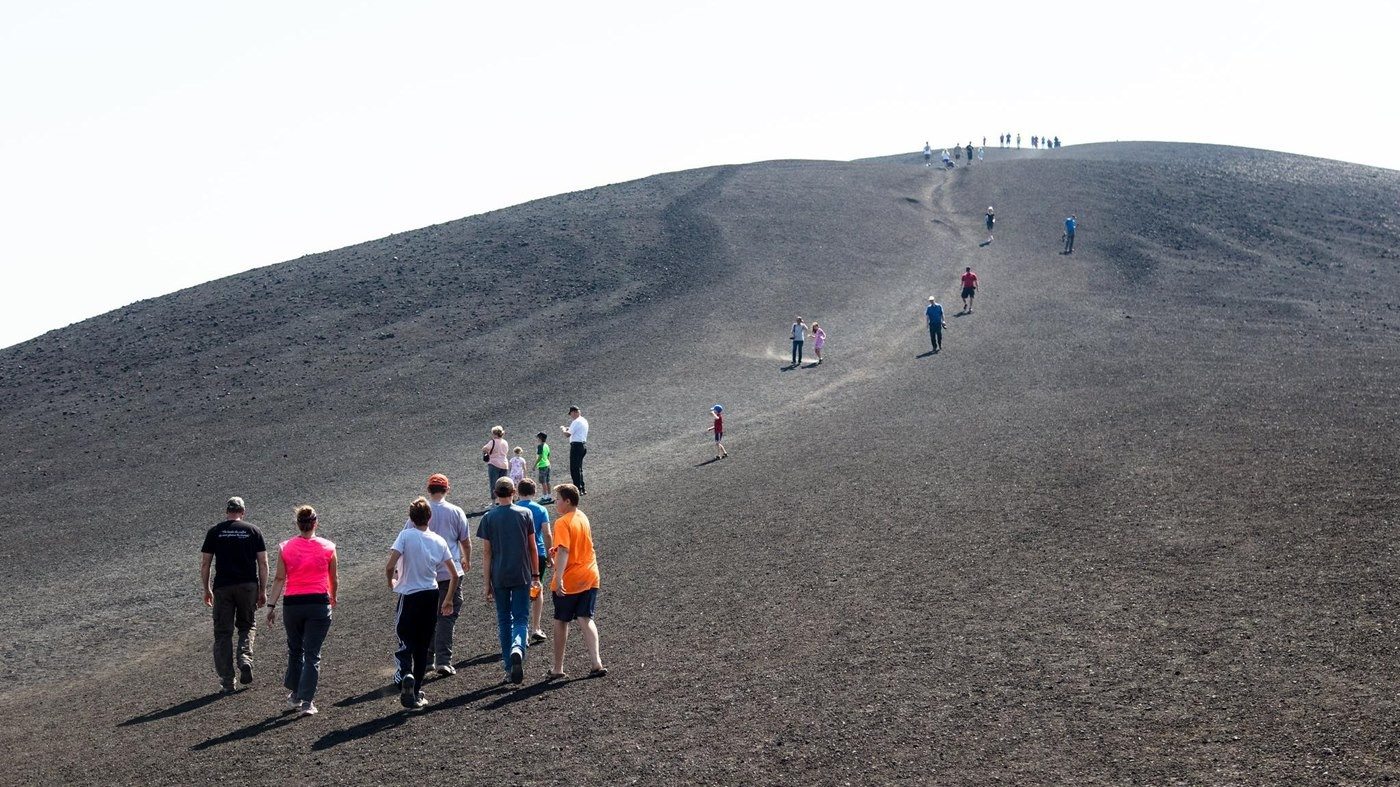
Inferno Cone rises above the lava landscape.
NPS photo. · Public domain (U.S. federal government work) · Original recordImage changes
Resized and converted to JPEG for display; no subject alteration.
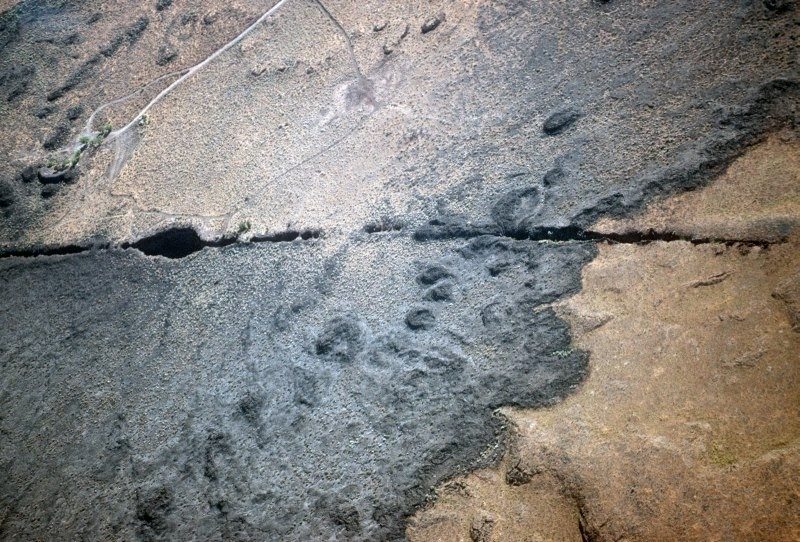
The Great Rift seen from the air near King's Bowl.
NPS Photo · Public domain (U.S. federal government work) · Original recordImage changes
Resized and converted to JPEG for display; no subject alteration.
The words
Astronauts
The astronauts practiced observing volcanic features and choosing scientifically useful rock samples. Their fieldwork at Craters of the Moon helped them describe unfamiliar terrain to geologists back on Earth.
Did you know?
Eugene Cernan, Joe Engle and Edgar Mitchell returned in 1999 for the monument’s seventy-fifth anniversary, thirty years after their geology training.
Big Craters
Big Craters is a group of overlapping volcanic vents along an eruptive fissure. Smaller craters sit within larger ones, recording how eruptions shifted along the crack.
Blue Dragon
The Blue Dragon Flow’s blue sheen comes from titanium-bearing magnetite crystals in its outer layer. Beneath broken patches, iron reacting with oxygen can turn the lava rusty red.
Broken Top
Broken Top’s lava flow marks the last eruption in the main Craters of the Moon field. It belongs to an eruptive period that also built cinder cones and opened fissures.
Park Service: Broken Top’s eruptive period (opens a new tab)
Devils Orchard
Devils Orchard contains blocks of volcanic crater wall carried away on moving lava. These rafted fragments record how eruptions could dismantle older cones and transport pieces across the lava landscape.
Park Service: Rafted blocks and lava drips (opens a new tab)
Goodale
Tim Goodale led emigrants across this lava country in 1862, following a route based on Shoshone travel paths. The movement brought settlers into Shoshone and Bannock homelands, where communities resisted the intrusion.
Great Rift
The Great Rift is a chain of deep cracks through which magma reached the surface. Stretching of the crust opened these weaknesses, feeding lava fields and rows of volcanic vents.
Indian Tunnel
Indian Tunnel’s walls carry ridges where molten lava paused at different levels. These tide marks record changes in the flow that once filled this underground passage.
Inferno Cone
Inferno Cone’s broad mound lacks the summit crater of a textbook cinder cone. Strong Idaho winds carried erupted cinders downwind, piling them beside the volcanic vent.
Geologist: Inferno Cone’s wind-built shape (opens a new tab)
Kipuka
A kipuka is an island of older ground surrounded by younger lava. At Craters of the Moon, these pockets preserve sagebrush and grass communities isolated within the volcanic landscape.
Lava Tube
A lava tube forms when a flow’s outer crust cools around an insulated river of molten lava. When the supply ends or shifts elsewhere, the lava drains away and leaves a hollow passage.
Did you know?
Some lava tubes have small stone icicles called lava stalactites, formed when molten material dripped from a hot ceiling and hardened.
Park Service: How lava tubes form (opens a new tab) · Park Service: Rafted blocks and lava drips (opens a new tab)
North Crater
North Crater lost part of its wall as thick lava flows carried broken pieces away. Its missing flank and the transported blocks show that an eruption can both build and destroy volcanic landforms.
Robert Limbert
Robert Limbert photographed and wrote about the lava landscape, arguing for its protection. His articles and a scrapbook sent to President Calvin Coolidge helped build support for the national monument created in 1924.
Did you know?
The National Park Service dedicated the visitor center to Limbert’s memory in 1990, recognizing his role in protecting the volcanic landscape.
Spatter Cones
Spatter Cones formed from sticky lava fragments that landed before fully hardening. The hot clots piled up around openings in the ground, building small, steep-sided mounds.
Tree Molds
Tree molds are impressions left when lava surrounded standing or fallen trees. Charred wood textures remain in the hardened basalt, preserving evidence of the vegetation that the eruption encountered.
Did you know?
Charcoal associated with tree molds has been used to carbon-date lava flows, allowing burned plant material to help establish the timing of eruptions.
Park Service: Tree molds and charcoal dating (opens a new tab)
Sources
- Space Exploration Research and Astronaut Training - Craters Of The Moon National Monument & PreserveNational Park Service
- Site Tour: North Crater Flow - Craters Of The Moon National Monument & PreserveNational Park Service
- Volcanoes / Lava Flows - Craters Of The Moon National Monument & PreserveNational Park Service
- Goodale's Cutoff - Craters Of The Moon National Monument & PreserveNational Park Service
- Caves - Craters Of The Moon National Monument & PreserveNational Park Service
- Plants - Craters Of The Moon National Monument & PreserveNational Park Service
- Fossils - Craters Of The Moon National Monument & PreserveNational Park Service
- Site Tour: Spatter Cones and Big CratersNational Park Service
- NPS Geodiversity Atlas—Craters of the Moon National Monument & Preserve, IdahoNational Park Service
- Geologic Activity - Craters of the MoonNational Park Service
- Site Tour: Caves AreaNational Park Service
- Volcanic Wonderland Awaits Adventurers in Southern IdahoNational Park Service
- History - Craters of the MoonNational Park Service