
The Life of Jesus
Puzzle 03 · Tidings and Promises · Page 15 in print
Gabriel at Nazareth
Gabriel visits Mary in Nazareth, announcing a son whose kingdom will have no end.
Jump to a word
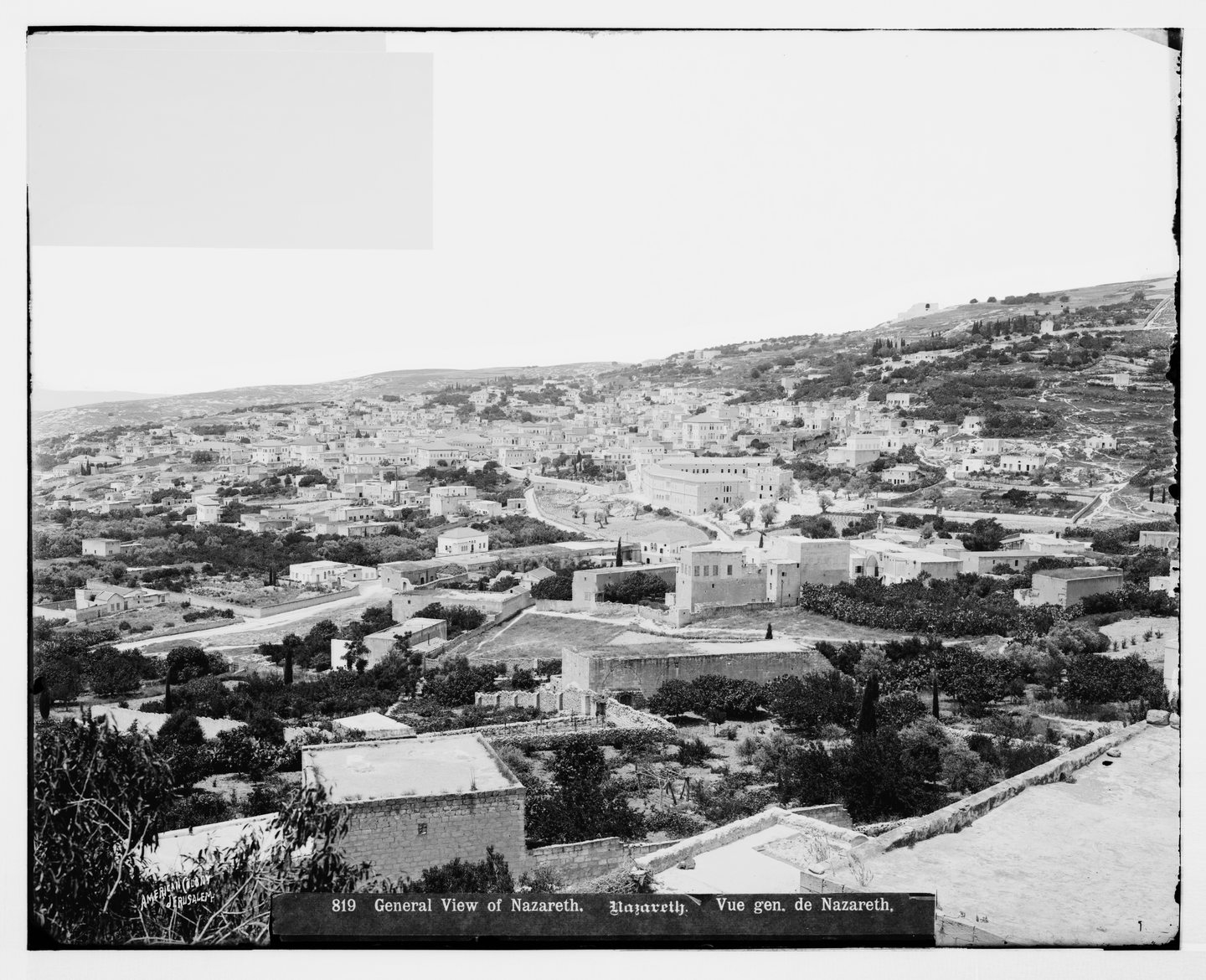
General view of Nazareth (between 1898 and 1914).
Nazareth is named as the town of Gabriel’s visit; this photograph shows the town long afterward.
G. Eric and Edith Matson Photograph Collection, Library of Congress · Public Domain Mark 1.0 · Original recordImage changes
Resized proportionally to at most 1440px and JPEG compressed; no crop or content alteration.
The words
Conceive
Gabriel tells Mary she will conceive and bear a son, then gives the name she is to call him: Jesus.
Cousin
Gabriel tells Mary that Elisabeth has conceived in her old age. The KJV calls her Mary’s cousin; the NIV says relative.
Luke 1:36 (opens a new tab) · NIV: Luke 1:36 (opens a new tab) · NET Bible: Luke 1:34-38 (opens a new tab)
Favour
After Mary is troubled by the greeting, Gabriel tells her not to fear, saying that she has “found favour with God.”
Gabriel
Luke names Gabriel as the angel sent from God to Nazareth; he brings Mary the promise of a son and answers her question.
Luke 1:26; Luke 1:31 (opens a new tab) · Luke 1:34–35 (opens a new tab)
Hail
Gabriel opens his greeting to Mary with “Hail,” calling her highly favored and saying that the Lord is with her.
Did you know?
The Catholic catechism describes the Hail Mary prayer as taking up Gabriel’s greeting first, followed by Elisabeth’s greeting to Mary.
Luke 1:28 (opens a new tab) · Vatican: Hail Mary prayer (opens a new tab)
Handmaid
Mary calls herself “the handmaid of the Lord” and replies, “be it unto me according to thy word”; Luke then says the angel departs.
Impossible
After telling Mary of Elisabeth’s pregnancy in old age, Gabriel adds, “For with God nothing shall be impossible.”
Kingdom
Gabriel’s announcement moves from the promised child’s name, Jesus, to his throne and reign, ending with a kingdom that will have no end.
Nazareth
Luke places Gabriel’s visit in Nazareth, a city of Galilee, where the angel is sent to Mary, espoused to Joseph.
Overshadow
Answering Mary’s question, Gabriel says the Holy Ghost will come upon her and the power of the Highest will overshadow her.
Did you know?
Luke uses “overshadowed” again in a mountain scene: Jesus has taken Peter, John and James to pray, and a cloud comes over them.
Luke 1:34–35 (opens a new tab) · Luke 9:28–34 (opens a new tab)
Reign
Gabriel says Mary’s son will reign over the house of Jacob forever, joining the promise of David’s throne to a kingdom without end.
Salutation
Greeting, in the NET’s rendering.
Mary is troubled by Gabriel’s words and considers what kind of salutation this might be, before the angel tells her not to fear.
Luke 1:29–30 (opens a new tab) · NET Bible: Luke 1:26-33 (opens a new tab)
Sixth Month
Luke’s “sixth month” refers to Elisabeth’s pregnancy. Earlier she had concealed herself for five months; Gabriel tells Mary she is in her sixth.
Luke 1:24 (opens a new tab) · Luke 1:26 (opens a new tab) · Luke 1:36 (opens a new tab) · NET Bible: Luke 1:26-33 (opens a new tab)
Throne
Gabriel says the Lord God will give Mary’s son the throne of his father David, before describing his reign over the house of Jacob.
Did you know?
In the message given to Nathan for David, 2 Samuel 7:16 also brings together house, kingdom and throne with the words “for ever.”
Luke 1:32–33 (opens a new tab) · 2 Samuel 7:4–5; 2 Samuel 7:16 (opens a new tab)
Virgin
Espoused, in Luke’s description, is rendered pledged to be married in the NIV.
Luke calls Mary a virgin espoused to Joseph; she asks how the promise can be, “seeing I know not a man.”
Luke 1:27 (opens a new tab) · Luke 1:34 (opens a new tab) · NIV: Luke 1:27 (opens a new tab)
Sources
- Luke 1:26-33 (King James Version)King James Version, passage navigation via Bible Gateway
- Luke 1:34-38 (King James Version)King James Version, passage navigation via Bible Gateway
- Luke 1:24-25 (King James Version)King James Version, passage navigation via Bible Gateway
- Luke 1:26-33 (NET Bible), translation and notesNET Bible, via Bible Gateway
- Luke 1:34-38 (NET Bible), translation and notesNET Bible, via Bible Gateway
- Luke 1:27 (New International Version)New International Version, via Bible Gateway
- Luke 1:36 (New International Version)New International Version, via Bible Gateway
- 2 Samuel 7:4-16 (King James Version)King James Version, passage navigation via Bible Gateway
- Luke 9:28-36 (King James Version)King James Version, passage navigation via Bible Gateway
- Catechism of the Catholic Church, paragraph 2676Libreria Editrice Vaticana