
The Life of Jesus
Puzzle 13 · The Forerunner · Page 29 in print
The Voice in the Wilderness
John calls people to repentance in the wilderness and uses harvest images to describe judgment.
Jump to a word
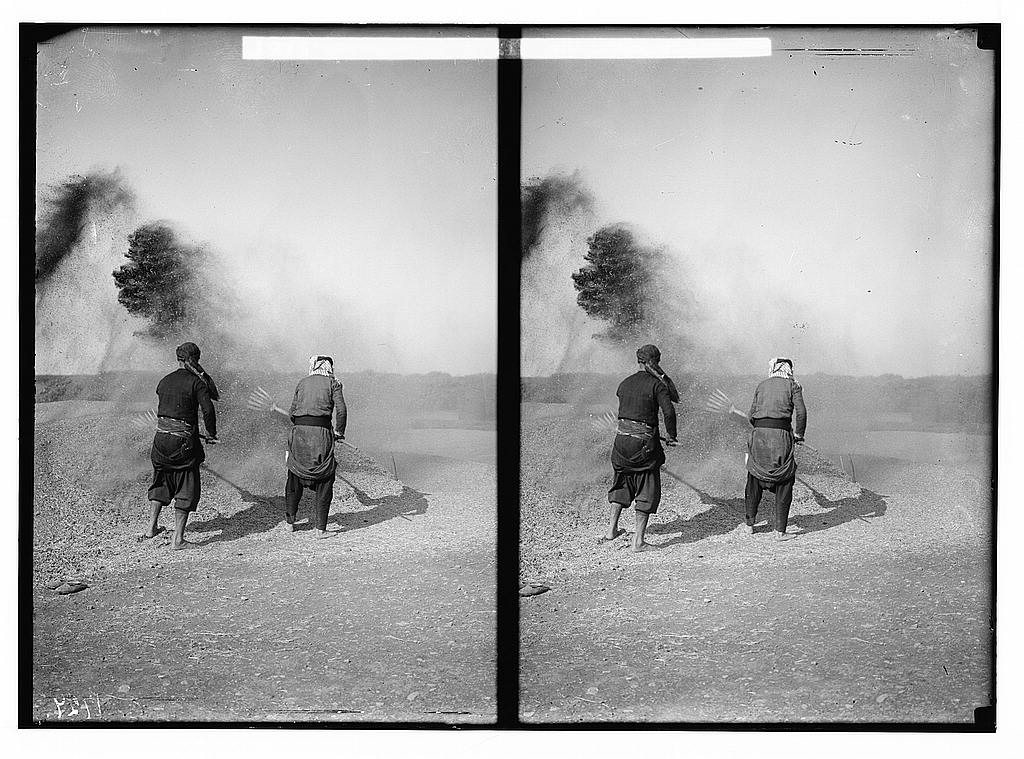
Winnowing grain in Lebanon, about 1900–1920.
Actual winnowing makes John’s distinction between grain and chaff easier to picture; the workers are from a much later period.
American Colony (Jerusalem). Photo Department; G. Eric and Edith Matson Photograph Collection, Library of Congress. · No known restrictions on publication · Original recordImage changes
Resized proportionally to at most 1440px and JPEG compressed; no crop or content alteration.
The words
Baptist
Matthew calls him John the Baptist, shows him preaching in Judaea’s wilderness and describes people being baptized by him in the Jordan, confessing their sins.
Camel's Hair
Matthew describes John’s clothing as camel’s hair and notes a leather girdle around his waist, pairing the clothing with locusts and wild honey.
Chaff
Plant material removed from threshed grain during winnowing.
In Matthew, John pictures the threshing floor being cleared, wheat gathered and chaff burned; the image follows his words about one mightier than himself.
Did you know?
The NET’s note describes a winnowing fork tossing threshed grain into the air, so wind carries off the chaff while the grain falls back down.
Matthew 3:11–12 (opens a new tab) · NET Bible: Matthew 3:7-12 (opens a new tab)
Garner
Matthew and Luke both place the garner in John’s winnowing image: wheat is gathered into it while chaff is separated for burning.
Matthew 3:12 (opens a new tab) · Luke 3:17 (opens a new tab)
Girdle
A belt.
Matthew describes a leather girdle around John’s waist, alongside his clothing of camel’s hair and his food of locusts and wild honey.
Did you know?
A leather belt also appears in 2 Kings 1:8’s description of Elijah. The KJV calls it a “girdle of leather,” compared with John’s “leathern girdle” in Matthew.
Matthew 3:4 (opens a new tab) · NET Bible: Matthew 3:1-6 (opens a new tab) · 2 Kings 1:8 (opens a new tab)
Latchet
Luke gives John’s words about being unworthy to loosen a shoe latchet; Matthew gives his words about being unworthy to bear the coming one’s shoes.
Luke 3:16 (opens a new tab) · Matthew 3:11 (opens a new tab)
Locusts
Matthew names locusts among John’s food; Leviticus 11:22 includes locusts among the winged creatures permitted as food in that passage’s dietary instructions.
Matthew 3:4 (opens a new tab) · Leviticus 11:21–22 (opens a new tab)
Pharisees
Matthew names Pharisees among those coming to John’s baptism; John addresses them with the warning about “wrath to come” and calls for fruits worthy of repentance.
Repentance
Matthew records John’s call to repent; Luke gives his replies about sharing clothes and food, collecting only what is appointed, and avoiding violence and false accusations.
Matthew 3:2 (opens a new tab) · Luke 3:8–14 (opens a new tab)
Sadducees
Matthew pairs Sadducees with Pharisees at the baptism scene; John warns those approaching not to rely on calling Abraham their father.
Tiberius
Luke dates John’s wilderness call to the fifteenth year of Tiberius Caesar, naming provincial rulers and high priests before describing John’s preaching.
Unquenchable
Unable to be put out.
Matthew and Luke both describe John’s image of wheat stored and chaff burned with unquenchable fire, following his words about one coming after him.
Matthew 3:11–12 (opens a new tab) · Luke 3:16–17 (opens a new tab) · NET Bible: Matthew 3:7-12 (opens a new tab)
Vipers
Matthew gives John’s “generation of vipers” warning to Pharisees and Sadducees; Luke gives it to the multitude coming to be baptized.
Wild Honey
Matthew pairs wild honey with locusts as John’s food, alongside his camel’s hair clothing and leather belt.
Wilderness
Matthew and Luke both link John’s wilderness preaching with Isaiah’s call to prepare the Lord’s way; Luke continues the quotation through valleys, mountains and salvation.
Matthew 3:1–3 (opens a new tab) · Luke 3:3–6 (opens a new tab) · Isaiah 40:3–5 (opens a new tab)
Sources
- Matthew 3:1-6 (King James Version)King James Version, passage navigation via Bible Gateway
- Matthew 3:7-12 (King James Version)King James Version, passage navigation via Bible Gateway
- Luke 3:1-6 (King James Version)King James Version, passage navigation via Bible Gateway
- Luke 3:7-14 (King James Version)King James Version, passage navigation via Bible Gateway
- Luke 3:15-18 (King James Version)King James Version, passage navigation via Bible Gateway
- Matthew 3:1-6 (NET Bible), translation and notesNET Bible, via Bible Gateway
- Matthew 3:7-12 (NET Bible), translation and notesNET Bible, via Bible Gateway
- 2 Kings 1:1-8 (King James Version)King James Version, passage navigation via Bible Gateway
- Leviticus 11:20-23 (King James Version)King James Version, passage navigation via Bible Gateway
- Isaiah 40:1-5 (King James Version)King James Version, passage navigation via Bible Gateway