
The Life of Jesus
Puzzle 01 · Tidings and Promises · Page 13 in print
The Book of the Generation
Matthew opens with a family record linking Jesus to Abraham and David; the names preserve the King James spellings.
Jump to a word
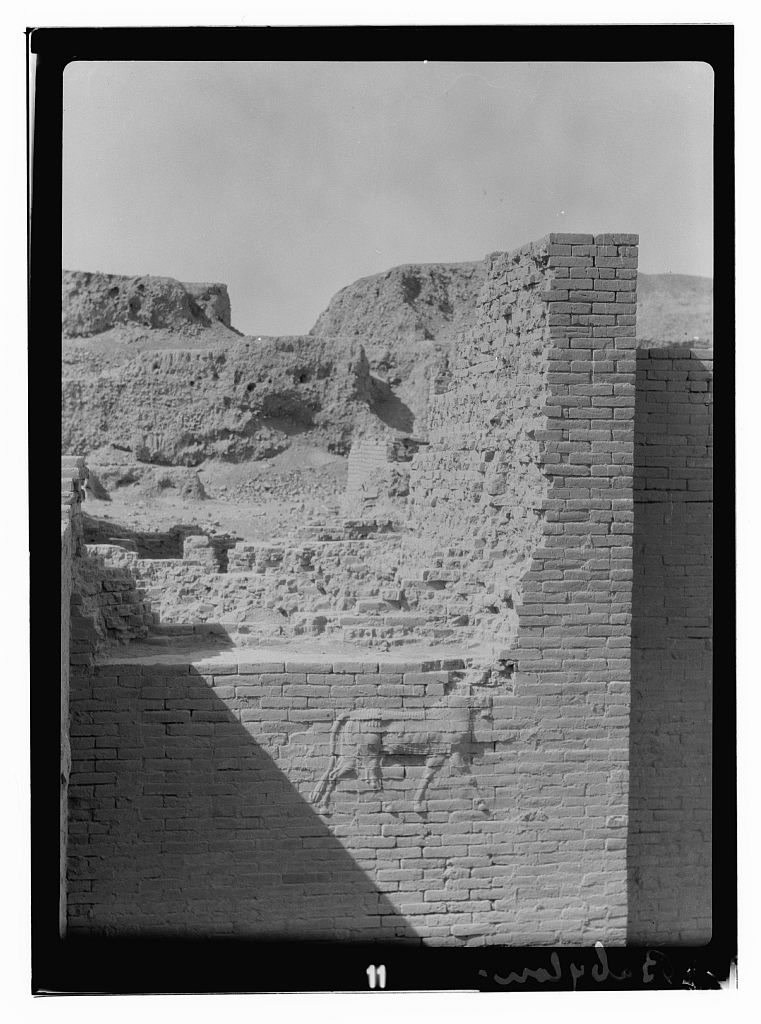
Brickwork and ruins at Babylon, 1932.
Babylon gives geographical context for the exile dividing Matthew’s genealogy; these ruins do not document the named individuals.
American Colony (Jerusalem). Photo Department; G. Eric and Edith Matson Photograph Collection, Library of Congress. · No known restrictions on publication · Original recordImage changes
Resized proportionally to at most 1440px and JPEG compressed; no crop or content alteration.
The words
Abraham
The family record begins with him: “Abraham begat Isaac.” Genesis tells how God renamed Abram, saying, “a father of many nations have I made thee.”
Did you know?
Scripture remembers Abraham as God’s friend: “Abraham thy friend” in 2 Chronicles 20:7, “Abraham my friend” in Isaiah 41:8, and in James 2:23, “the Friend of God.”
Matthew 1:2 (opens a new tab) · Genesis 17:5 (opens a new tab) · 2 Chronicles 20:7 (opens a new tab) · Isaiah 41:8 (opens a new tab) · James 2:23 (opens a new tab)
Babylon
Matthew divides Jesus’s family record at “the carrying away into Babylon”: fourteen generations from David to the exile, and fourteen more from the exile to Christ.
Did you know?
Clay tablets dug up at Babylon list oil rations for “Ya’u-kīnu, king of the land of Yahudu,” and his five sons. Scholars identify him as Jehoiachin, the Jechonias of Matthew’s list.
Matthew 1:11–12, 17 (opens a new tab) · 2 Kings 25:27–30 (opens a new tab) · COJS: Jehoiachin ration list (opens a new tab) · Wikipedia: Jehoiachin’s ration tablets (opens a new tab) · NIV: Matthew 1:1–17 (opens a new tab)
Booz
Boaz, spelled here from the Greek form of his name.
“Booz begat Obed of Ruth”: he is Boaz of the Book of Ruth, who took Ruth as his wife; their son Obed was King David’s grandfather.
Did you know?
The name also stood at Solomon’s temple. Hiram of Tyre cast two brass pillars for its porch, and named the right one Jachin and the left one “Boaz.”
Matthew 1:5 (opens a new tab) · Ruth 4:13–17 (opens a new tab) · 1 Kings 7:13–21 (opens a new tab) · Strong’s G1003 (Booz) (opens a new tab) · NIV: Matthew 1:1–17 (opens a new tab)
Generation
Here, line of descent: a record of ancestry. Modern translations say “genealogy.”
“The book of the generation of Jesus Christ” is Matthew’s heading for the list that follows, and every other word in this puzzle is drawn from that list.
Did you know?
Matthew’s Greek word here is genesis, “origin,” which gave the Bible’s first book its name. Genesis 5:1 opens a family list the same way: “This is the book of the generations of Adam.”
Matthew 1:1 (opens a new tab) · Genesis 5:1 (opens a new tab) · Strong’s G1078 (genesis) (opens a new tab) · NIV: Matthew 1:1–17 (opens a new tab) · Wikipedia: Book of Genesis (opens a new tab)
Isaac
Second in Matthew’s list, Isaac is the son Sarah bore Abraham “in his old age,” when Abraham was a hundred years old.
Did you know?
Isaac’s Hebrew name, Yitschaq, comes from the word for “laugh.” At his birth Sarah said, “God hath made me to laugh, so that all that hear will laugh with me.”
Matthew 1:2 (opens a new tab) · Genesis 21:2–6 (opens a new tab) · Strong’s H3327 (Yitschaq) (opens a new tab)
Jacob
“Isaac begat Jacob; and Jacob begat Judas and his brethren.” Judas is Judah, one of the twelve sons of Jacob, the patriarch God renamed Israel.
Did you know?
Matthew’s list has a second Jacob near its end: “Matthan begat Jacob,” and “Jacob begat Joseph the husband of Mary.” Like the Joseph of Genesis, Matthew’s Joseph is a son of Jacob.
Matthew 1:2, 15–16 (opens a new tab) · Genesis 35:10, 22–26 (opens a new tab) · NIV: Matthew 1:1–17 (opens a new tab)
Jesse
In Matthew’s list, “Jesse begat David the king.” He is “Jesse the Bethlehemite,” to whom God sent Samuel, saying, “I have provided me a king among his sons.”
Did you know?
Isaiah 11:1 speaks of “a rod out of the stem of Jesse.” Medieval artists made it the Tree of Jesse, usually a vine growing from a reclining Jesse, its branches holding kings from Matthew’s list.
Matthew 1:5–6 (opens a new tab) · 1 Samuel 16:1 (opens a new tab) · Isaiah 11:1 (opens a new tab) · Wikipedia: Tree of Jesse (opens a new tab) · V&A: Jesse Tree window panel (opens a new tab)
Josias
Josiah, king of Judah, spelled here from the Greek form of his name.
Matthew’s list nears the exile with King Josias, who “begat Jechonias and his brethren, about the time they were carried away to Babylon.”
Did you know?
Josiah became king at eight and reigned thirty-one years. In his reign the high priest Hilkiah reported, “I have found the book of the law in the house of the LORD.”
Matthew 1:10–11 (opens a new tab) · 2 Kings 22:1, 8 (opens a new tab) · Strong’s G2502 (Josias) (opens a new tab) · NIV: Matthew 1:1–17 (opens a new tab)
Phares
Perez, son of Judah (Pharez in Genesis), spelled here from the Greek form.
Matthew carries the line through Phares, one of Judah’s twin sons: “Phares begat Esrom.” The Book of Ruth traces the same line from him to David: “these are the generations of Pharez.”
Did you know?
His name means “breach.” At the twins’ birth, Genesis says, his brother put out a hand first, but Phares broke out ahead, and the midwife said, “this breach be upon thee.”
Matthew 1:3 (opens a new tab) · Genesis 38:27–30 (opens a new tab) · Ruth 4:18–22 (opens a new tab) · Strong’s G5329 (Phares) (opens a new tab) · NIV: Matthew 1:1–17 (opens a new tab)
Rachab
Rahab, spelled here from the Greek form of her name.
“Salmon begat Booz of Rachab,” Matthew writes. She is usually identified with Rahab of Jericho, “Rahab the harlot,” who hid Joshua’s spies and was spared when the city fell.
Did you know?
“Rachab” appears only once in the King James Bible. Where Hebrews 11:31 and James 2:25 name Rahab of Jericho, their Greek spells it Rhaab, and the King James translators wrote “Rahab.”
Matthew 1:5 (opens a new tab) · Joshua 2:1 (opens a new tab) · Joshua 6:17, 25 (opens a new tab) · Hebrews 11:31; James 2:25 (opens a new tab) · Bible Gateway: KJV search, “rachab” (opens a new tab) · Strong’s G4477 (Rachab) (opens a new tab) · Strong’s G4460 (Rhaab) (opens a new tab)
Ruth
Matthew names Ruth as Obed’s mother. She was a widow from Moab who would not leave her mother-in-law, Naomi: “whither thou goest, I will go.”
Did you know?
The Book of Ruth is traditionally read in synagogue at Shavuot, the Festival of Weeks. One reason given: like the festival, its story is set at harvest time (Ruth 1:22; 2:23).
Matthew 1:5 (opens a new tab) · Ruth 1:4–5, 16, 22 (opens a new tab) · Ruth 2:23 (opens a new tab) · Wikipedia: Shavuot (opens a new tab) · My Jewish Learning: Ruth on Shavuot (opens a new tab)
Solomon
Matthew’s line passes from “David the king” to Solomon, Bathsheba’s son, of whom 2 Samuel says “the LORD loved him.” Solomon followed David on the throne.
Did you know?
1 Kings credits Solomon with “three thousand proverbs” and songs numbering “a thousand and five,” and says he spoke of trees “from the cedar tree that is in Lebanon even unto the hyssop.”
Matthew 1:6–7 (opens a new tab) · 2 Samuel 12:24 (opens a new tab) · 1 Kings 2:12 (opens a new tab) · 1 Kings 4:32–33 (opens a new tab)
Thamar
Tamar, spelled here from the Greek form of her name.
Matthew writes that “Judas begat Phares and Zara of Thamar.” She is Tamar of Genesis 38, Judah’s “daughter in law,” the widow of his firstborn son, Er.
Did you know?
Her name returns in a blessing. When Boaz weds Ruth, the people at the gate say, “let thy house be like the house of Pharez, whom Tamar bare unto Judah.”
Matthew 1:3 (opens a new tab) · Genesis 38:6–7, 11 (opens a new tab) · Ruth 4:11–12 (opens a new tab) · Strong’s G2283 (Thamar) (opens a new tab) · NIV: Matthew 1:1–17 (opens a new tab)
Urias
Uriah the Hittite, spelled here from the Greek form of his name.
Matthew mentions Urias only as the former husband of Solomon’s mother, Bathsheba. 2 Samuel 11 tells how David “took” her, then ordered Uriah set “in the forefront of the hottest battle,” where he died.
Did you know?
Uriah also served among David’s mighty men. The roll of those warriors in 2 Samuel 23 ends with his name: “Uriah the Hittite: thirty and seven in all.”
Matthew 1:6 (opens a new tab) · 2 Samuel 11:3–4, 15–17 (opens a new tab) · 2 Samuel 23:8, 39 (opens a new tab) · Strong’s G3774 (Urias) (opens a new tab) · NIV: Matthew 1:1–17 (opens a new tab)
Zorobabel
Zerubbabel, spelled here from the Greek form of his name.
Matthew’s list reaches him after the carrying away to Babylon: “Salathiel begat Zorobabel.” He is Zerubbabel, “governor of Judah,” who led exiles home and began rebuilding the temple at Jerusalem.
Did you know?
When Zerubbabel’s builders laid the new temple’s foundation, Ezra says, old men who “had seen the first house” wept aloud while others shouted for joy, and no one could tell the sounds apart.
Matthew 1:12 (opens a new tab) · Ezra 3:8–13 (opens a new tab) · Haggai 1:1 (opens a new tab) · Strong’s G2216 (Zorobabel) (opens a new tab) · NIV: Matthew 1:1–17 (opens a new tab)
Sources
- Matthew 1:1-17 (King James Version)King James Version, passage navigation via Bible Gateway
- Genesis 5:1 (King James Version)King James Version, passage navigation via Bible Gateway
- Genesis 17:1-8 (King James Version)King James Version, passage navigation via Bible Gateway
- Genesis 21:1-7 (King James Version)King James Version, passage navigation via Bible Gateway
- Genesis 35:9-26 (King James Version)King James Version, passage navigation via Bible Gateway
- Genesis 38:6-7; Genesis 38:11 (King James Version)King James Version, passage navigation via Bible Gateway
- Genesis 38:27-30 (King James Version)King James Version, passage navigation via Bible Gateway
- Joshua 2:1 (King James Version)King James Version, passage navigation via Bible Gateway
- Joshua 6:17-25 (King James Version)King James Version, passage navigation via Bible Gateway
- Ruth 1:1-22 (King James Version)King James Version, passage navigation via Bible Gateway
- Ruth 2:23 (King James Version)King James Version, passage navigation via Bible Gateway
- Ruth 4:11-22 (King James Version)King James Version, passage navigation via Bible Gateway
- 1 Samuel 16:1 (King James Version)King James Version, passage navigation via Bible Gateway
- 2 Samuel 11:1-27 (King James Version)King James Version, passage navigation via Bible Gateway
- 2 Samuel 12:24 (King James Version)King James Version, passage navigation via Bible Gateway
- 2 Samuel 23:8-39 (King James Version)King James Version, passage navigation via Bible Gateway
- 1 Kings 2:12 (King James Version)King James Version, passage navigation via Bible Gateway
- 1 Kings 4:29-34 (King James Version)King James Version, passage navigation via Bible Gateway
- 1 Kings 7:13-21 (King James Version)King James Version, passage navigation via Bible Gateway
- 2 Kings 22:1-13 (King James Version)King James Version, passage navigation via Bible Gateway
- 2 Kings 25:27-30 (King James Version)King James Version, passage navigation via Bible Gateway
- 2 Chronicles 20:7 (King James Version)King James Version, passage navigation via Bible Gateway
- Ezra 3:8-13 (King James Version)King James Version, passage navigation via Bible Gateway
- Isaiah 11:1 (King James Version)King James Version, passage navigation via Bible Gateway
- Isaiah 41:8 (King James Version)King James Version, passage navigation via Bible Gateway
- Haggai 1:1 (King James Version)King James Version, passage navigation via Bible Gateway
- Hebrews 11:31; James 2:25 (King James Version)King James Version, passage navigation via Bible Gateway
- James 2:23 (King James Version)King James Version, passage navigation via Bible Gateway
- Matthew 1:1-17 (New International Version)New International Version, passage navigation via Bible Gateway
- Keyword search: rachab, King James VersionBible Gateway
- Strong’s Greek 1003: Boos (Booz, Boaz)Bible Hub
- Strong’s Greek 1078: genesis (origin, birth, genealogy)Bible Hub
- Strong’s Greek 2216: Zorobabel (Zerubbabel)Bible Hub
- Strong’s Greek 2283: Thamar (Tamar)Bible Hub
- Strong’s Greek 2502: Iosias (Josiah)Bible Hub
- Strong’s Greek 3774: Ourias (Uriah)Bible Hub
- Strong’s Greek 4460: Rhaab (Rahab)Bible Hub
- Strong’s Greek 4477: Rhachab (Rahab)Bible Hub
- Strong’s Greek 5329: Phares (Perez)Bible Hub
- Strong’s Hebrew 3327: Yitschaq (Isaac)Bible Hub
- Book of Genesis: TitleWikipedia
- Jehoiachin's Rations TabletsWikipedia
- Babylonian Ration List: King Jehoiakhin in Exile, 592/1 BCECOJS (Internet Archive copy)
- Tree of JesseWikipedia
- Prophet: stained-glass panel from a Jesse Tree window, France, about 1250Victoria and Albert Museum
- Shavuot: Book of RuthWikipedia
- Why We Read The Book of Ruth on ShavuotMy Jewish Learning